Get Full Government Meeting Transcripts, Videos, & Alerts Forever!
Get email alerts on the Charter Review topic
No spam. Unsubscribe anytime.
Coconut Creek approves first reading of Charter Review Board recommendations; debate over HOA membership rule
Summary
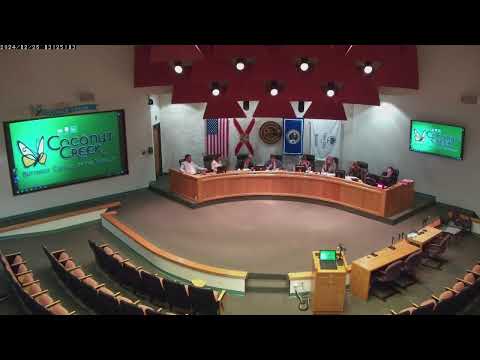
The Coconut Creek City Commission gave first-reading approval on May 22 to a package of Charter Review Board recommendations, including changing the review interval to six years and adding economic development as a Planning and Zoning Board qualification.
The Coconut Creek City Commission gave first-reading approval on May 22 to a set of changes proposed by the Charter Review Board, advancing six recommended edits consolidated into five ballot questions for the November 3, 2026, general election.
The changes include a proposal to change the periodicity of the charter review process so future Charter Review Boards would convene at six-year (rather than five-year) intervals to better align with general elections, and a recommendation to add economic development as a qualifying discipline for appointment to the Planning and Zoning Board.
The Charter Review Board convened 13 times beginning January 9, 2025, and the board's chair, Craig Valvo, told the commission the group worked through charter language, neighboring-city code and state law before finalizing its recommendations. “The board that worked together did have a common goal, serving the community,” Valvo said, thanking staff and commissioners for their engagement.
The commission debated one controversial recommendation from the Charter Review Board that would require individuals serving on homeowners’ association or condominium boards to resign those positions if they are elected to the city commission. Mayor Railey said the proposal was unnecessary and exclusionary: “This proposal is not only unnecessary, but it's fundamentally wrong,” she said, arguing that neighborhood leadership should be seen as a qualification rather than a disqualification for city office.
Valvo, who chaired the Charter Review Board, defended the recommendation as a protective measure. He said the board made the suggestion “out of respect for you and out of protection for you,” explaining the intent was to prevent the appearance of conflicts of interest and to keep elected officials “above reproach.”
Commissioners sought and received staff clarification that the Council can submit its own charter suggestions but cannot change the board’s recommendations other than clerical fixes; any differing measures would travel to voters alongside the board’s proposals.
Commissioner comments reflected a range of views: several commissioners and the mayor voiced support for the six-year interval and for adding economic development to the planning board criteria, while also acknowledging the public will decide contested measures at the ballot box. The commission recorded a unanimous roll-call vote in favor of advancing the ordinance to second reading.
The charter amendments will return for a formal second reading, at which staff will insert the commission’s consensus language (including whether the review interval is six or eight years). If approved on second reading, the consolidated questions will be placed on the November 3, 2026 ballot for voter approval.