Get Full Government Meeting Transcripts, Videos, & Alerts Forever!
Get email alerts on the Travel Reimbursement topic
No spam. Unsubscribe anytime.
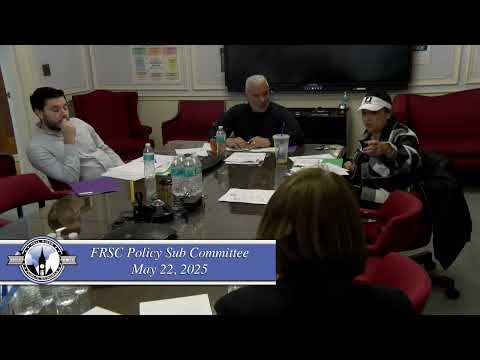
Policy subcommittee asks administration to draft travel-reimbursement guidelines after sustained discussion
Summary
Fall River City School Committee policy subcommittee debated creating a formal travel-reimbursement policy, reviewed recent travel spending and grant funding, and voted to table formal policy in favor of administration-drafted guidelines to return to the subcommittee.
The policy subcommittee of the Fall River City School Committee voted to table a proposal to create a formal travel-reimbursement policy and directed district administration to draft concrete guidelines for the committee to review.
Committee members spent the bulk of the meeting debating whether to set numeric caps and specific rules for reimbursable hotel, meal and transportation expenses for staff travel. The group also examined a recent district spreadsheet showing operating- and grant-funded travel spending.
The move to pause creation of a formal policy and ask administration to develop guidelines was the formal outcome of the discussion. The subcommittee’s motion asked the administration to present the proposed guidelines at a future policy subcommittee meeting; the committee approved the motion.
Why it matters: committee members said clearer guidelines would give reviewers and the public a consistent expectation about what the district will reimburse and help ensure grant and operating funds are used appropriately.
Discussion and context
Miss Pereira, a School Committee policy subcommittee member, said the current written policy is “very vague” and lacks specifics such as maximum reimbursements. Pereira said a clearer policy or set of guidelines would prevent inconsistent approvals and questions when expense amounts appear large.
Mister Corey, a School Committee policy subcommittee member, recommended limits be reasonable rather than overly prescriptive. “Maybe a maximum per night reimbursement for hotels, vehicles, and, like my colleague said, food,” Corey said, adding that per-night rates might be adjusted depending on conference location.
Committee members and staff described an existing travel-request and approval workflow. The superintendent confirmed that staff submit travel requests that are reviewed by the employee’s supervisor, the assistant superintendent and finally by the superintendent for sign-off; she said about 90% of travel is funded through grants.
Clarifying details and examples cited at the meeting
- Suggested per-meal reimbursement range discussed: about $45–$60 (presented as an example by a committee member). (approximate) - Example hotel figures mentioned in debate: $130–$150 per night as a suggested baseline; one member said she recently paid $160 for a cheap Albany hotel on a weekday; another noted Wynn (Las Vegas) nightly rates can be $300–$400 depending on season. (approximate) - Committee members said many conferences include lunches or dinners as part of registration and that guidelines should account for meals provided by the conference. - District accounting snapshot cited at the meeting (operating vs. grant-funded travel): operating-budget hotel expenses $1,800; vehicle rentals $700; flights $400; grant-funded travel: hotels ~$8,000; flights reported in the spreadsheet as $9,200 (spreadsheets were reviewed at the meeting). (figures as presented by staff) - The superintendent described a three-step approval process (supervisor, assistant superintendent, superintendent) before staff may attend a conference.
Actions and next steps
The subcommittee voted to table a motion to create a formal policy and instead requested that the administration draft specific guidelines and present them to the policy subcommittee at a future meeting (members suggested aiming for before the start of the next school year). The motion passed.
What was not decided
Committee members expressly avoided adopting numeric caps at this meeting. Several members cautioned that strict dollar caps risked producing perverse outcomes (for example, staying at a cheaper hotel and renting a car could be less economical in some cases). The subcommittee did not adopt a policy on whether vehicle reimbursement is automatically disallowed when the conference is hosted at the conference hotel.
Meeting context
The discussion was the meeting’s most substantial item, took the majority of the subcommittee’s time and involved several committee members and district staff. Committee members emphasized they did not want to discourage professional development; instead, they sought transparent fiscal controls and predictable procedures for reviewers and the public.
Ending
The administration will draft reimbursement guidelines reflecting the committee’s feedback and return those guidelines to the policy subcommittee for review before they are presented to the full school committee.