Get Full Government Meeting Transcripts, Videos, & Alerts Forever!
Get email alerts on the School Safety Accountability topic
No spam. Unsubscribe anytime.
Senate committee hears testimony on bill to allow civil suits when Texas schools are negligent in abuse cases
Summary
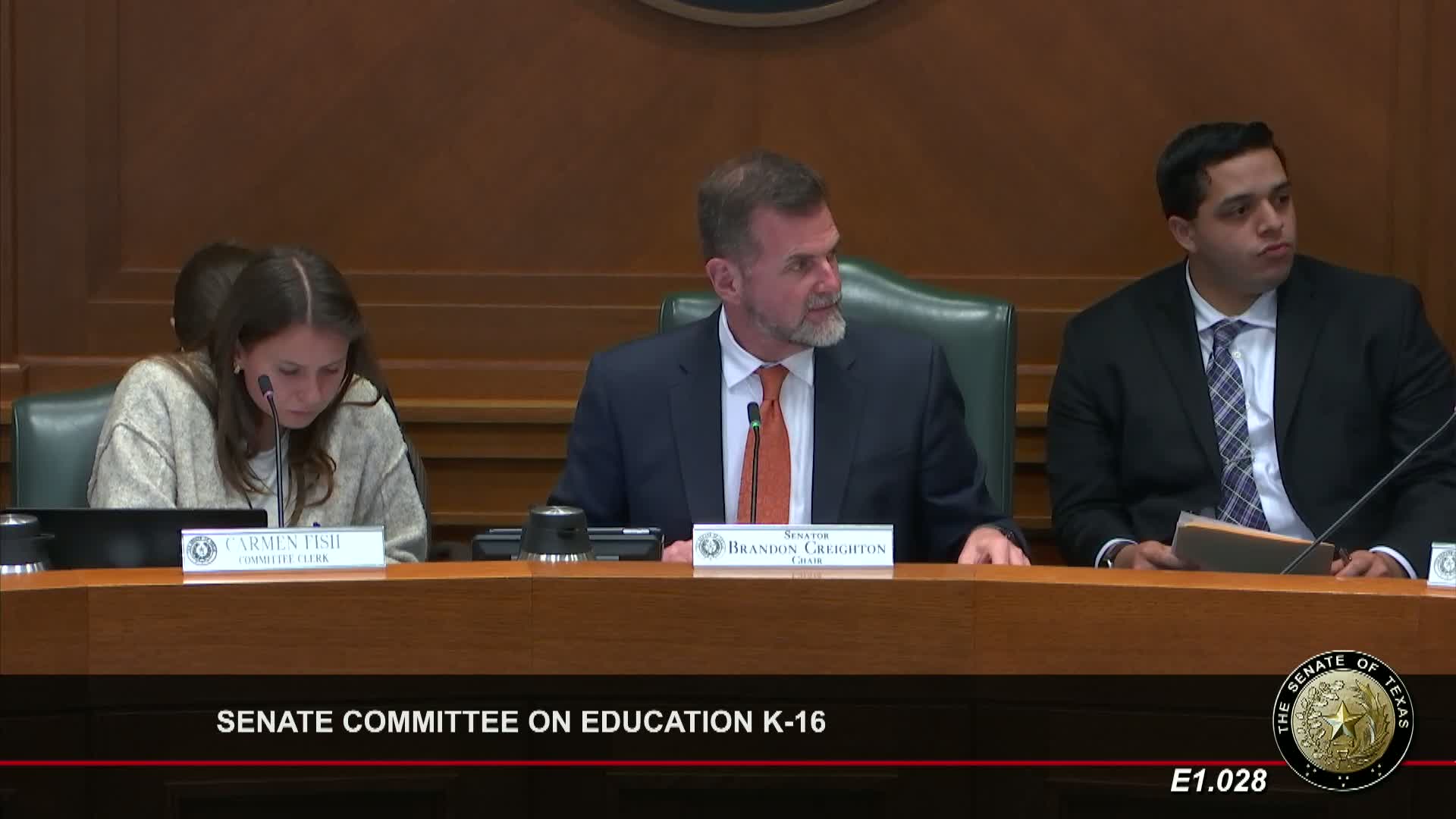
Senators on the Committee on Education K–16 heard more than four hours of public testimony on House Bill 46 23, a measure from Rep. (filed in the House) that would allow civil claims against Texas public schools when the district is negligent in hiring, supervising or retaining employees who commit abuse against students.
Senators on the Committee on Education K–16 heard more than four hours of public testimony on House Bill 46 23, a measure from Rep. (filed in the House) that would allow civil claims against Texas public schools when the district is negligent in hiring, supervising or retaining employees who commit abuse against students.
The bill’s sponsor in the Senate, Sen. Paxton, told the committee the measure removes sovereign immunity for specific acts of negligence so victims can seek redress. Supporters framed the change as a narrow waiver of immunity tied to negligence in hiring or supervision; opponents and some senators asked how damages caps and procedural rules would operate in practice.
Sen. Paxton said the bill “allows civil claims to be brought against Texas public schools or professional school employees when the public school is negligent in the hiring, supervising, or employing of a professional school employee.” He told the committee the House passed the measure 109 to 19.
Witnesses described repeated failures by districts to investigate allegations and to share records with law enforcement. Tammy Brown Rodriguez, director of policy for Jacob Boynes Ministries and a family member of a survivor, said, “The average cost for a single sexual-abuse survivor is over $250,000 across their lifetime.” Aileen Blakowski of Texas Education 911 called the pattern she documented “State Sponsored Child Abuse” and walked the committee through a file she said showed a staff member moving from district to district without effective discipline.
Parents told the committee that videos and evidence were not always preserved and that districts sometimes returned accused employees to the classroom. Cori Booth, whose testimony described a case in Rockwall ISD, said the district deleted video that “corroborated my son’s claim.” Multiple witnesses said they were told districts relied on lawyers and on a slow investigation process that left children exposed.
TEA staffman Christopher Lucas acknowledged the agency’s investigative unit was not present and agreed to find records committee members requested. The chair asked TEA to provide specific case files the committee cited by 10 a.m. the next day.
Committee members pressed on limits and mechanics of the bill. Sen. Menendez raised concerns that the proposal could create a large contingent-fee litigation market and asked whether California’s experience with similar laws led to reduced abuse reports or primarily higher insurance costs. Sen. West noted the Texas Tort Claims Act’s current caps for other government liability ($100,000 per person and $300,000 per occurrence) and suggested aligning any new caps with that structure.
Supporters said the bill is designed to create accountability where school systems ignored or shuffled employees rather than removing them from student contact. Opponents and some witnesses urged stronger prevention measures, including better background checks, use of psychological screening and more robust enforcement of the existing do-not-hire registry.
Public testimony closed after testimony from dozens of survivors, parents, advocates and representatives of educator groups. The committee took no final vote; the chair said House Bill 46 23 would be left pending subject to the call of the chair.
The committee requested follow-ups from TEA and flagged questions about statute-of-limitations changes, the interaction with Texas Tort Claims Act procedures, and how the bill’s $500,000-per-occurrence cap (as drafted in committee discussion) would apply to sequential acts.
House Bill 46 23 remains pending; the committee indicated it would seek additional documentation from TEA and may consider statutory clarifications on damages caps and procedural rules before any recommendation to the full Senate.