Get Full Government Meeting Transcripts, Videos, & Alerts Forever!
Get email alerts on the School Discipline topic
No spam. Unsubscribe anytime.
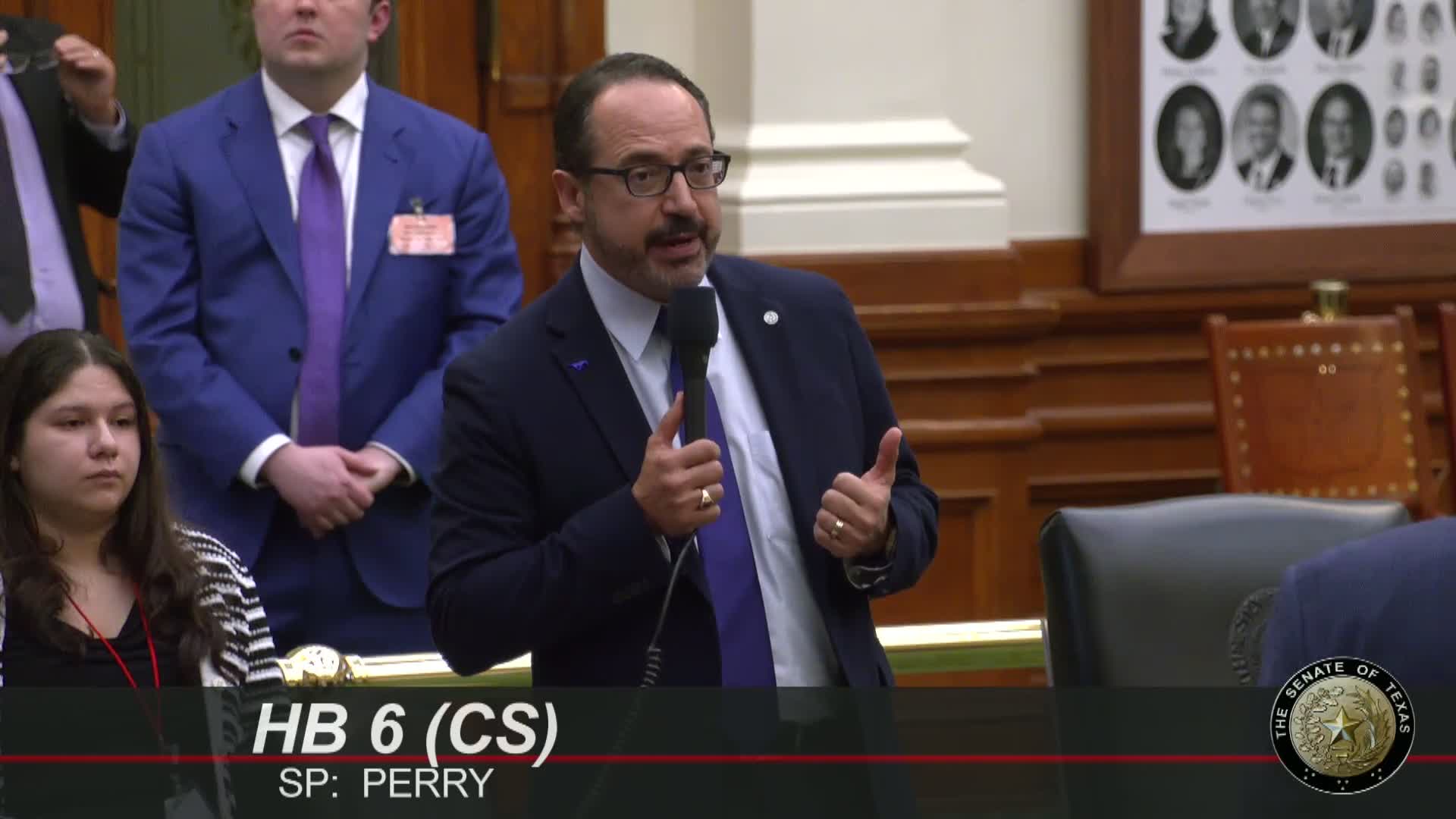
Senate passes HB 6 after amendments to expand school discipline options and telehealth access
Summary
The Senate approved a committee substitute for House Bill 6, changing discipline rules for public schools, clarifying charter‑school admission language, removing a court‑order option to compel parental involvement and adding telehealth mental‑health references; the bill passed third reading 29–2.
The Senate voted to pass the committee substitute for House Bill 6, which the sponsor said revises how public schools handle discipline and expands access to telehealth mental‑health services. The measure passed final reading 29 ayes to 2 nays after a series of floor amendments addressing charter schools, parental engagement, in‑school suspension reviews and special education threat assessments.
Senator Charles Perry, sponsor of the Senate amendment, said HB 6 “is intended to holistically review how we address school discipline in our public schools.” Perry told the chamber stakeholder input over multiple sessions shaped the bill and the floor amendments adopted on the Senate floor.
Why it matters: Supporters said the bill gives districts more flexibility to respond to disruptive or dangerous student behavior without defaulting to long out‑of‑school placements, and it removes a provision that would have allowed districts to seek court orders to compel parents to participate in discipline planning. Opponents raised procedural objections during floor action but the bill moved forward after amendments were adopted.
Key changes and debate
The Senate adopted multiple Perry floor amendments that sponsors described as technical fixes and policy clarifications. Floor amendment No. 1 restored charter‑school language so that charters may deny admission to students previously placed in DAEP (disciplinary alternative education programs) or expelled under public‑school rules. Perry described floor amendment No. 2 as removing “the court order option” and replacing it with a carrot: districts may reduce suspension time if parents engage in the discipline plan.
Senator Roland Menendez — who engaged extensively with the sponsor — thanked Perry for openness to amendment work and said the changes address teachers’ concerns about classroom safety while avoiding “arbitrarily” removing young students from school. Menendez described the parental‑engagement change as preferable to “automatically being able to drag the parent to court.”
On vaping and first‑offense discipline, the Senate adopted an amendment offered by Senator Menendez that keeps mandatory DAEP placement for students who sell or deliver e‑cigarettes but gives schools discretion on first‑offense possession, allowing either DAEP placement or in‑school suspension. Menendez said that change “provides flexibility at the community level” and can let schools offer an educational response for first offenses.
Other notable changes approved on the floor included:
- A reduction in required review intervals for in‑school suspension from every 15 days to every 10 days and specification that principals will review placements, intended to harmonize with Chapter 37 discipline rules. - An amendment clarifying that students in in‑school suspension must receive comparable instructional programming to what they would receive in class. - Creation of a named “virtual expulsion program” limited to expulsion‑level offenses and barred where a county JJAEP (juvenile justice alternative education program) exists unless that JJAEP is full. - Addition of educational diagnosticians and behavioral specialists to the list of SPED professionals who may participate in threat assessments for students with disabilities. - Removal of a state‑level counterpart to the Honig process so that the special‑education assessment route remains a federal procedure, the sponsor said.
Formal action
- Motion: Suspend the regular order of business on the committee substitute for House Bill 6. Outcome: Rule suspended; bill laid out on second reading (roll was called). (motion recorded in the transcript) - Multiple floor amendments by Senator Perry, Senator Menendez and others were adopted without recorded opposition after the amendments were presented and discussed on the floor. (amendments adopted: Perry Nos. 1,2,4,7,8,9,10; Menendez No. 3 accepted; West/Bettencourt proposals incorporated where noted) - Final passage: Committee substitute for House Bill 6 passed third reading 29 ayes, 2 nays. Outcome: approved.
Discussion versus decision
Discussion: Senators raised concerns and offered examples (including a cited case of a 9‑year‑old who received 14 days in‑school suspension after an empty vape cartridge was found in a classmate’s backpack) to justify making first‑offense responses more flexible.
Direction/assignment: Committee and sponsor recorded that amendments were worked with House authors and stakeholders; several amendments reflect negotiated changes with House chairman Jeff Leach and others.
Formal action: The Senate adopted multiple floor amendments and passed the bill on final reading, 29–2.
What’s next
With final Senate passage recorded in the transcript, the committee substitute for HB 6 is completed on the Senate side. The text and the floor amendments adopted on the record will be included in the enrolled bill sent on to the enrolling process and then to the governor according to legislative procedures.
Quotes in context
- “HB 6 is intended to holistically review how we address school discipline in our public schools,” — Senator Charles Perry, sponsor. - “It's a carrot. It's probably the right policy. And I think it's probably a better start than automatically being able to drag the parent to court,” — Senator Charles Perry, describing removal of the court‑ordered parent‑engagement option. - “Teachers have been begging for help, and many of them are concerned, or worried, or frightened,” — Senator Menendez, urging balance between safety and preserving educational opportunities for removed students.
Ending
Senators described the bill as the product of multiple sessions of stakeholder work and cross‑chamber coordination. The Senate record shows the body adopted technical and policy amendments intended to give districts additional disciplinary tools, more frequent review of in‑school suspensions, and added clarity for special‑education threat assessments while removing a state court option to compel parents. The bill passed final reading 29–2 and, per the Senate transcript, will proceed in the legislative enrollment process.