Get Full Government Meeting Transcripts, Videos, & Alerts Forever!
Get email alerts on the Officer Safety Sentencing topic
No spam. Unsubscribe anytime.
Committee hears proposal to raise minimum sentence for attempted capital murder of peace officers
Summary
Senators heard House Bill 18,171 to raise minimum sentences and deny parole for attempted capital murder of peace officers. Prosecutors argued it closes a perceived sentencing gap; defense groups warned about overbreadth and urged limiting the change to firearm cases.
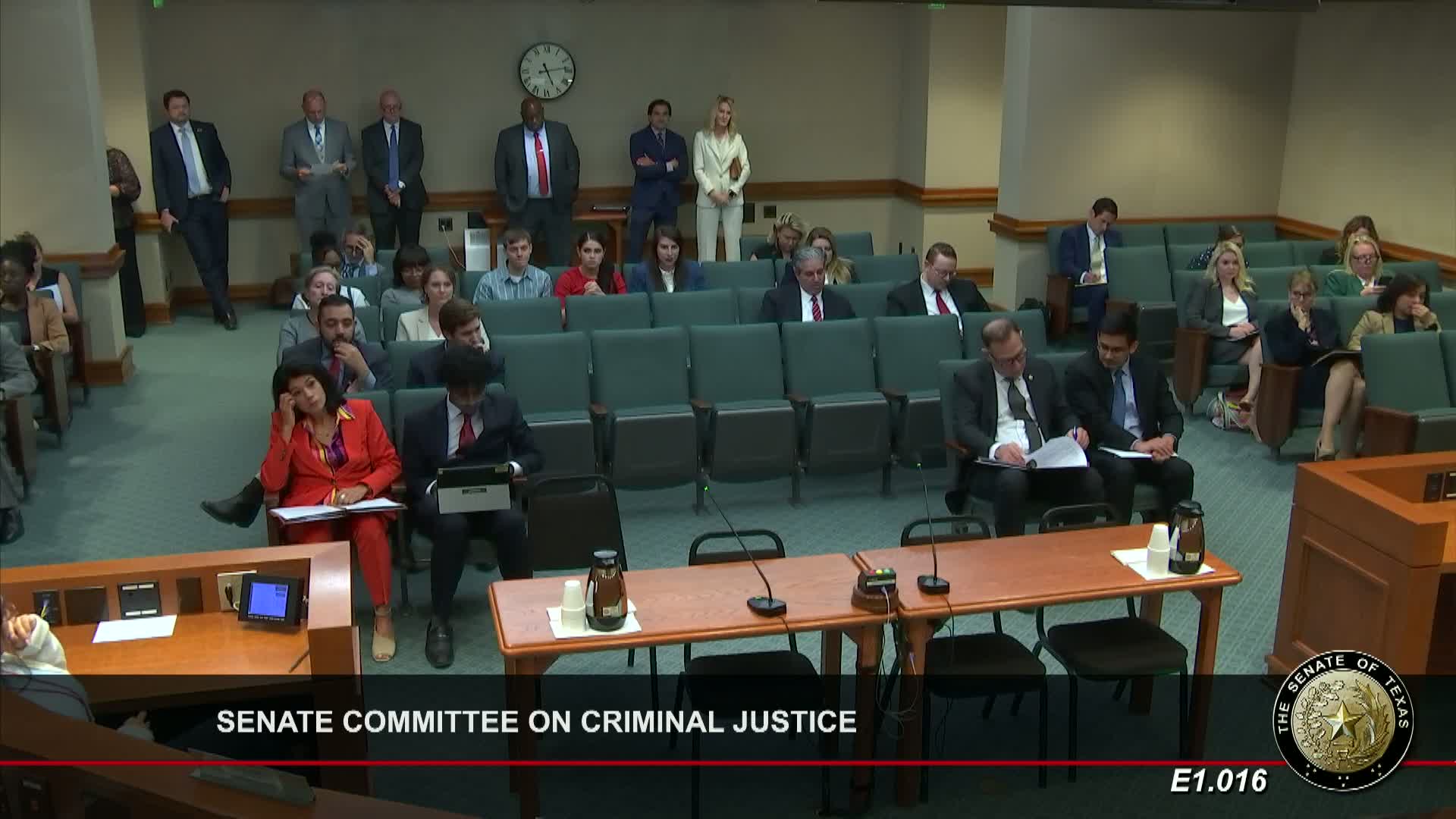
The Senate Committee on Criminal Justice considered House Bill 18,171, which would raise penalties for attempted capital murder of a peace officer and make individuals convicted of that offense ineligible for parole or mandatory supervision. Sponsor Sen. Schwertner said the measure would provide a stronger deterrent against attacks on officers and adjust punishment to reflect the seriousness and proof difficulty of attempted capital murder charges.
Jarvis Parsons, Brazos County district attorney, testified in support, saying prosecutors encounter cases where attempted capital murder and reckless aggravated assault carry the same statutory range and that the bill would allow stronger sentences for individuals who show a specific intent to kill an officer. "Increasing the punishment from a minimum of probation to a minimum of 25 years up to life in prison," Parsons said, "and it denies parole for individuals convicted of attempted capital murder of a peace officer."
Opposition testimony came from David Gonzalez of the Texas Criminal Defense Lawyers Association, who warned the committee about moving to a mandatory 25-year floor in cases that vary widely in facts. Gonzalez said jury verdicts across published cases already produced lengthy sentences in violent firearm cases but shorter sentences in cases involving brandishing or vehicle-related incidents; he argued juries are well-positioned to assess intent. "Our concern is that right now, the juries are listening to the evidence. They're making the decisions appropriately," Gonzalez said, and he suggested the minimum should apply to firearm cases but not necessarily to other fact patterns.
Prosecutors and some committee members debated whether the bill would allow prosecutors to seek the enhanced range only where facts show specific intent and whether lesser-included offenses would remain available; Parsons told senators lesser included offenses would remain an option for juries. The committee closed public testimony and left the bill pending.
Public testimony summary: invited witness Jarvis Parsons in support; David Gonzalez (Texas Criminal Defense Lawyers Association) opposed; multiple senators asked clarifying questions about scope and evidence standards.