Get Full Government Meeting Transcripts, Videos, & Alerts Forever!
Get email alerts on the Brackish Desalination topic
No spam. Unsubscribe anytime.
Committee hears bill to let TWDB fund brackish desalination for border counties
Summary
House Bill 3,898 would allow the Texas Water Development Board to provide financial assistance for brackish-water desalination projects in certain border counties, committee staff said.
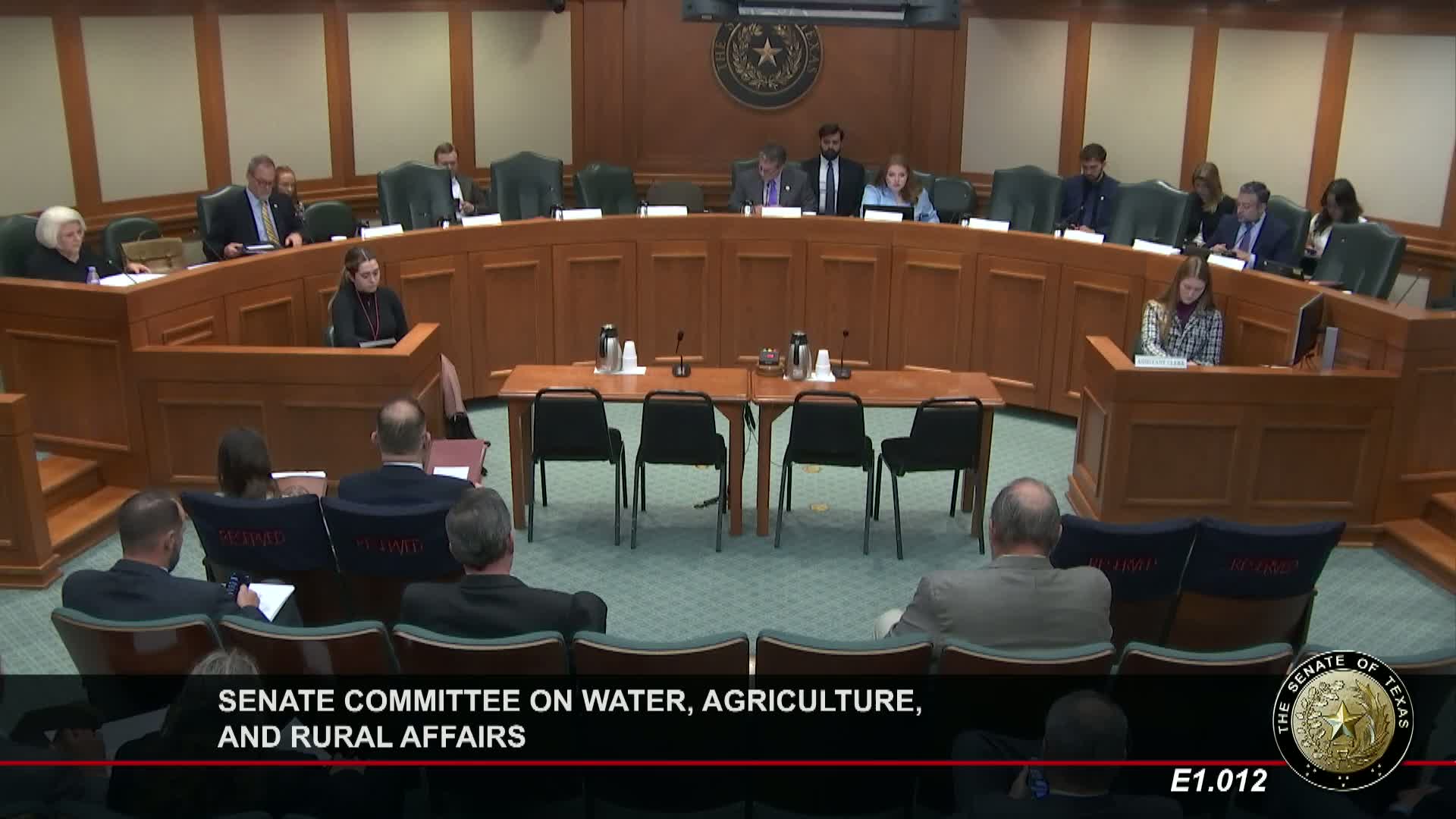
House Bill 3,898 would allow the Texas Water Development Board to provide financial assistance for brackish-water desalination projects in certain border counties, a committee staff member said at the Senate Committee on Water, Agriculture & Rural Affairs hearing.
The measure, introduced in the House by Representative Richard Peña Raymond, targets counties with populations greater than 250,000 on an international border that lack a groundwater conservation district or a nonprofit water-supply corporation inside the county, committee staff explained. The bill’s sponsors say it is intended to address drinking-water shortages and enable future water planning for communities reliant on the Rio Grande.
The bill prompted sharply different testimony. Adam Foster, executive director of the Texas Alliance of Groundwater Districts, told the committee that his group “respectfully oppose[s] House Bill 3,898 because it would allow projects to receive state funding without first going through the regional and state water planning process.” Foster urged that projects seeking public financial support be required to follow the state’s established regional and state water planning framework so that technical review and stakeholder input occur before funds are awarded.
David Earl, general counsel for the Legacy Water Supply Corporation in Webb County, said the situation on the border requires a different response. “Without a brackish water project, over 300,000 people in Webb County may well be in stage 4 rationing, this year, limiting number of times they can take a shower a week,” Earl told the committee, stressing that Laredo and Webb County face immediate supply risks tied to Rio Grande deliveries and treaty performance.
Bridal McMath, executive administrator of the Texas Water Development Board, told the committee the proposal “would be a departure from traditional funding for water projects,” confirming the bill would allow state funding for projects not previously identified in the State Water Plan.
Committee members questioned witnesses about whether the projects contemplated by the bill would affect neighboring groundwater conservation districts or regional plans. Earl said hydrologic work indicates the proposed wells for the Webb County project “would not have any impact” on adjacent counties or conservation districts, citing the district’s hydrologists.
The chair opened public testimony and heard the resource witnesses before closing testimony for the item. The committee did not adopt a final action on the bill during the hearing; committee members indicated they would continue consideration, including the possibility of moving the bill to the floor if a quorum could not be maintained in committee.
Why it matters: Border communities seeking alternatives to Rio Grande surface supplies say brackish desalination could avert severe rationing; regional water planners and groundwater districts argue that bypassing established planning steps risks uncoordinated development.
Next steps: Committee testimony concluded and the bill was left in committee for further consideration.