Get Full Government Meeting Transcripts, Videos, & Alerts Forever!
Get email alerts on the State Local Revenue Sharing topic
No spam. Unsubscribe anytime.
Legislative staff outlines complexities of state–local revenue sharing in informational meeting
Summary
Legislative Revenue Office staff presented a draft overview of state and local revenue sharing on May 22, explaining statutory splits, tax-shifting effects, programmatic gain-share arrangements, and direct appropriations, and committee members requested further analysis of several mechanics.
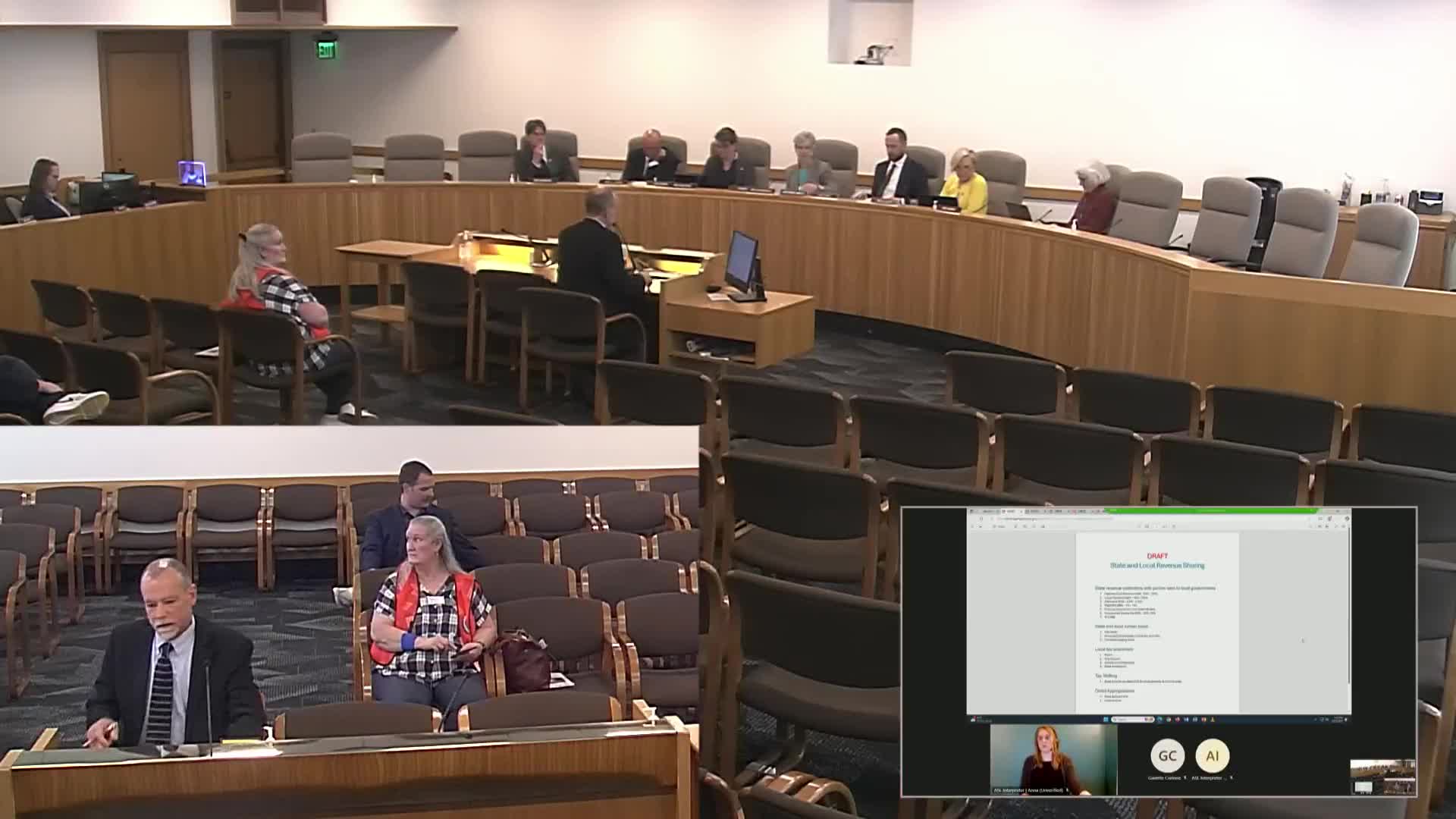
The House Committee on Revenue closed its bill work and opened an informational meeting on state and local revenue sharing on May 22. Chris (Legislative Revenue Office) presented a draft overview describing multiple ways state and local revenues interact, and the committee used the session to identify topics for further analysis.
Chris described several “buckets” of sharing: direct statutory splits where state-collected revenue is distributed to counties and cities (for example, certain gas, liquor and marijuana revenues and some portions of tobacco taxes); cases where local and state taxes are similar but independently levied (such as local transient lodging taxes and local sales-type taxes in other states); programmatic gain-share arrangements tied to property-tax exemptions such as SIP and enterprise zone programs; tax shifting and deductibility (including interactions with federal SALT rules); and direct appropriations from the state to local governments.
Committee members raised specific questions. One representative said county officials report the “50–30–20” highway-fund split does not always operate as described; Chris said some dollars come off the top and the statutory mechanics vary, and he offered to provide a more detailed explanation. Members also discussed how cigarette taxes that allocate a fixed cents-per-pack to cities/counties can produce counterintuitive results when the total tax increases because per-pack shares do not scale proportionally with price-induced demand changes.
The briefing noted the effect of federal changes (SALT deduction limits) on how taxes are exported between federal, state, and local levels; Chris said LRO tracks these interactions and will supply additional modeling. Committee members said the overview was useful context for other committee work and requested follow-up on specific mechanics, distribution numbers, and the incidence of tax shifting. The informational meeting was characterized as a “white board” draft and the staff asked the committee for guidance on topics to pursue next.