Get Full Government Meeting Transcripts, Videos, & Alerts Forever!
Get email alerts on the Homelessness Services Contract topic
No spam. Unsubscribe anytime.
Banning council hears Faith in Action proposal for homeless services, directs staff to seek grant rework
Summary
City council heard a detailed pitch from Faith in Action to provide coordinated homeless services and workforce support, heard resident concerns about business impacts and encampments, and directed staff to explore reallocating federal/state grant funds rather than award a contract at the meeting.
The Banning City Council on May 27 considered a proposal from nonprofit Faith in Action to provide homeless services, workforce training and housing navigation and directed staff to explore modifying existing grant spending rather than awarding a contract at that meeting.
The presentation from Faith in Action outlined a shift toward coordinated outreach, housing navigation, career technical education and “structured weekly engagement” for program participants, with an emphasis on incorporating partners and using rapid rehousing and Pathway to Home funding. Daniel, a Faith in Action board member, urged a collaborative approach: “If we can get all of us in the same room at the same time, I think that we could really form a collaborative,” he said.
Why it matters: the council is weighing how to use nearly $980,000 in grant-funded Opportunity Village line items and related emergency-response funding tied to state and county grant agreements. City staff and the council raised that changing how the money is spent requires formal budget modification requests and state approval, a process that must be followed to avoid potential repayment or other remedies under the grant standard agreement.
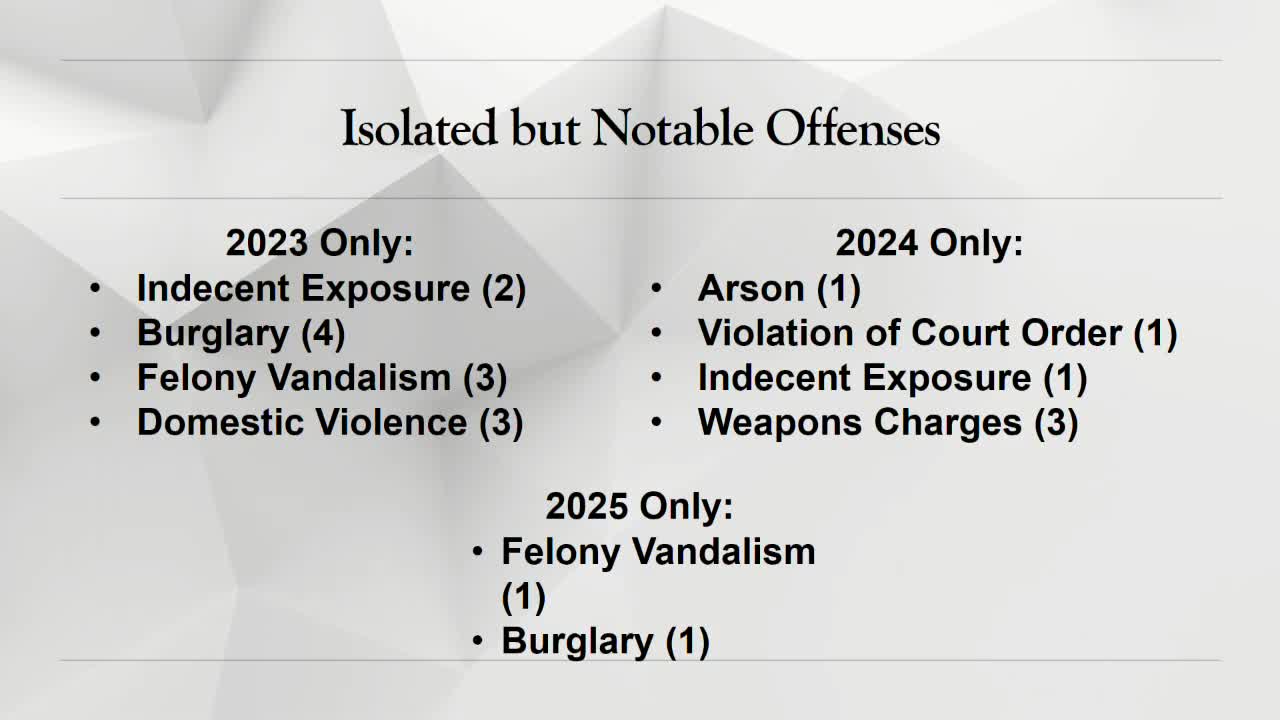
Most important facts first: Police staff presented transient-disturbance statistics showing homelessness-related calls remain the department’s largest single call type; the department reported 1,740 calls in 2023 and 516 year-to-date as of April. Officers described multiple encampment cleanups, including about 14–15 sites near 300 South Highland Springs and four encampments removed in a separate April cleanup. Sergeant Vaca (police) said patrol, code enforcement and the homeless liaison have worked the cleanups and that the city will continue enforcement of camping ordinances while pursuing service partnerships.
Faith in Action’s presentation described services it provides or proposes: intake and vulnerability screening tied to HMIS and coordinated entry; housing navigation and rapid rehousing; case management and mentorship pairing participants with staff and people with lived experience; and workforce training with local partners (for example, trucking school and union training pipelines). The presenter emphasized compliance with Continuum of Care (CoC) and state program standards and noted existing contracts and funding sources including HHAP, ESG (on hold at the time), IEHP-contracted services, and a Pathway to Home designation.
Council members pressed for specifics on past performance and finances. Councilmember Wallace asked why Faith in Action’s contract had not been renewed previously; Faith in Action representatives attributed the pause to the city hiring its own case management capacity and to a “philosophical difference.” Councilmember Miller and others asked for counts of people served, job placements and staffing; Faith in Action said historical program numbers are available in an accountability booklet but that the current leadership did not have immediate counts on hand.
Several residents and business owners spoke during public comment. A Sizzler employee, Resendo Del Rio, said managers and staff worry about business impacts if visible homelessness increases near their location. Other speakers urged collaboration and recommended considering both Faith in Action and SWAG (an outreach-focused provider that previously presented to the council) rather than choosing a single contractor.
Fiscal and grant details were a central thread. The council’s finance discussion reviewed the state standard agreement for the city’s emergency-response funding. Staff described the original Opportunity Village budget line items (examples cited in staff material included $106,200 for shelter structures, $134,000 for utility/rehousing funding, and a proposed total near $980,461 across shelter, utilities, rehousing and wraparound services). Staff also said as of February roughly $300,000 (approximate) had been recorded against the grant; staff emphasized that budget modifications and state approval would be required to repurpose remaining funds.
Council action: a motion passed to have staff reevaluate the Opportunity Village project and return with a plan that could include reworking the grant-funded budget toward wraparound services and then pursue any required grant modifications. The council did not award a contract to Faith in Action or another provider at the meeting. City staff said they will engage the grantor’s modification process and report back to council before reallocating funds.
What remains open: council members requested more granular program metrics from Faith in Action (numbers of clients served, job placements, payroll/salaries and asset balances), clarity on which services require outreach versus center-based enrollment, and a written plan detailing how Opportunity Village resources could be transitioned into housing placements or other allowable uses. Staff also committed to confirm the exact remaining grant balance and the modification steps required by the state.
The council scheduled follow-up and directed staff to return with options for grant reallocation and with clearer performance and budget data before any contract award or program change.