Get Full Government Meeting Transcripts, Videos, & Alerts Forever!
Get email alerts on the Transportation Infrastructure topic
No spam. Unsubscribe anytime.
Miami County Road and Bridge director urges higher asphalt, equipment funding to avoid emergency repairs
Summary
Road and Bridge Director Eric Samberg told commissioners the department seeks larger asphalt and equipment budgets to sustain a mill-and-overlay program and avoid costly emergency repairs, while proposing changes to chip-seal cycles and equipment replacement timing.
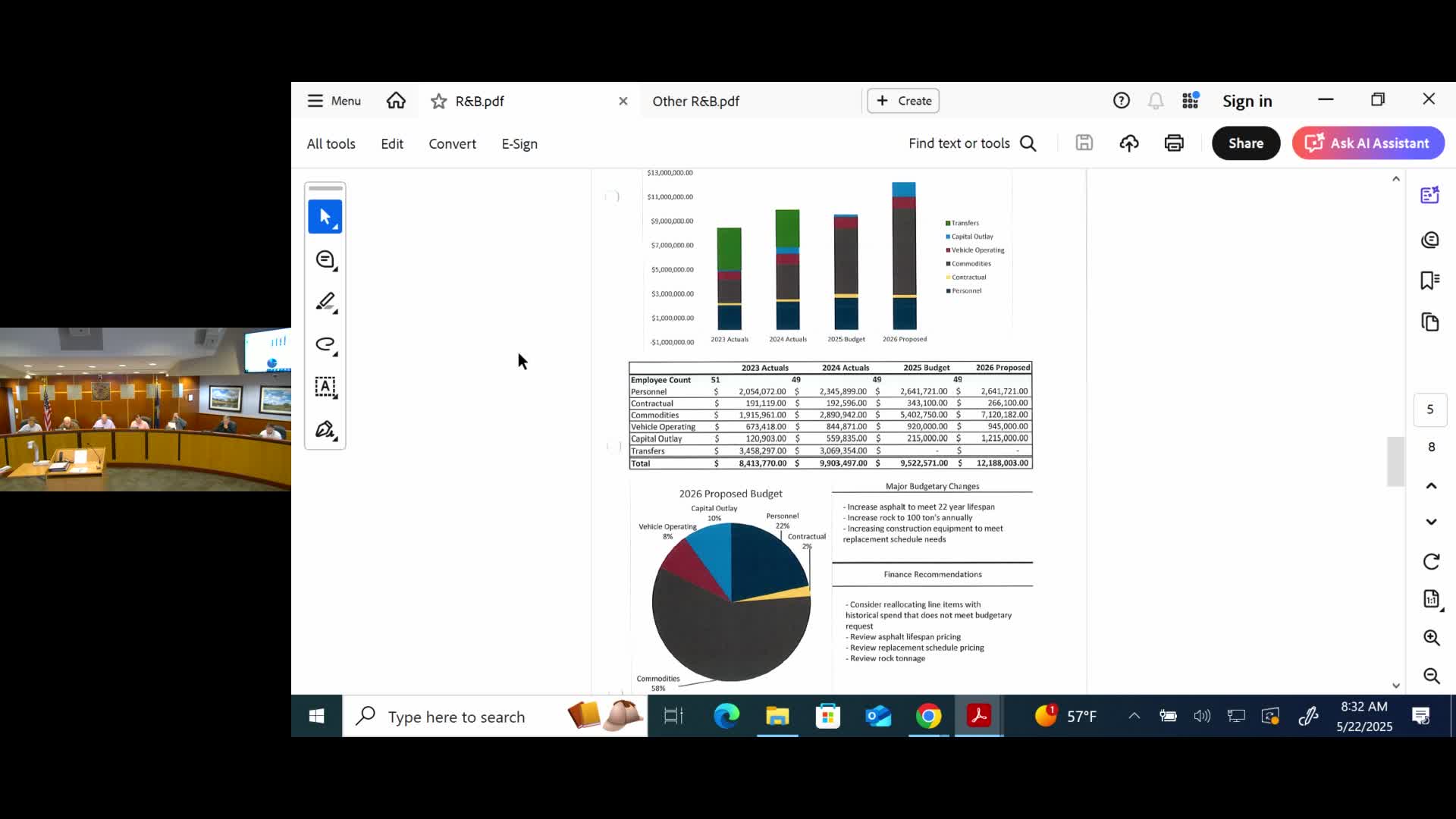
At a Miami County budget hearing Road and Bridge Director Eric Samberg presented detailed budget requests tied to a 22-year life cycle for road wearing surfaces and warned that delaying maintenance could lead to emergency reconstruction.
“The feeling we got was about 15.2 miles… at $4,568,000 give or take,” Samberg said, describing the county’s mill-and-overlay plan. “This entire budget isn't based on wants. I'm not adding anything. I'm not adding new desks, security to the building. I'm not adding any fancy anything.”
Samberg told the commission he set the asphalt project line after conversations about the county’s long‑term pavement plan and that the department expects to rely on a mix of transfers and project-line funding. He said roughly $650,000 is allocated internally for ongoing preservation work such as crack sealing, chip sealing and spot patching, while contracted mill-and-overlay work and transfers account for the larger sums. “What's that gonna look like as an emergency repair? We're gonna tear it up, put rock in there till we can figure out how we're gonna get it fixed and have the budget for that. It's kinda what we wanna get away from,” Samberg said.
Equipment replacement was the other major budget pressure. Samberg said many dump trucks are being pushed to about 300,000 miles and the department has only $200,000 budgeted this year for vehicle replacement. He outlined options—buying state‑spec new trucks, searching for used trucks that can be retrofitted, overhauling motor graders at about half the cost of new machines, and leasing—and warned that losing trucks during a snow event would hamper response. He said outfitting a new state‑spec truck for snow work could add roughly $190,000 in costs beyond the truck price.
Samberg also reviewed the chip-seal program and a proposed change in maintenance frequency for non‑asphalt chip‑seal roads. He said there are approximately 60 miles of non‑asphalt chip‑seal roads and proposed reducing the annual renewal cycle to a five‑year rotation for those roads while continuing chip sealing as a preservation tactic on asphalt corridors. “Chip seal's a preservation method that we will do on asphalt roads to… stop water from infiltrating into the base,” Samberg said.
Commissioners and staff asked about tradeoffs between life‑cycle targets and equipment replacements; several commissioners expressed interest in meeting in the middle—extending life cycle targets modestly while increasing equipment funding. Commissioners also discussed a possible reallocation of special bridge mill levy revenue into the road budget (and back if needed) to gain flexibility.
Samberg said he will bring back itemized options and the equipment replacement schedule for further commissioner discussion so the board can weigh a higher asphalt target against additional equipment funding.
Ending
The commission did not take formal action during the session. Staff will return with detailed line‑item options and replacement schedules for further budget sessions so commissioners can decide whether to raise asphalt and equipment allocations or adjust the pavement life‑cycle target.