Get Full Government Meeting Transcripts, Videos, & Alerts Forever!
Get email alerts on the Public Finance Sales Tax topic
No spam. Unsubscribe anytime.
Commissioners discuss health sales tax as option to reduce property tax burden for public safety and health
Summary
Commissioners and staff discussed whether a voter‑approved health sales tax could offset property tax support for EMS and public health; staff noted statutory limits, timing constraints and messaging challenges for a ballot measure.
County commissioners and staff discussed using a voter‑approved health sales tax to shift some public safety and health funding away from property taxes and toward sales tax revenue.
Why it matters: commissioners said shifting some recurring public‑safety and health costs from property tax to sales tax could reduce the mill levy burden on homeowners and spread costs across broader consumer activity. Staff warned statutory restrictions, ballot timing and the need for clear public messaging would affect feasibility and timing.
The discussion revisited statute language and ballot timing. Shane (county staff) read K.S.A. 12‑187(b)(5), which allows a county to implement a sales tax up to 1 percent, pledging revenue for financing the provision of health care services and a list of eligible uses that includes local health departments, hospitals, nursing homes, preventative health services, mental health services, indigent care, EMS and rural health clinics. Staff noted the health sales tax does not have the same city‑share obligations as the county‑wide public safety sales tax, and that a health sales tax question would require voter approval.
Commissioners emphasized two practical constraints. First, the timing of a ballot question and the county budget cycle do not align for a 2026 budget year: even if a question were successful in November, the new revenue stream would realistically start in 2027 because of collection and distribution lags. Second, public messaging would need to be clear: multiple commissioners said prior ballot efforts (a quarter‑cent courthouse request) failed in part because voters perceived an unclear or excessive project cost. Several commissioners argued a health‑tax question could be structured to show dollar‑for‑dollar offsets — for example, labeling the tax to fund EMS, health‑department services and specific mental‑health or indigent‑care lines and explicitly reducing the mill levy in tandem — but they said the education campaign would be critical.
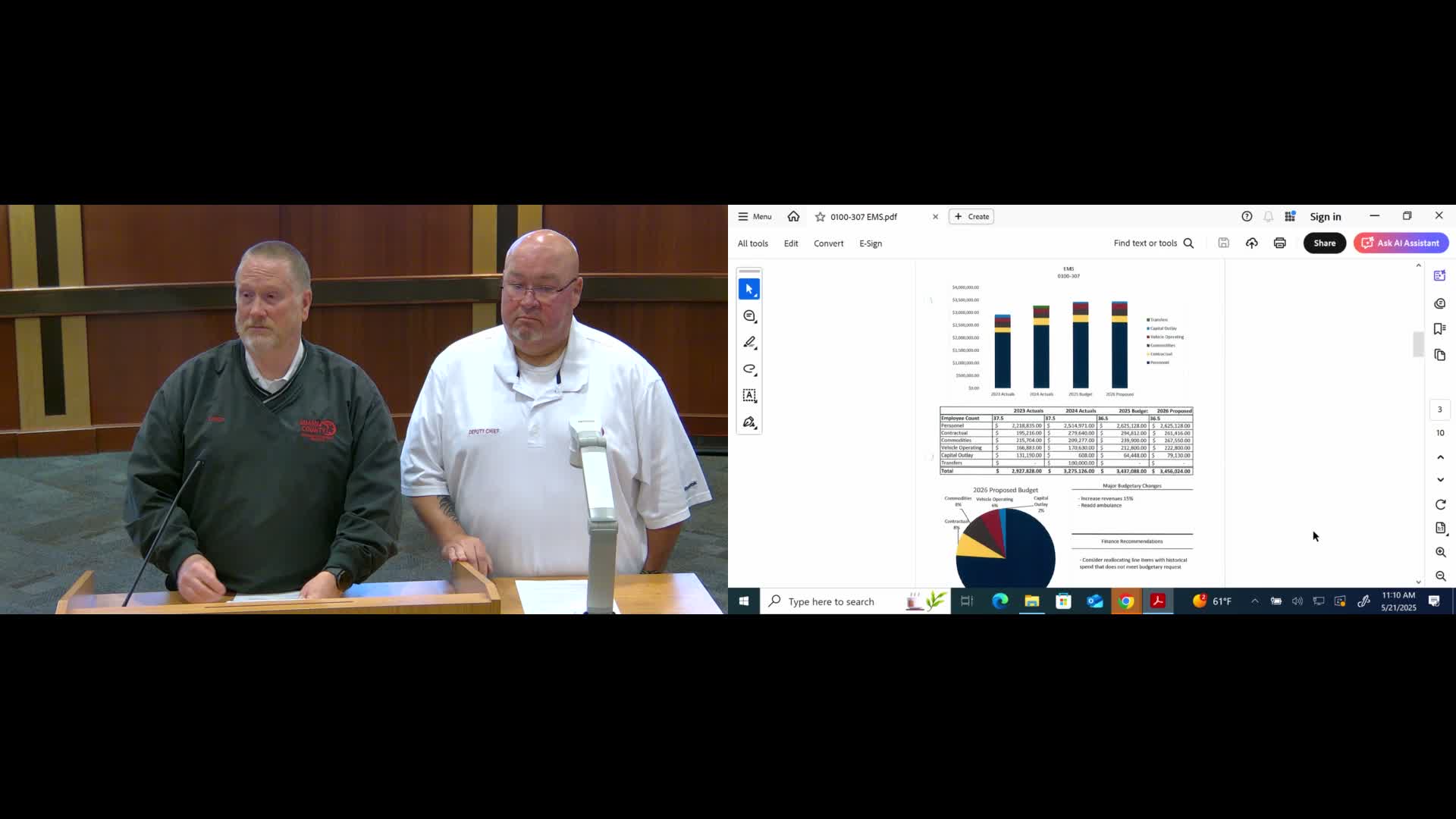
Staff presented rough arithmetic: combining EMS shortfalls and mental‑health and health‑department deficits in recent budgets would approximately equal the revenue from a quarter‑cent health sales tax in a typical year, but staff warned that sales tax collections vary with economic activity and that higher sales tax rates can produce diminishing returns. Legal and operational follow‑up items identified included: confirming which exact health‑department and EMS lines qualify under state statute, modeling the priced impact of a quarter‑cent or half‑cent measure on property tax offset, and producing a public education plan if commissioners choose to place a question on a future ballot.
Commissioners did not place a measure on the ballot at the hearing. They asked staff to return with a memorandum that lays out (1) the precise statutory allowable uses, (2) an estimate of revenue from a quarter‑cent and a half‑cent health sales tax for Miami County, (3) a clear mapping that shows dollar‑for‑dollar offsets to current property tax lines, and (4) a recommended ballot timing and public‑education plan.
If commissioners pursue the route, staff noted the soonest realistic start date for revenue to affect county budgeting would be the 2027 fiscal year, because of ballot timing, certification and the normal tax collection cycle.