Get Full Government Meeting Transcripts, Videos, & Alerts Forever!
Get email alerts on the Public Safety Fire topic
No spam. Unsubscribe anytime.
Miami County fire districts request modest budget increases as call loads, equipment needs rise
Summary
Fire chiefs and county staff told commissioners that 2026 budgets will rise slightly to cover repairs, firefighter training, portable radios and aging apparatus; the county will explore small station repairs, grant funding and mutual‑aid cost options.
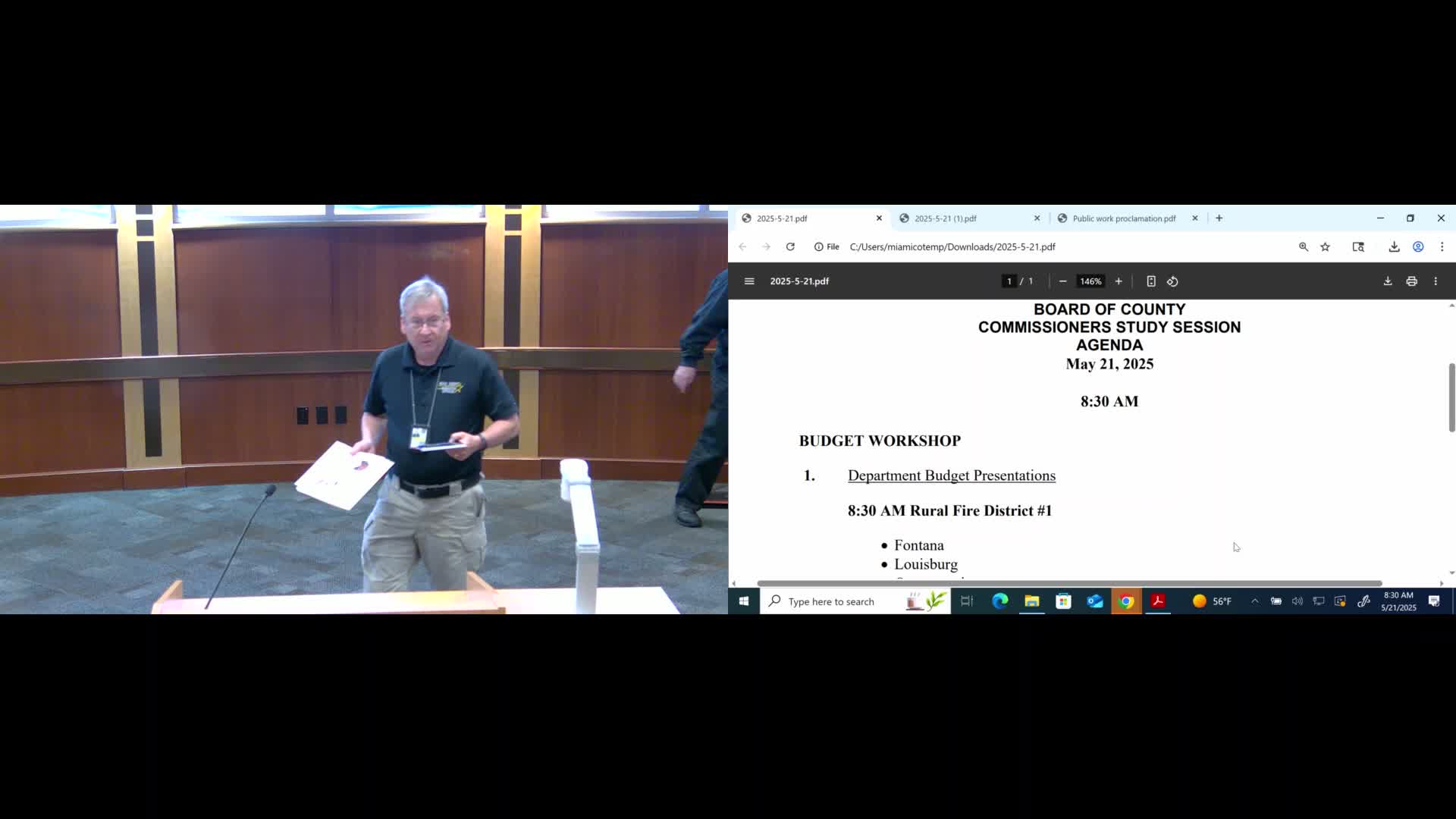
At a Miami County Commission budget hearing, fire department leaders and county staff outlined 2026 budget requests and capital priorities for multiple rural stations, citing rising call volume, aging apparatus and new training needs.
The requests matter because several volunteer stations reported higher call loads and equipment failures that county staff said could reduce response capacity unless addressed. County commissioners and staff discussed short‑term fixes — including heating an unused old station, replacing worn pumps and compressors, and pursuing grant funding — while declining to adopt any immediate binding changes.
Mark Wayland, the county’s rural fire coordinator, opened the discussion on Fontana’s budget, saying the department expects to be “pretty close to the $92.07 80 with repairs to equipment and, training and additional items” and that the 2026 request is “only…to go up 0.27% to a total of $93,030.” He reported Fontana’s roster has grown from about eight to “14 or 15 members,” with organizers working to certify volunteers to Firefighter I level. Wayland and other chiefs described frequent equipment maintenance needs on brush rigs and low pump pressures; a new tender chassis has been paid for and body construction was reported in progress with delivery expected in late October or November.
Lewisburg sought a larger increase, described by staff as roughly 8 percent, driven by equipment maintenance, contract labor and personal protective equipment. County staff said repairs to a recently purchased used engine and replacement bunker gear are major drivers; one new set of bunker gear was cited in discussion as costing “about $6,000 to $8,000 a set.” Jerry (a Lewisburg speaker) said the station roster is about 25 and that engine and pump maintenance have been recurring expenses. The county and city share many bunker‑gear and training costs on a roughly 50/50 basis, staff said.
Other departments reported similar pressures: Osawatomie (sometimes spelled “Osawaatomi” in the transcript) asked for training increases and higher repairs and maintenance lines after recent brush‑truck gearbox and pump problems; Paola said it will replace imaging cameras and portable radios as scheduled. The water‑rescue team reported routine maintenance needs and a recent outboard motor replacement after an earlier transom failure; staff proposed lowering that line to better match expected 2025 spending and to let underspent funds roll to the capital fund.
Capital concerns threaded the discussion. Multiple chiefs and staff flagged the county’s aging high‑pressure breathing‑air compressors — used to refill self‑contained breathing apparatus — and said a modern compressor suitable for current bottle pressures would cost in the order of $100,000 and should be located to minimize apparatus out‑of‑service time. County staff explained why compressors are difficult and costly to certify and retrofit and that existing units could be resold if certified at time of sale.
Fontana prompted a separate but related capital discussion after Wayland described a train blocking multiple road crossings during a grain‑elevator fire, which delayed east‑side volunteers. County leaders and volunteers proposed three short‑term and longer‑term options: add a heated bay to the existing Fontana station, heat the old (north) station so a brush rig can remain ready, or build a small new Butler‑type two‑bay heated satellite station east of the tracks. Commissioners asked staff to explore the cost and feasibility of adding heat to the old station and to pursue grant possibilities, including community development block grant options that staff said “would put us in a more favorable position” if pursued as a partnership with the city.
The chiefs also noted pay parity and mutual‑aid effects. County staff described clauses in city contracts that can require the fire district to match municipal increases in per‑call pay or other wages, and they summarized discussions with Johnson County and Overland Park about possible per‑diem coverage of parts of rural territory. Those outside proposals were described as estimates based on FEMA equipment and labor reimbursement rates; staff said Johnson County estimated roughly $60,000 a year to provide paid coverage for part of one contract area but cautioned legal and timing issues could delay any new agreement until next year.
Commissioners did not vote on new policies at the hearing. Instead they asked county staff to return with cost estimates and grant research, to confirm exact warranty and maintenance histories on specific engines and brush rigs, and to report back on the feasibility and estimated cost of heating the old Fontana station or building a small satellite bay.
The hearing included repeated reminders that many capital and maintenance costs are driven by changing national standards for equipment and certifications (pump and ladder testing, certified emergency vehicle technicians, and explosion‑proof compressor cabinets), and by higher labor and parts costs. Chiefs warned some apparatus will remain on the capital replacement schedule for several years but asked the county to keep a contingency fund for emergency repairs and extended out‑of‑service periods.
County and city officials said that any underspend in operating lines is normally transferred to the capital fund to be available for planned purchases.
For follow‑up, staff committed to: provide specific repair estimates for the brush rigs and pumps flagged during the hearing; work with the county grant administrator on community development block grant opportunities for a Fontana east‑side satellite or expansion; and confirm the estimated cost and split with cities for any proposed breathing‑air compressor replacement.