Get Full Government Meeting Transcripts, Videos, & Alerts Forever!
Get email alerts on the Historic Preservation topic
No spam. Unsubscribe anytime.
Resident tells commission removing Miami County courthouse from National Register requires loss of historic integrity or demolition
Summary
At the May 21 Miami County Commission meeting, resident Dean O'Mato urged commissioners to consult the county attorney and the State Historic Preservation Officer before pursuing removal of the courthouse from the National Register, and identified state grant and tax-credit options.
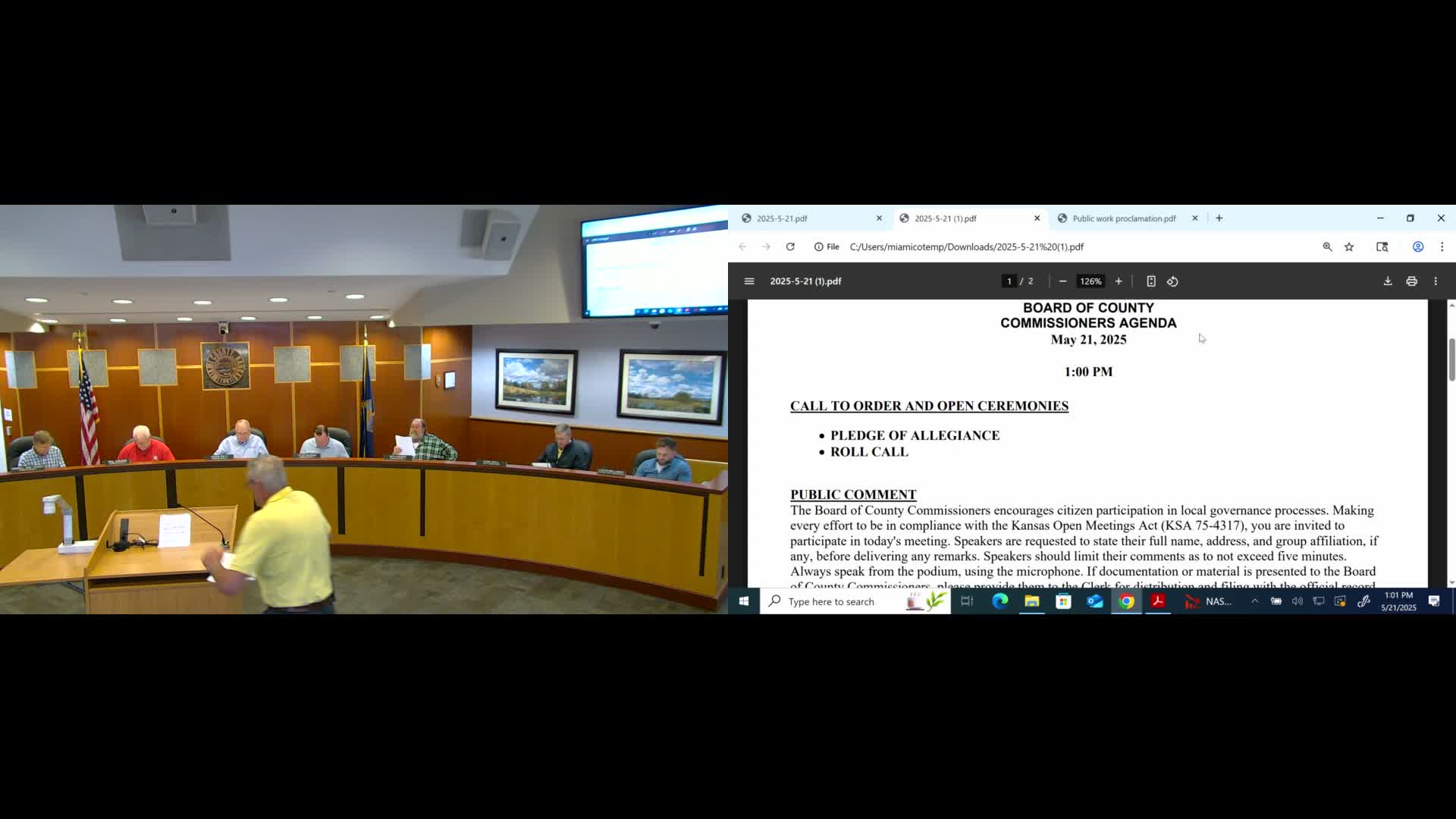
Dean O'Mato, a Miami County resident, told the commission on May 21 that removing the county courthouse from the National Register of Historic Places is permitted only if the building loses its historic or architectural integrity — for example if it collapses, burns, or the county votes to demolish it.
O'Mato said the county must notify the State Historic Preservation Officer (SHPO), identified in his remarks as Katrina Ringler, and that the SHPO may call public hearings that would be held within 60 days of notice. He urged the commission to consult the county attorney about legal steps and appeals.
Why it matters: Removing a listed property carries procedural steps, potential public hearings and, O'Mato warned, civil penalties for work that damages a listed property without required permits. He also outlined state funding options the county could pursue instead of demolition.
O'Mato told commissioners that the formal legal paths include provisions in state law and court review; he specifically cited K.S.A. 75-2724 and K.S.A. 60-2101 and referenced state administrative regulations governing historic-preservation review. He said the SHPO must be notified by certified mail if the county passes a resolution to demolish, and that a failure of the SHPO to respond within 30 days can be treated as approval under that process.
He also warned that undertaking work that would “damage or destroy any historic property” without required demolition or alteration permits can expose the county to civil penalties “not to exceed $25,000 for each violation,” and recommended the commission obtain counsel on those risks.
O'Mato identified two possible state funding mechanisms: the Heritage Trust Fund, administered by the Kansas Historical Society, which he said offers grants of up to $100,000 and requires a local match; and state historic-preservation tax credits administered through the Kansas Department of Revenue. He said he found little local experience in Miami County using those tax credits but suggested the state maintains a list of entities that can help.
The remarks were offered during the public-comment portion of the May 21 meeting; the commission did not take formal action on the courthouse during the session.
The commission received O'Mato's materials and direction to consult county counsel and applicable state offices would be the next step if the commission pursues changes to the courthouse's status.