Get Full Government Meeting Transcripts, Videos, & Alerts Forever!
Get email alerts on the Rental Code Enforcement topic
No spam. Unsubscribe anytime.
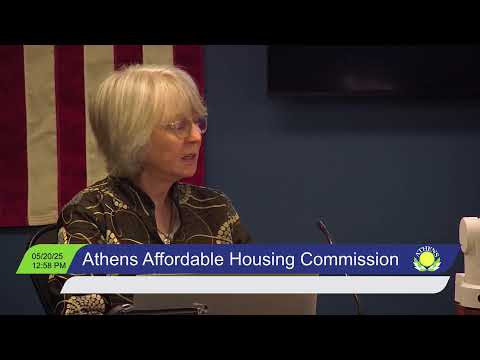
Athens affordable housing commission to form ad hoc group to review rental code inspections
Summary
Members of the Athens City Affordable Housing Commission voted to revise and return a resolution that would create an ad hoc committee to review rental code inspection processes, citing staffing limits in the city code office and recommendations in the 2040 comprehensive plan.
Solve Spiones, chair of the Athens City Affordable Housing Commission, introduced a resolution at the commission’s meeting proposing an ad hoc committee to review the city’s rental code inspection processes and recommend ways to improve efficiency and safety.
The commission’s proposal draws on the Athens 2040 comprehensive plan, which “according to the 2040 comprehensive plan” says about “70% of the housing units in Athens are rentals,” and lists two housing priorities related to rentals: “improve the student rental experience” and “empower the code office.” Commissioners and guests discussed staffing limits in the code and community development office, gaps in inspection coverage, and possible nonbudget solutions such as better use of existing reporting software and searchable online rental databases.
Why it matters: Commissioners said the city’s high rental share strains code enforcement resources and that the city does not currently have enough officers to inspect every rental unit within the required annual period. Commission members described a range of housing-safety problems reported by residents — from pests to structural failures — and said an objective review could identify cost-effective fixes and process improvements without additional city funds.
Discussion highlights included several recommendations that appear in the 2040 plan: expanding code-office staffing where funds exist, developing searchable rental databases, and increasing collaboration with Ohio University on renter outreach. Participants debated the word “oversight” in the plan’s language about university collaboration; several commissioners said the plan’s intent is collaboration rather than formal university control over private property.
The resolution proposes an ad hoc committee of at least seven members, including a student renter, a landlord with a history of code compliance, an experienced renter advocate, a member of the affordable housing commission, an Ohio University administrator appointed by the university president, a research consultant, and a code-office representative. The group would report quarterly to the commission and to city council and aim to complete its work by Dec. 1 (the resolution’s stated target date). The resolution’s text also references Athens City Code Title 3 administrative provisions and the 2040 comprehensive plan as its basis for action.
Public commenter Shelby Elzinga, who identified herself as a resident who works in Athens, urged the commission to gather complaint data and make it available for analysis: “Do you guys have a way of recording the various complaints on the health and safety of buildings? ... Getting that data and just having it, and being able to analyze it would be good,” she said.
Commission members identified specific process fixes to explore, including activating underused reporting features in existing software and using iPads for inspection reporting to speed filing and transparency. Members also discussed longer-term limits — for example, the commission noted that building-code inspections for new residential construction below a specified size fall under state jurisdiction rather than local control.
Action taken: Mary (commissioner) moved that “corrections and additions be made to the resolution and that it be presented next month for adoption.” The motion was seconded, put to a voice vote and approved with no nays. Commissioners agreed to refine the resolution text and to return it to the full commission at the next meeting for possible presentation to City Council or internal handling through the Neighborhood Revitalization Committee.
The meeting also included routine committee reports and approvals of minutes with edits. The chair emphasized the effort is meant to be “not pointing fingers, not witch hunting” but rather an objective effort to make rental inspections “more efficient, more effective and more satisfying for all our stakeholders.”