Get Full Government Meeting Transcripts, Videos, & Alerts Forever!
Get email alerts on the Transportation Active Mobility topic
No spam. Unsubscribe anytime.
Athens council approves Columbus Road shared‑use path after protracted debate over grants and safety
Summary
Athens City Council on May 19 adopted Ordinance 57‑25 to build a shared‑use path and sidewalk along Columbus Road using an ODOT small‑cities grant that covers most eligible construction costs; council and residents debated the project’s scope, grant timing and pedestrian safety.
Athens City Council voted May 19 to approve Ordinance 57‑25, authorizing the service safety director to advertise, accept bids and enter into contracts for construction of a shared‑use path and sidewalk along Columbus Road.
The ordinance text says the Ohio Department of Transportation (ODOT) awarded a small‑cities grant that covers up to 90% of eligible construction costs capped at $1,032,881. The ordinance authorizes the city to expend up to $1,382,881 for the project, including $350,000 from the city’s street fund; $160,000 of that local amount had been previously authorized for engineering design services, according to the ordinance language read into the record.
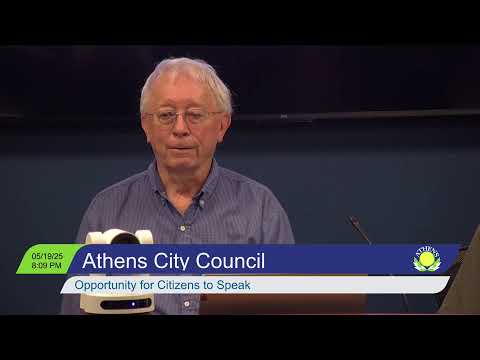
Supporters at the meeting framed the project as a safety and accessibility priority for people who walk, bike or use wheelchairs along Columbus Road. “Columbus Road is no longer a highway,” said Stephanie Hunter, of 204 Elmwood Place, speaking for the Pedestrian Accessibility and Bicycle Task Force and with blessing from the Disability Commission. “This is not a safe place for people to walk, roll, bike, or push a stroller. Yet that is what people are doing along Columbus Road every day.”
Ben Ziff, mobility coordinator with HAPCAP for Athens and Hocking Counties, told council he regularly observes people pushing strollers and walking the route. “Individuals walk, bike, and roll on this road every single day, every single day,” he said. “The danger and harm that we are currently forcing people into is entirely unacceptable.”
Michelle Hahn, speaking for the pedestrian task force and the Athens City Commission on Disabilities, said the path would serve nearby clinic and shelter sites and that losing the grant funding would be “a show of bad faith” and could jeopardize future awards.
Council debate addressed both the project specifics and the city’s broader grant process. Treasurer Joe Thomas explained that many of the large infrastructure ordinances council has reviewed this year rely primarily on outside funding, and that these grants often require a local match. “When you look at all these ordinances… 75–80% of the funds that are spent actually come from other sources, ODOT through grants,” Thomas said, adding that the grant opportunities can produce “sticker shock” when members of the public see large totals without context.
Council Member Spiones apologized for earlier remarks about a “path from nowhere to nowhere,” saying his comment was about discontinuous projects rather than residents. “In retrospect… I can understand how someone might have thought that. And for that, I apologize,” Spiones said, and later voted in favor of the ordinance.
Director Stone, the city’s service safety director, summarized the project history and the city’s use of planning documents to prioritize work. He noted that Columbus Road’s lack of pedestrian facilities was identified in the 2009 Bike and Pedestrian Master Plan and again in Athens 2040, and he warned that staff capacity is a limiting factor for pursuing grants: “I’m saturated… it’s not a function of funds. It’s a function of staff capacity to manage it.”
Council members debated whether grant applications should be vetted in committee before staff apply and whether the city could pull back after award; several members warned that refusing an awarded grant could harm future opportunities. Member Spine (Spiones) and others urged consideration of a process to review grant applications earlier when feasible, while other members cautioned that grant deadlines sometimes preclude committee review.
After public comment and council discussion, the motion to adopt Ordinance 57‑25 carried. Council also approved related first‑reading LPA (local public agency) agreements required by ODOT during the same meeting.
The ordinance text schedules the project to provide approximately 4,700 feet of connectivity from the Athens corporate limit to the intersection with the Hockhocking‑Adena bikeway and ties the path into existing bicycle facilities; specific construction details, phasing and final alignment will be set by the service safety director as bids are received.
Council did not amend the ordinance at the meeting; the action authorizes the director to proceed with bidding and contracting so work can be completed during the construction season and to preserve the ODOT funding award.