Get Full Government Meeting Transcripts, Videos, & Alerts Forever!
Get email alerts on the Temporary Housing Shelters topic
No spam. Unsubscribe anytime.
Planning commission approves temporary shelters at 7 N. Congress, tables broader code change
Summary
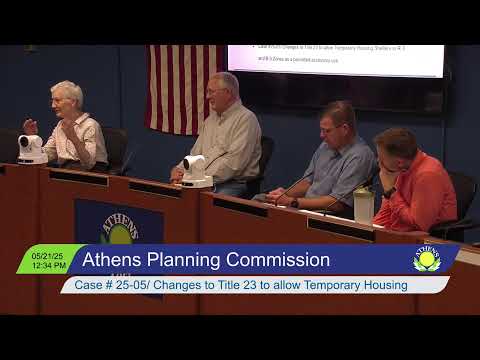
The Athens City Planning Commission on May 21 recommended that city council approve a site‑specific temporary housing accessory use at 7 North Congress and set limits tying structure counts to available restroom fixtures, while tabling a broader code change that would allow temporary shelters across R‑3 and B‑3 zones.
The Athens City Planning Commission on May 21 recommended that the city council allow a temporary-housing accessory use at 7 North Congress, the Gathering Place site, and approved limits tying the number of temporary structures to available sanitary fixtures. The commission voted 3-1 to approve Case 25-04 with staff language amended to require reapproval every two years and a limit of three temporary housing structures per sink and toilet provided.
The vote followed testimony from Gathering Place representatives and residents and a separate discussion about Case 25-05, proposed changes to Title 23 that would allow temporary housing shelters in R‑3 and B‑3 zones as an accessory use. Commissioners debated whether the changes should make the use a conditional permit to ensure neighbor notice and Board of Zoning Appeals review. The commission tabled Case 25-05 for further work on language and implementation details.
Why it matters: the decisions affect whether small, temporary non‑permanent housing structures — described at the meeting as “temporary housing shelters” or “structures of a temporary nature that are not affixed to the property” — can be sited in downtown and nearby zones and under what procedural safeguards neighbors will be notified.
Commissioners and staff framed the 7 North Congress approval as a site‑specific, accessory authorization rather than a wholesale code change. Director David Riggs told the commission the use is not permitted in an R‑3 zone under existing code; the planning commission’s recommendation would send the site‑specific request to city council and, separately, the package proposing broader code changes would be considered after additional review.
Gathering Place board member Kelly Brer described the organization’s plan and capacity needs. “It is our intention at this 0.3 would be what we would be looking at,” Brer said, adding that the group intends to start with three structures: “6 is probably the maximum it could potentially have, but 3 is what we are wanting to start with.” Resident Rob Delish said other locations had been considered and urged the commission to find alternatives but acknowledged local opposition had closed a prior site.
Commissioners debated the appropriate approval and oversight mechanism. Some members, citing neighborhood input and property‑value concerns, favored a conditional use that would require Board of Zoning Appeals review and neighborhood notification. Director Riggs noted that a conditional use would create a public notification process through the BZA, while an accessory use would be administratively approved with less formal neighborhood notice. The commission discussed tying capacity to facilities: the proposed draft requires “1 sink and 1 toilet must be available for use within 200 feet for every 3 temporary housing shelter units.” Riggs testified he had drafted language tying counts to available restroom fixtures so the limit would scale with on‑site sanitation.
Formal actions and next steps: the planning commission approved Case 25-04 with the following modifications: change the proposed annual reapproval to biannual (every two years) and limit temporary housing structures to three per available sink and toilet. The motion was moved by Miss Knisely and seconded by Mr. Stone; the measure passed 3‑1 with Mr. Phillips recorded in opposition. The commission then tabled Case 25-05 (the proposed Title 23 code changes) and asked staff to revise draft language to (1) consider making the use conditional rather than purely accessory, (2) add standards the BZA could apply, and (3) clarify whether both R‑3 and B‑3 zones should be included. The motion to table was moved by Miss Knisely and seconded (recorded in the minutes); the table motion carried unanimously.
Context and constraints: Director Riggs said the draft code language would require prior approval of the safety services director and periodic reapproval and that temporary housing shelters must not contain kitchens or bathrooms in the structures themselves. Commissioners and a member of the Board of Zoning Appeals suggested adding clear criteria for the BZA’s review if the use is moved to conditional status, including public notice and standards such as proximity to primary building uses, sanitation verification and limits to prevent commercial renting of temporary structures.
The Planning Commission did not adopt the Title 23 amendments at this meeting. Staff will return with revised code language that reflects the commission’s direction for additional safeguards and clarity on zones, notification and whether the use should be conditional. The site‑specific recommendation for 7 North Congress will proceed to city council as the commission’s formal recommendation.