Get Full Government Meeting Transcripts, Videos, & Alerts Forever!
Get email alerts on the District Budget And Legislation topic
No spam. Unsubscribe anytime.
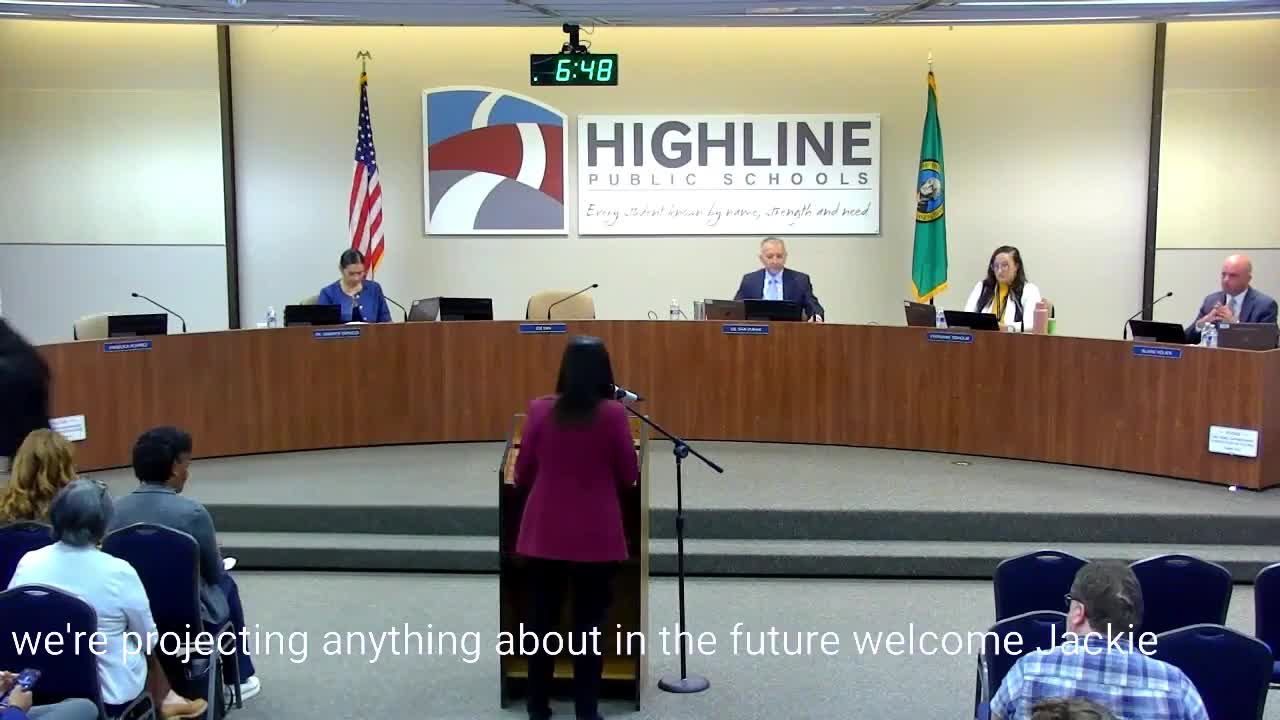
Highline CFO outlines budget outlook as governor signs K‑12 operating budget
Summary
Chief Financial Officer Jackie Bridal told the board the district finished the year with higher enrollment and tentative numbers showing revenues roughly matching expenditures, but new state accounting rules and modest legislative increases shift funding pressures into next year.
Chief Financial Officer Jackie Bridal told the Highline School District board the district is ending the year with enrollment above projections and provisional year‑to‑date figures that leave the district roughly balanced for 2024–25, but signaled fiscal pressure for 2025–26 as state accounting changes reallocate how special education is funded.
Bridal said May enrollment came in about 547 full‑time‑equivalent students over the district’s original projection and that the district had collected about 59% of its revenue and expended about 64% of its budget as of April, numbers she called “what we would expect to see at this time of year.” She said the district’s unassigned fund balance finished the 2023–24 cycle around 7% (the board policy minimum is 3%).
Why it matters: Bridal said legislative action finalized when the governor signed the operating budget changed how special education funding interacts with local levies. “We are now, no district of all of the districts in the state are allowed to use local levy dollars to offset the underfunding of special education,” Bridal said, describing an accounting change in the enacted bill. The Legislature also eliminated the prior funding cap for special education and set a new multiplier at 1.16, she said. Those changes increase state support but shift which local dollars can be used for basic education versus special education.
Bridal summarized other legislative outcomes: a modest increase for materials, supplies and operating costs (about $110 per student, she said) and no additional transportation funding. She said districts received increased levy authority that may allow some local revenue increases to offset state funding changes. Bridal cautioned the board the district expects to run “higher expenditures next year than revenues,” meaning use of some fund balance and possible future decisions to realign expenditures and revenues.
Bridal said the Office of Superintendent of Public Instruction (OSPI) must still issue updated budget tools after the governor signed the budget, and the district will finalize F‑203 and F‑195 forms for the 2025–26 budget once those tools are available. She outlined the district’s June schedule for budget work sessions, a public hearing and the July 2 action meeting on the budget.
Board context: Superintendent Doctor Duran thanked Bridal and noted the budget timing coincided with significant district events and communications. Directors asked for follow‑up details on how the legislative accounting change will affect levy allocations and what, if any, program-level adjustments may be required for 2025–26.
Ending: Bridal said official year‑end and projection numbers will be presented with the June budget documents once OSPI tools are available.