Get Full Government Meeting Transcripts, Videos, & Alerts Forever!
Get email alerts on the Terrorism Statute Expansion topic
No spam. Unsubscribe anytime.
Committee questions broad expansion of terroristic offenses in HB 2214; DPS recommends narrower approach
Summary
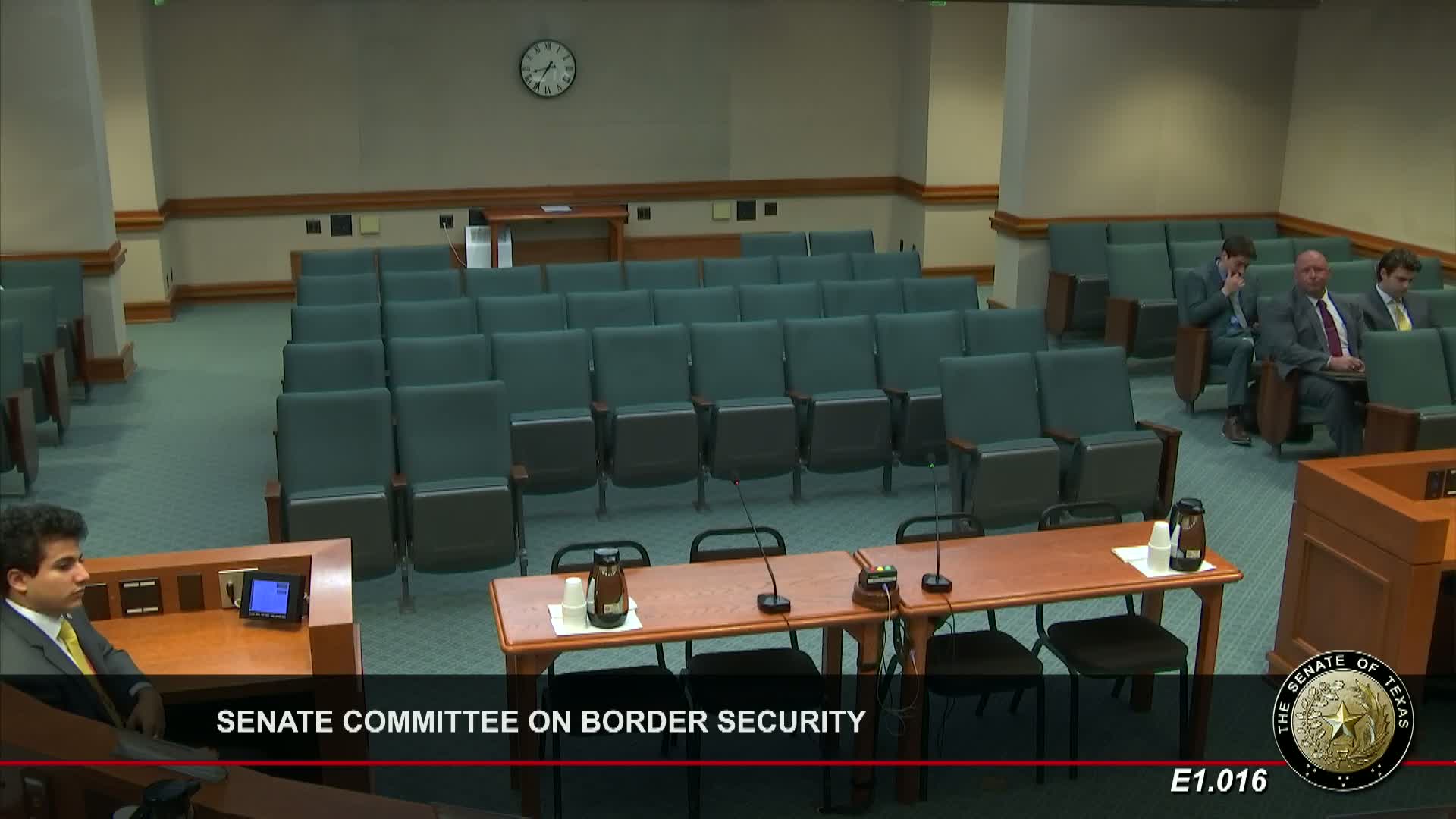
During a committee hearing on HB 2214, committee members and a Texas Department of Public Safety captain debated whether adding many offenses to the state's terrorism statute would be overly broad. The committee left the bill pending and directed further work with DPS; no public testimony was taken.
The Committee on Border Security opened a hearing on House Bill 2214, a proposal to expand the state’s terroristic-offense provisions and to broaden offenses related to firearm and ammunition smuggling. The chair said the bill would be discussed with the Department of Public Safety before the committee considers advancing the measure.
Chairman Birdwell (who sponsored the bill) said he wanted a public, technical discussion with DPS rather than move the bill as filed. “I don't want to include an expansive list of offenses and label them as terrorism,” he told the panel, and said his goal was to refine the bill with law enforcement so it would be enforceable without unintended consequences.
Captain Michael Stanford of the Texas Department of Public Safety’s Criminal Investigations Division testified for the department and urged caution. Stanford said some listed offenses have clear links to terrorism — for example, attacks on critical infrastructure or use of explosives — but others, such as commercial bribery, routine criminal mischief or ordinary identity-fraud offenses, are frequently unrelated to terrorist intent. “There's merit to pieces of the bill,” Stanford told the committee, “but ... there's equal as much risk as it not falling under an act of terrorism and capturing somebody ... where terrorism does not apply.”
Committee members repeatedly pressed the department and the chair about where to draw the line. Senator Kirk flagged the difficulty of proving the required mens rea — the intent to “intimidate the public or influence government action” — while Senator Eckhart suggested focusing on offenses that are frequently the modus operandi of terrorism, such as explosives, firearms and breaches of critical infrastructure.
As presented in committee, HB 2214 would expand the terroristic-offense list to include, among other crimes: aggravated kidnapping; continuous smuggling of persons; criminal mischief when committed with a firearm or explosive weapon; commercial bribery; fraudulent use or possession of identifying information, if a third-degree felony; breach of computer security; a range of telecommunications offenses (manufacture, possession or delivery of unlawful telecommunications devices; theft of telecommunications service; publication of telecommunications access devices; false caller ID); impersonating a public servant when the impersonated role is a peace officer; certain prohibited-weapons offenses involving explosive devices or automatic firearms; and firearm- and ammunition-smuggling statutes. The bill would amend unlawful transfer provisions to make acquiring a firearm with the intent to deliver it to a person the state knows is prohibited from possessing firearms a state-jail felony.
Witnesses and members noted trade-offs. Stanford said telecommunications- and fraud-related offenses can be tools in facilitation of terrorism, but they are also common in everyday crime, which risks capturing many nonterrorism actors under a terrorism label. He recommended narrowing the list to offenses that demonstrably and predominantly serve terroristic aims. Members also discussed the role of organized criminal activity statutes and whether existing law already addresses many of the conduct listed in HB 2214.
No members of the public registered to speak on HB 2214; the committee closed public testimony and left the bill pending while staff and the department work to refine the language.
The hearing was framed as an exploratory step: the chair said he did not intend to move the bill in its current form and sought committee counsel and DPS input before any further action.