Get Full Government Meeting Transcripts, Videos, & Alerts Forever!
Get email alerts on the Land Use Etj topic
No spam. Unsubscribe anytime.
Panel hears sharp debate over Fort Worth carve-out to ETJ-release law
Summary
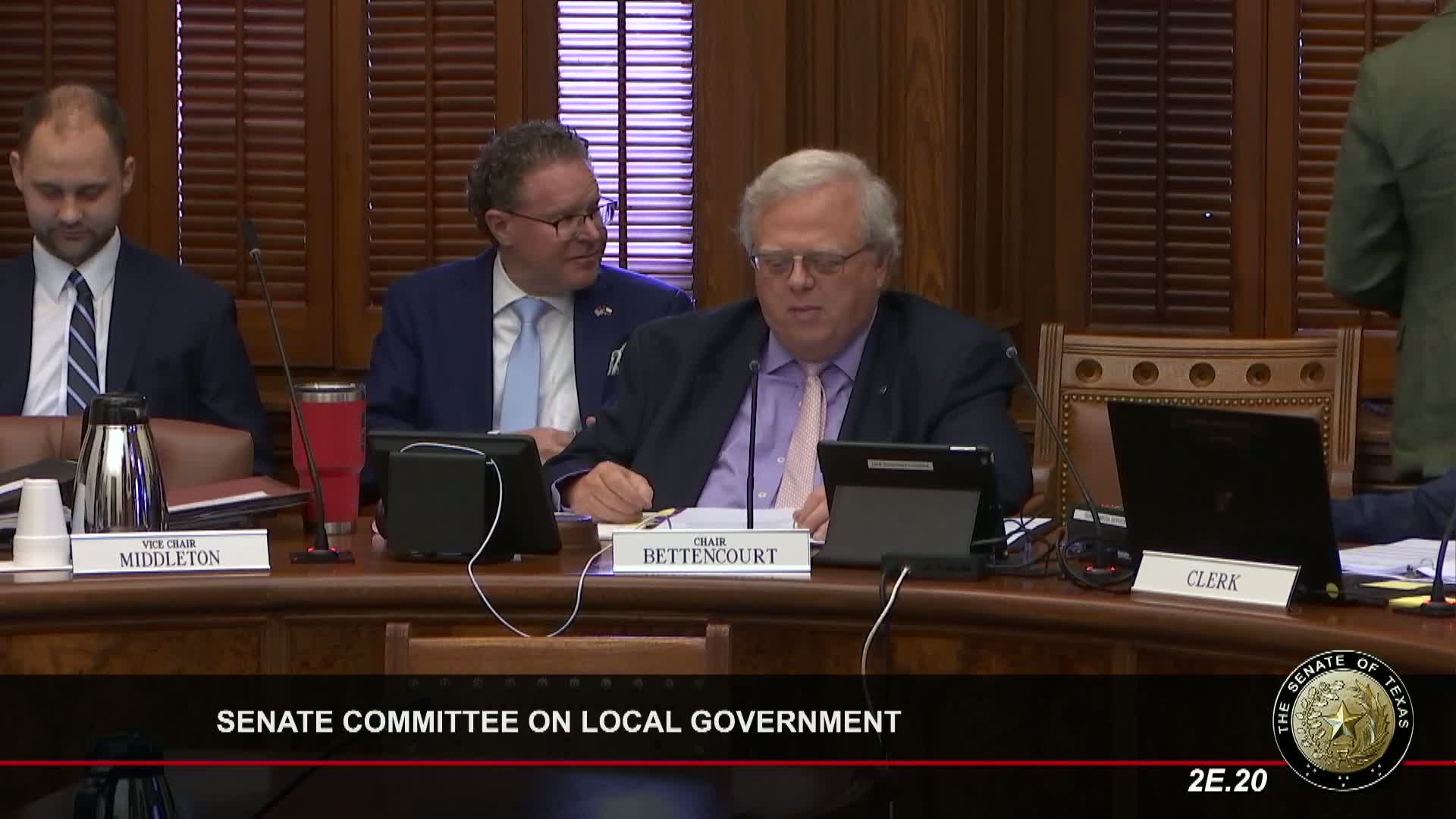
House Bill 2,512, a local bill for Fort Worth, was discussed at the Senate Committee on Local Government after testimony split between protecting municipal infrastructure investments and preserving property owners’ post‑SB 2038 rights.
House Bill 2,512, a local bill filed for the city of Fort Worth, was laid out in the Texas Senate Committee on Local Government and drew testimony both for and against the measure.
The bill would add exemptions to the ETJ-release statute created by 2023’s SB 2038: it would exempt land subject to an active development agreement in Fort Worth; exempt lots under 12 acres; and exempt platted subdivisions of 25 or more lots in a single lot block. Senator King, the Senate sponsor, said the changes are intended to “protect the City of Fort Worth’s investment in critical infrastructure for land subject to development agreements and ensure efficient provision of services by all municipalities.”
The nut of the debate was property rights versus municipal infrastructure protection. Dana Bergdorf, assistant city manager for the City of Fort Worth, testified in support: “Dana Bergdorf, assistant city manager with the city of Fort Worth here to speak in support.” She told the committee the city has invested “over $250,000,000 in running water and other infrastructure” for areas expected to develop and that the carve-out would protect that investment.
Several witnesses opposed the bill’s statewide provisions. Nate Criswell, who testified representing himself, warned the committee that the proposal would “reverse the progress achieved through Chairman Bettencourt’s SB 2038” and urged rejection of the bill “in its current form.” James Quintero of the Texas Public Policy Foundation said the bill risks creating a statutory precedent that other large cities could seek, eroding the pathway SB 2038 established for property owners seeking release from municipal extraterritorial regulation.
Opponents also flagged two separate elements in the draft: a local, Fort Worth–only exemption tied to active development agreements and broader statewide sections (referred to in testimony as subsections 7 and 8 of section 1 and 2) that, they said, could create a “Swiss cheese” effect where scattered parcels could remove themselves from an otherwise contiguous development area and complicate service provision.
Committee members requested clarity on which provisions would be local to Fort Worth and which would apply statewide; Senator King and other sponsors clarified in committee discussion that the active development agreement exemption was local, while the other subsections were statewide. No committee vote was taken; the bill was left pending, subject to call of the chair.
Clarifying details recorded during testimony included the three exemptions proposed (active development-agreement land in Fort Worth; lots under 12 acres; platted subdivisions of 25 or more lots) and concerns that statewide changes to the SB 2038 release process could undermine the ability of property owners across Texas to petition for release from ETJ regulation. The committee also heard constituent examples of hardship from property owners who used SB 2038 to obtain release from ETJ rules.
The committee closed public testimony and left House Bill 2,512 pending subject to call of the chair.