Get AI Briefings, Transcripts & Alerts on Local & National Government Meetings — Forever.
Senate committee debates new ‘farm winery’ permit aimed at boosting use of Texas‑grown grapes
Loading...
Summary
Senator Hancock presented an optional farm winery permit that would require 75% Texas‑grown fruit for certain privileges, including up to five off‑site tasting rooms and eligibility for a marketing assistance fund.
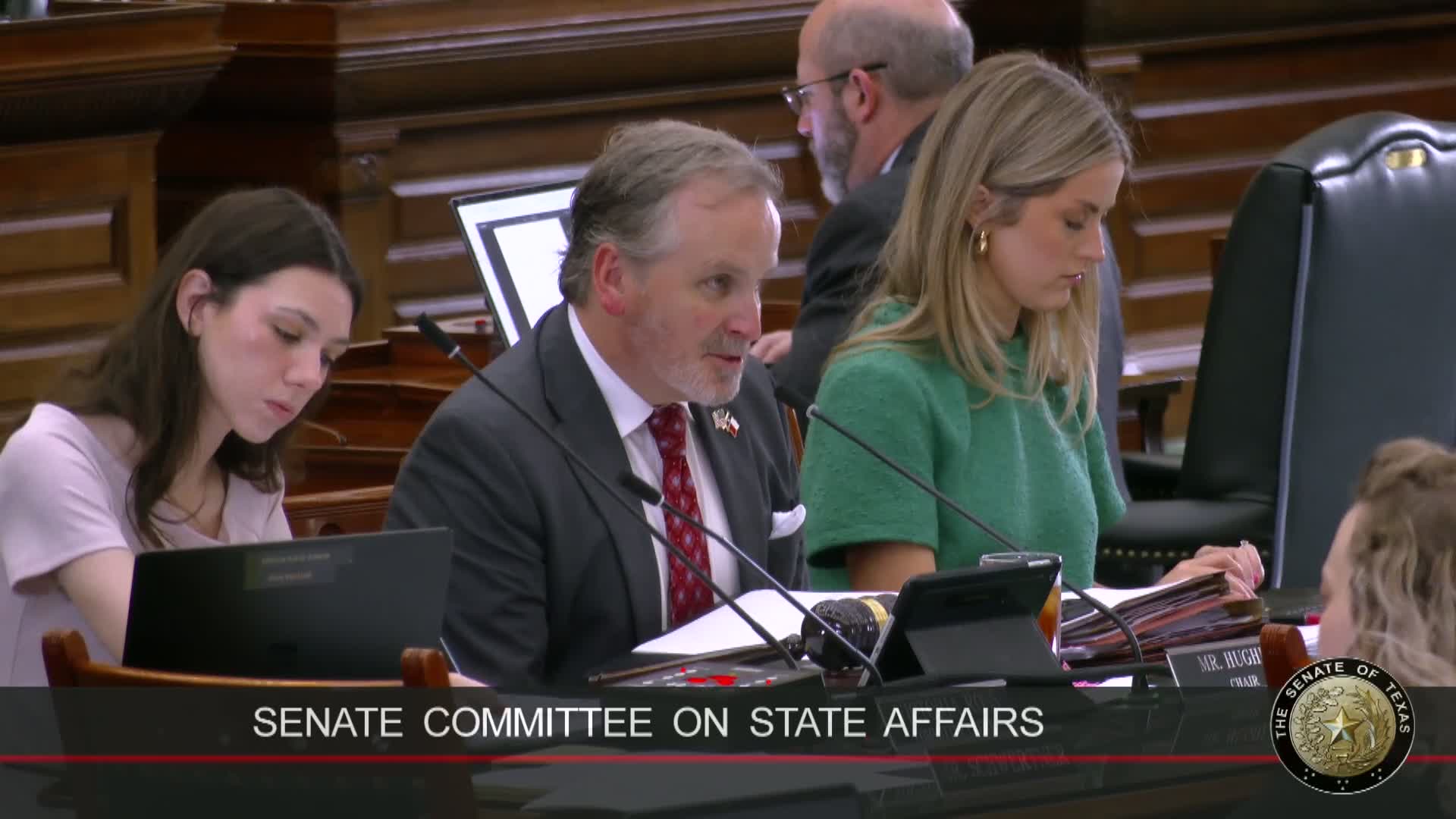
Senator Hancock presented House Bill 33,85, which would create a new optional Texas farm winery permit for wineries that use Texas‑grown fruit. Under the bill as explained at the hearing, a qualifying farm winery would need to use at least 75% Texas‑grown grapes (collectively, by varietal/production), could operate up to five additional off‑site tasting rooms without separate permits and would be eligible for a dedicated farm winery marketing assistance fund.
Matthew Cherry, senior counsel for the Texas Alcoholic Beverage Commission, acted as the committee’s resource witness. He said the proposal does not change operations already allowed under a standard winery permit (chapter 16), but would add a new optional authorization with additional activities tied to use of Texas fruit. “Right now under the bill, it is 75%,” Cherry told senators when asked how the threshold would be measured; he said the 75% requirement applies collectively to Texas‑grown grapes and that the bill would remove the need for additional permits for tasting rooms that otherwise would be required under current law.
Industry witnesses were divided. John Rivenberg, president of Texas Wine Growers and owner of Rivenberg Wine, strongly supported the bill, telling senators he had helped start dozens of wineries and had been involved in planting more than 1,000 acres of grapes. He said roughly 4,000 tons of Texas grapes were left unharvested or unsold last year and that increased demand driven by the permit could spur more planting and economic activity.
Several small winery owners and trade group representatives testified in opposition or urged caution. Sammy Lam, owner of Warnerless Wine Company, called the bill duplicative and “creates complexity where clarity is needed,” arguing it would impose regulatory burdens and offer a benefit (five off‑site tasting rooms) that small and emerging wineries could not absorb. Julie Herbert, president of the Texas Wine and Grape Association (TWIGA), told senators TWIGA’s board unanimously opposed the bill because it is “vague” — particularly on how to define the 75% requirement (e.g., by bottle, vintage, lot, or year) — and because it could re‑introduce permit fragmentation that a recent TABC sunset review had sought to reduce.
Supporters said the bill is modeled on farm winery permits in other states and is intended to strengthen the agricultural side of the wine industry and agritourism. Opponents pressed for clearer rulemaking standards on traceability and audits. Cherry acknowledged TABC does not currently audit grape origin for wineries and that the agency would need a new mechanism if the law required verification: “We would be looking at a new and additional types of records than what the agency is currently looking at,” he said.
Committee members pressed witnesses on market supply concerns — whether Texas grows enough grapes now for broad adoption of a 75% standard — and on the risk that larger wineries might outbid smaller ones for limited Texas fruit. Supporters said greater demand would lead to more acreage planted; opponents warned of potential short‑term price and access harms for small operators.
The committee heard a long panel of testimony for and against the proposal, including representatives of TABC, Texas Wine Growers, Messina Hof, TWIGA, and several individual wineries. After invited and public testimony, the committee left House Bill 33,85 pending for further consideration and potential amendment.
Key unresolved issues raised during the hearing included precise definition and measurement of “75% Texas‑grown,” audit and traceability procedures for grape origin, whether the specified tasting‑room privilege would create an unfair competitive advantage, and whether the bill duplicates or conflicts with TABC’s sunset recommendations.