Get Full Government Meeting Transcripts, Videos, & Alerts Forever!
Get email alerts on the Electric Transmission Ercot topic
No spam. Unsubscribe anytime.
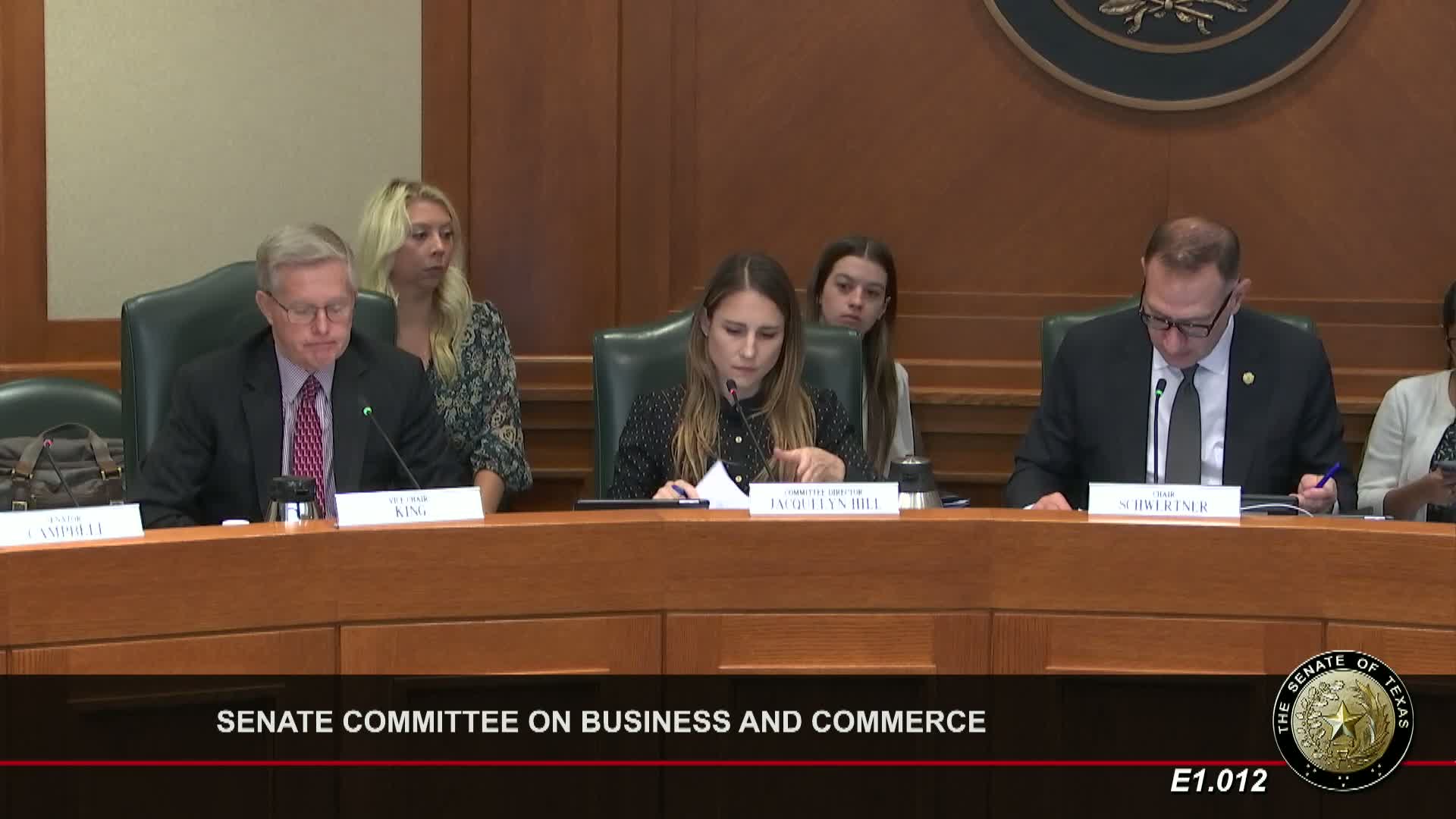
Senate committee hears long‑range transmission planning bill aimed at ERCOT congestion costs
Summary
House Bill 30 69 would direct the PUC to adopt a supplemental multi‑decade planning criterion for transmission certificates to evaluate long‑term congestion relief and potential customer savings.
House Bill 30 69, sponsored in the Senate committee by Senator Schwartner, would direct the Public Utility Commission of Texas (PUC) to develop a supplemental, multi‑decade transmission planning criterion that could be used in evaluating certificate of convenience and necessity (CCN) applications for large electric transmission projects in ERCOT. The bill’s sponsor said the measure is designed to help address rising congestion costs by allowing a second economic test that looks farther into the future than existing short‑term analyses.
The measure matters because ERCOT has reported large congestion costs in recent years; proponents said longer planning horizons could capture savings that near‑term tests miss. Eddie Lucio III of the Texas Transmission Project, a nonpartisan nonprofit, called HB 30 69 “a consensus bill that, asks the PUC to develop through rulemaking a alternative to how they have been issuing certificates,” and said only two of the last 24 certificates used economic planning.
Cyrus Reed of the Lone Star chapter of the Sierra Club said the bill “allows another process, to look longer term to see if there are benefits,” while cautioning that the proposal still requires ERCOT, the PUC and stakeholder engagement and would not bypass contested‑case procedures. Katie Coleman of the Texas Association of Manufacturers said the bill is neutral: it sends the methodology to the PUC and “require[s] the commission to look at should you for example require the benefits to exceed the cost by some factor or should you apply some discount rate to the assumed benefits.” Coleman warned that long‑range forecasts introduce uncertainty and that careful discounting and hurdle rates will be important.
Committee members asked about the scope and interaction with prior legislation. Witnesses and the sponsor said the long‑term test would not replace existing near‑term economic tests but would provide an additional tool; the PUC would retain discretion and contested‑case review would remain the avenue for parties to challenge assumptions.
Public testimony closed at the end of the panel. The committee left HB 30 69 pending for further consideration and noted that representatives from the PUC would be available if needed for later questions.