
Joint committee reviews tax-expenditure extensions; earned-income credit expansion would add $60 million to baseline
Get AI-powered insights, summaries, and transcripts
Subscribe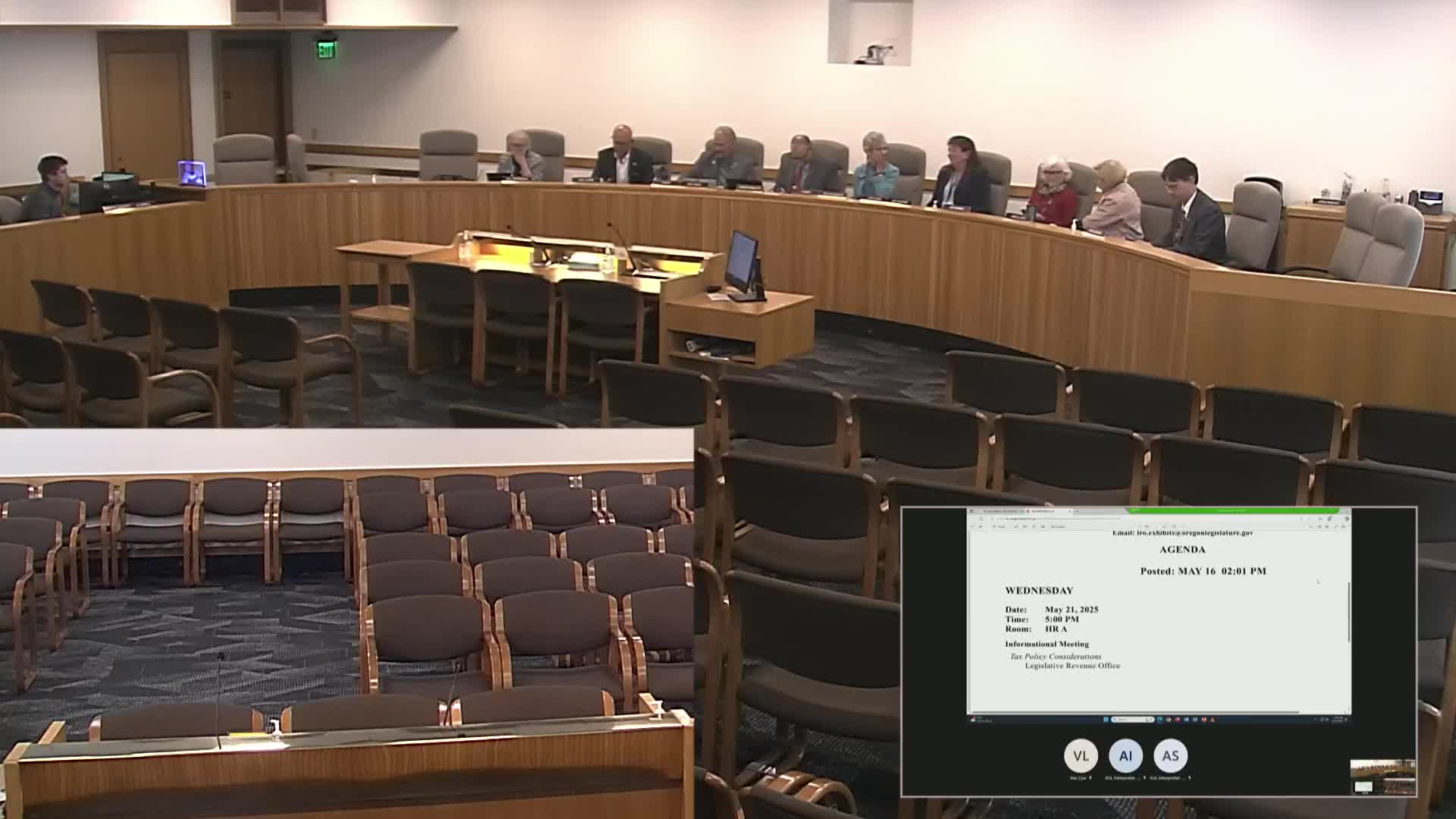
Summary
At an informational meeting May 21, the Joint Committee on Tax Expenditures reviewed a table of credits up for routine sunset review and possible expansions, highlighting the earned-income tax credit as the largest potential budgetary change and noting a pending House Revenue Committee consideration of additional bills.
The Joint Committee on Tax Expenditures met May 21 for an informational session on credits and other tax-expenditure policies scheduled for review this legislative session.
Committee members and staff discussed a table of policies that are either in the regular six-year sunset-review cycle or have drawn stakeholder interest. Staff said the earned-income tax credit (EIC), crop-donation tax credit, pension-income credit and a manufactured-dwelling-related credit are the four credits in the regular review block, and that the EIC is the largest fiscal item under consideration.
"What is not included is the next line down the expansion. So that $115,000,000 impact is $60,000,000 more than what's in that baseline," staff member Mr. Allenac said, describing the difference between the baseline extension and a proposed EIC expansion. Staff told the committee the baseline figure of about $53,000,000 for the EIC is already incorporated into current budget discussions and that an expanded version would increase the general-fund impact.
Committee members were also warned that the House Revenue Committee was scheduled to consider multiple bills the next day that could affect what arrives at the joint committee. "The ones on the left are what LRO is expecting will be working tomorrow," Mr. Allenac said, noting timing awkwardness between committees.
Members and staff discussed crop-donation proposals that would expand the existing credit. One co-chair said the committee amended Senate Bill 108 to broaden the credit, and Co-chair Nathanson said the House discussion included proposals to reimburse donors for the costs of making donations — "the cost of the fuel and supplies to get this donation to a place that would process or receive it," Nathanson said, citing testimony heard in the House committee.
Committee members asked how to read the table's figures; Nathanson clarified that alternative rows for a given credit represent replacement options rather than additive figures. Staff reiterated that some other tax-expenditure items outside the regular credit review — including certain transportation-related taxes and corporate activity tax provisions identified in the governor's tax-expenditure report from the Department of Revenue — have generated stakeholder outreach but currently lack bill numbers.
No formal motions or votes were taken. Co-chairs told members the committee will continue meeting as needed through the end of session to hold public hearings, determine potential outcomes and make recommendations to budget writers. "We would love to have a good budget. I've stated ... it takes money to make money," the Committee Chair said in closing.
The committee also reviewed timing and process: the credits subject to the statutory sunset review come up on a roughly six-year cycle, with about a third reviewed each biennial session. Staff and members noted that whether expansions move forward depends on separate committee actions, appropriations and negotiations with Ways and Means co-chairs.
Matters the committee flagged for follow-up include: potential revenue estimates for specific expansion proposals, final actions in House Revenue the following day, and stakeholder input on noncredit tax-expenditure items mentioned in the governor's report.