
Oregon committee hears competing testimony on bill to restrict flavored tobacco sales to OLCC stores
Get AI-powered insights, summaries, and transcripts
Subscribe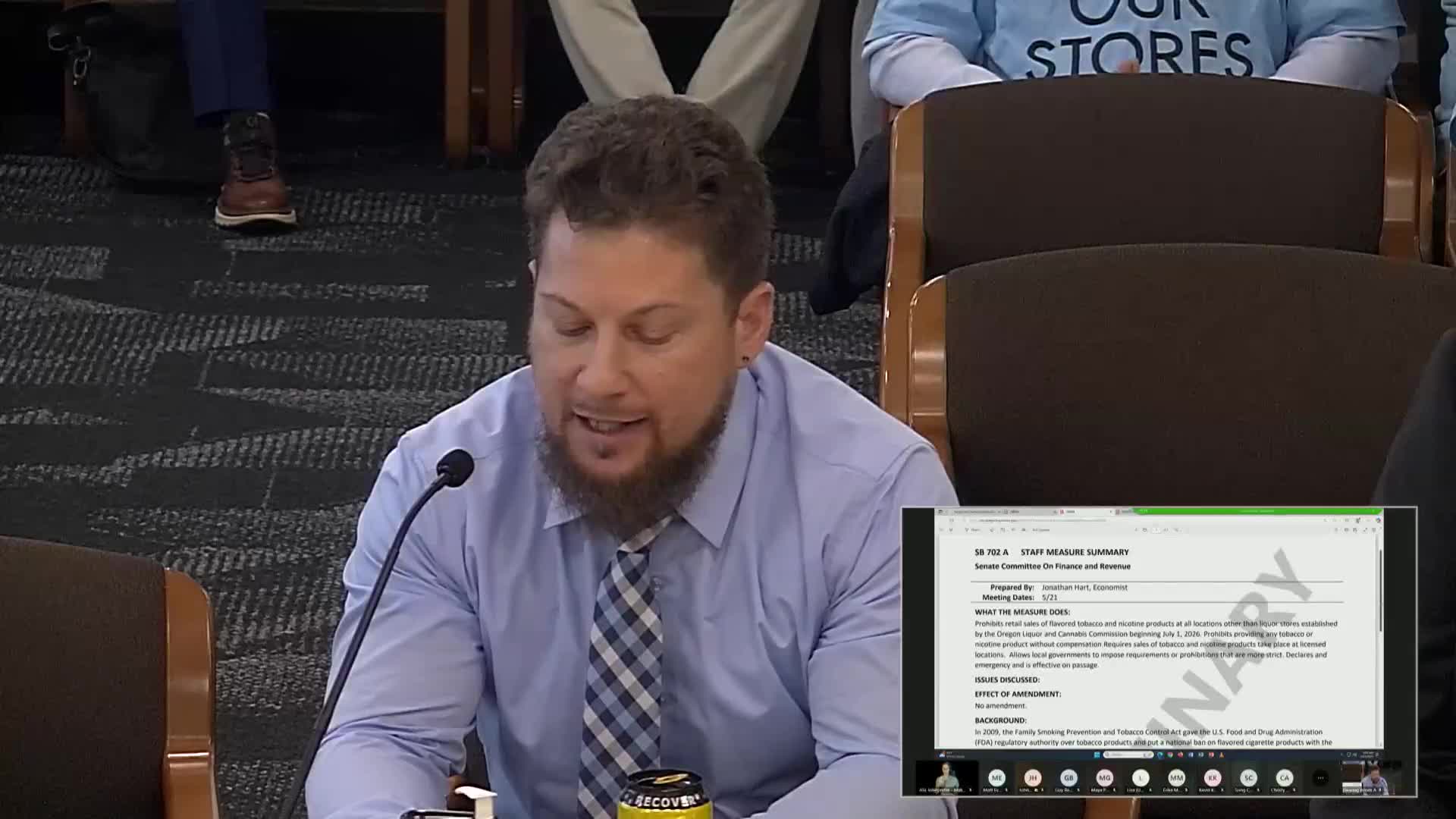
Summary
The Senate Committee on Finance and Revenue opened a public hearing on Senate Bill 702A on May 21, 2025, a proposal that would limit retail sales of flavored tobacco and flavored synthetic‑nicotine products to stores established by the Oregon Liquor and Cannabis Commission (OLCC), and prohibit providing tobacco or nicotine products without compensation.
The Senate Committee on Finance and Revenue opened a public hearing on Senate Bill 702A on May 21, 2025, a proposal that would limit retail sales of flavored tobacco and flavored synthetic‑nicotine products to stores established by the Oregon Liquor and Cannabis Commission (OLCC), and prohibit providing tobacco or nicotine products without compensation.
Proponents, including Senator Lisa Reynolds and several pediatricians and public‑health experts, told the committee the measure would reduce youth access and prevent nicotine addiction. Opponents — retailers, wholesalers and some elected officials — said shifting sales from roughly 3,000 private retailers to about 280 OLCC stores would cut state tax revenue, cost jobs and expand illicit markets.
The bill’s core provision would require flavored tobacco and flavored synthetic‑nicotine products be sold only at OLCC stores established under ORS 471.75. Senator Lisa Reynolds, state senator for Senate District 17, said the bill "limits the sale of flavored tobacco and flavored synthetic nicotine products in Oregon" and emphasized its public‑health aims, noting the measure "excludes FDA approved smoking cessation products" and includes an implementation date of July 1, 2026. A legislative staff member (Mr. Hart) provided a preliminary fiscal estimate, saying the restriction would produce "about dollars 18,000,000 revenue reduction per year upfront, but because these are declining revenue sources, that does decline in later years." Supporters framed the change as narrowing availability from nearly 3,000 tobacco retailers to 280 OLCC stores and argued OLCC stores are 21+ and have stricter controls and higher ID‑check compliance.
Physicians and public‑health witnesses described clinical harms. Dr. Wendy Hassan, a pediatric critical care physician, described severe e‑cigarette or vaping‑associated lung injury (EVALI) and said such admissions "are entirely preventable," urging passage. Dr. Marlo McElrath, a pediatrician on OHSU faculty, described rising use of flavored nicotine pouches (Zyn) among teens and cited research showing over 80% of youth who have ever used tobacco began with a flavored product.
Youth witnesses also spoke in favor. Julian Guerra Molina, chair of the Oregon City Youth Advisory Commission and a high‑school senior, told the committee: "Money is not more important than people's health. It's not more important than children's health." Miles Kinney, another Oregon City student, described seeing vapes in backpacks and bathrooms and said peers obtain products through older acquaintances rather than by buying them directly.
Opposition came from a mix of retailers, industry groups and some legislators. Senator David Brock Smith (Senate District 1) said the proposal would "gut potentially 90% of the revenues coming in to this state from the tax revenues off the sale of these" products and argued the change would redistribute private retail sales to state‑run stores. Sean Miller of the Northwest Grocery Retailers Association disputed the compliance argument put forward by proponents, citing Oregon Health Authority and OLCC minor‑decoy statistics and saying liquor stores had higher violation rates in the OLCC decoy program (a 68% pass rate cited by Mr. Miller versus 84% pass rates cited for grocery and convenience stores). Jonathan Polonsky, CEO of Plaid Pantry, and convenience‑store owners warned of lost revenue for small and family‑owned outlets. Jason Weber, owner of multiple vape shops, said many vape stores are already 21+ and urged the committee to include specialty tobacco retailers rather than limiting sales to OLCC.
Witnesses also raised ancillary issues: the potential for a larger illicit market and online sales, impacts on workforce and distributors, and cultural effects on hookah lounges. Daniel Mokht, speaking in a personal capacity as a Middle Eastern Oregonian, asked the committee to consider an exemption for hookah lounges that do not sell liquor. Several small business owners and franchisees said flavored tobacco represents a significant portion of store revenue and warned of closures and layoffs if the bill passes.
Officials clarified regulatory gaps and next steps. Sarah Wiley, manager of the Tobacco Retail License Program at the Oregon Health Authority, told the committee that "synthetic and tobacco‑derived nicotine products like Zyn are not currently regulated under Oregon law," meaning the state cannot inspect for them under the tobacco license program; she referenced House Bill 2528A as addressing that statutory gap. Marissa James, chief deputy legislative counsel, offered to provide the committee with written legal answers to outstanding regulatory questions.
No formal committee action was taken on SB 702A during this session. The chair paused the public hearing to take up a work session on another bill and reminded witnesses they could submit written testimony within 48 hours.
The hearing record contains competing factual claims the committee may review further — including the preliminary $18 million annual revenue estimate provided to staff, differing compliance statistics cited by retail and public‑health witnesses, and questions about whether specialty vape retailers could be included in a regulatory solution.
The committee will accept written testimony for 48 hours after the hearing and legislative staff said they will produce written clarifications and legal guidance on regulatory authority for synthetic‑nicotine products.