Get Full Government Meeting Transcripts, Videos, & Alerts Forever!
Get email alerts on the Grid Security Emp topic
No spam. Unsubscribe anytime.
Retired Marine and security experts warn Louisiana lawmakers of EMP and solar-weather risks to the grid
Summary
Retired Lieutenant Colonel Tommy Waller briefed the House Select Committee on Homeland Security about electromagnetic threats to the U.S. electric grid — from adversary-directed attacks to natural solar storms — and urged state-level action to harden transformers and critical infrastructure.
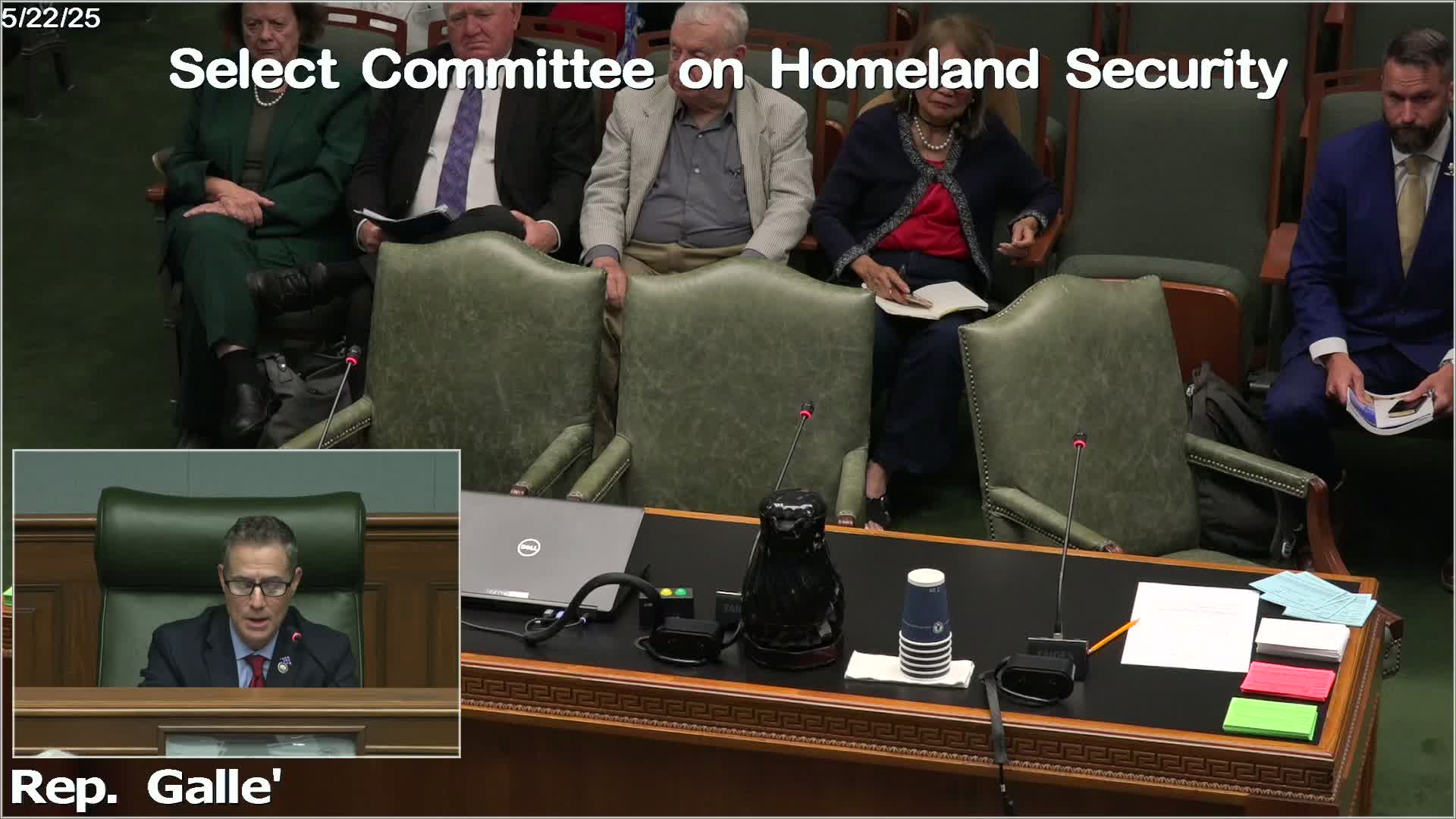
Retired Lieutenant Colonel Tommy Waller told the House Select Committee on Homeland Security on May 22 that electromagnetic threats — both manmade and natural — pose a substantial risk to Louisiana's electric grid and to the state's critical infrastructure.
"Taking down the electric grid is exactly how our enemies can and are planning currently to take down this civilization," Waller said, urging state leaders to act where federal responses have lagged.
Waller outlined six threat vectors to the grid and focused on two he said have been ignored for decades: supply-chain vulnerabilities in high-voltage transformers and electromagnetic threats from high-altitude nuclear detonations and extreme solar storms (ground-induced currents). He cited a 2019 inspection of a transformer that found a hardware backdoor and said there are roughly 550 transformers of Chinese origin on U.S. systems.
Waller described the technical risk: a high-altitude burst or severe coronal mass ejection can induce ground currents that ‘‘catastrophically ruin’’ large transformers and argued that the current North American Electric Reliability Corporation (NERC) standards provide insufficient protection in many southern U.S. locations, including Louisiana. He said replacing damaged large transformers could take four to six years and that a single damaged high-voltage transformer can cost tens of millions of dollars to replace.
Waller promoted technological mitigations such as neutral-ground blockers and substation hardening, pointing to deployed solutions with per-unit costs far below the economic losses he says solar weather already causes. He cited an Oak Ridge National Laboratory study and Department of Energy and Department of Defense analyses in support of recommended protections.
Representatives and committee members asked about domestic manufacturing capacity for transformers and the economics of protecting critical assets. Representative Amade (Representative Amade) and Representative Cruz raised the potential for Louisiana and Texas to develop domestic manufacturing and suggested incentives and Defense Production Act mechanisms for onshore production.
Entergy representative Jody Montelaro told the committee the state's utilities take grid security seriously and that Louisiana's low share of intermittent renewables (about 2–3 percent, Montelaro said) helps preserve baseload capacity. Montelaro encouraged legislative coordination with the Louisiana Public Service Commission and offered continued cooperation with the committee on potential policy steps.
Waller urged the committee to consider a state-level resolution and to educate the Public Service Commission, utilities and legislators about immediate, affordable mitigations — steps he said could substantially reduce the risk of long-term, widespread outages.
No formal vote or regulation resulted from the briefing; members said they would continue the dialogue with utilities, the Public Service Commission and federal partners.