Get Full Government Meeting Transcripts, Videos, & Alerts Forever!
Get email alerts on the Data Centers topic
No spam. Unsubscribe anytime.
Georgia lawmakers hear warnings that data centers could strain water, power and local services
Summary
At a May 22 meeting of the Georgia General Assembly—s Special Committee on Energy and Water, nonprofit experts warned that the state—s rapid data center growth is consuming large quantities of fresh water and electricity, creating risks for drought resilience, local air quality and municipal services.
At a May 22 meeting of the Georgia General Assembly—s Special Committee on Energy and Water, nonprofit experts warned that the state—s rapid data center growth is consuming large quantities of fresh water and electricity, creating risks for drought resilience, local air quality and municipal services.
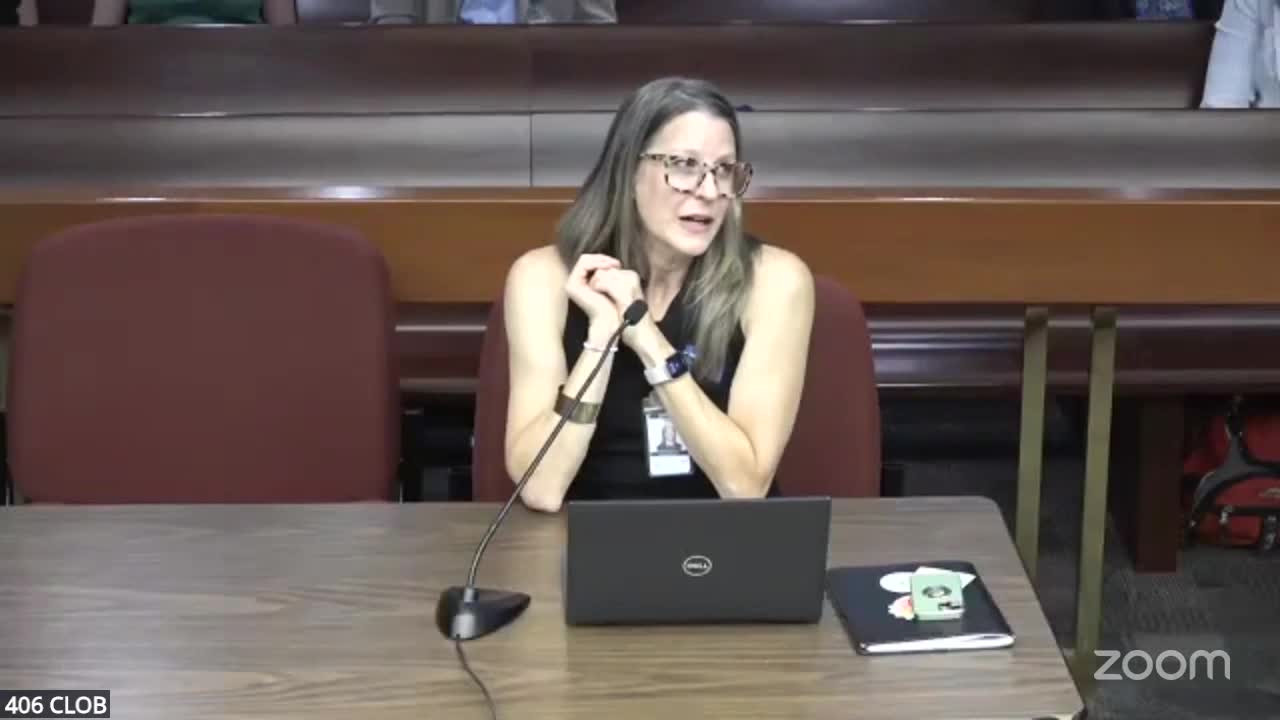
"Data centers use a lot of water," said Jeanette Gehr, director of Environment Georgia, in testimony to the committee. Amy Sharma, executive director of Science for Georgia, told lawmakers, "We need data centers, and we need AI," and urged lawmakers to require more transparency and stronger community protections so the facilities can be "good neighbors."
The testimony combined state- and national-level figures with local examples to underscore two central points: current public data on data-center water and power use are incomplete, and projected growth could materially affect water basins and electricity demand. Gehr said her group's scan of permits and reporting produced an estimate that existing and proposed data centers could be withdrawing roughly 68,500,000 gallons of water per day from Georgia rivers, a figure she described as an "best guess" based on available permit and reporting data. Gehr added that average individual centers in the group's review used about 9,000,000 gallons per day, with roughly 6,000,000 gallons being consumptive use that is not returned to the river.
Sharma provided separate industry-based estimates and repeated that the numbers her group presented are approximate because no single state registry tracks the facilities. She told the committee that her group's count identified roughly 97 existing data centers and 19 announced projects as of early 2025, and that a typical statewide build-out scenario could add some 14,000 megawatts of demand -- a quantity Sharma compared to the output of multiple plant-scale generators. Sharma also cited a figure published by Good Jobs First and others estimating $300 million in forgone tax revenue in 2025 tied to sales-tax and high-tech exemptions, while noting that some localities receive increased ad valorem (property) revenue from the facilities.
Both presenters warned that many of the numbers are estimates. Gehr told the committee that Environment Georgia—s totals came from a mixture of permit data and public announcements and that the state Environmental Protection Division (EPD) did not have a single, consolidated data-center registry. Sharma said her group used common industry planning assumptions ("50 to 300 watts per square foot" and a water-use range she cited as "2 to 4 gallons" per [unit not specified in testimony]) to make rough statewide projections and emphasized the limits of those estimates in planning decisions.
Presenters flagged several policy areas for committee attention:
- Water and drought resilience: Gehr asked the committee to consider how consumptive water use by data centers affects downstream and upstream users during droughts and recommended inviting neighbors of existing centers to describe local impacts. Committee members were urged to consult existing state water-planning councils and Georgia Power planning analyses when assessing basin-by-basin availability and future demand.
- Electricity and air quality: Gehr and Sharma noted that powering data centers increases demand on generation resources and could prolong use of fossil-fuel plants or require new capacity; Sharma displayed Georgia Power planning projections showing substantial additional generation needed to serve data-center growth and warned this could increase emissions if new generation is fossil-fuel linked. Gehr noted that diesel backup generators at facilities can also cause temporary but serious local air-pollution events when used for extended outages.
- Land use and stormwater: Gehr said announced and existing data centers occupy substantial acreage statewide and asked the committee to consider erosion, sediment control and transmission-line siting, including eminent-domain implications for nearby residents.
- Tax incentives and local benefits: Sharma said Georgia—s current sales-tax and high-tech exemptions reduce immediate state and local sales-tax receipts, and she cited a Good Jobs First analysis estimating roughly $300 million in foregone revenue in 2025; she also acknowledged that some localities see meaningful ad valorem (property tax) gains and said net fiscal impacts merit closer analysis.
Committee leaders responded that they planned targeted follow-up. The committee chair (identified in committee materials as the chair of the special committee) said the committee will form two subcommittees, water and energy, and announced tentative water-focused meeting dates and locations: June 4 (Coastal Georgia, location TBD), July 17 (Fayetteville, tentative) and Aug. 27 (Moultrie, ag/power-generation focus). The chair said staff would maintain a living document summarizing testimony and policy options and the committee plans to seek more granular data from EPD, Georgia Power and the state—s water-planning councils.
Representative Reese pressed presenters on cooling-system assumptions and whether closed-loop systems were reflected in the water-use estimates. Sharma said the groups used lower-end industry estimates in their calculations to avoid overstating usage but reiterated that facility-by-facility disclosure would be needed to refine those results.
Neither presenter urged banning data centers. Instead, both recommended steps the Legislature could take to reduce local impacts and financial risk: require transparent reporting of water and power use; condition local and state incentives on community benefits and grid resilience investments (for example, requiring battery storage or other grid-support assets); adopt clawback provisions or longer-term commitments for incentive recipients; encourage reuse of nonpotable or gray water where feasible; and consider stronger permitting and siting standards to protect downstream users and reduce erosion.
The testimony showed divergence in how localities value data-center projects: some committee members said property-tax increases and construction-related spending can provide substantial local benefits, while the presenters and other members said the net fiscal and environmental picture remains uncertain without better data.
The committee did not take any formal votes or adopt policy at the May 22 meeting. Members directed staff to continue compiling testimony and to invite additional experts and community representatives to future hearings.
Community members and organizations referenced in testimony included Environment Georgia, Science for Georgia and Chattahoochee Riverkeeper; agency names discussed included the Georgia Environmental Protection Division (EPD) and the Georgia Public Service Commission (PSC), which the chair said had a recent rate-freeze announcement from the governor—s office to extend electricity rate protections for three years.
The committee meeting is scheduled to continue the water-focused review at the dates listed above and to begin an energy-focused subcommittee later in the summer; the chair said subcommittee assignments and more detailed meeting locations would be circulated to members in the coming days.