Get Full Government Meeting Transcripts, Videos, & Alerts Forever!
Get email alerts on the Commercial Pace topic
No spam. Unsubscribe anytime.
Committee pauses bill allowing parishes to authorize commercial CPACE financing after hours of debate
Summary
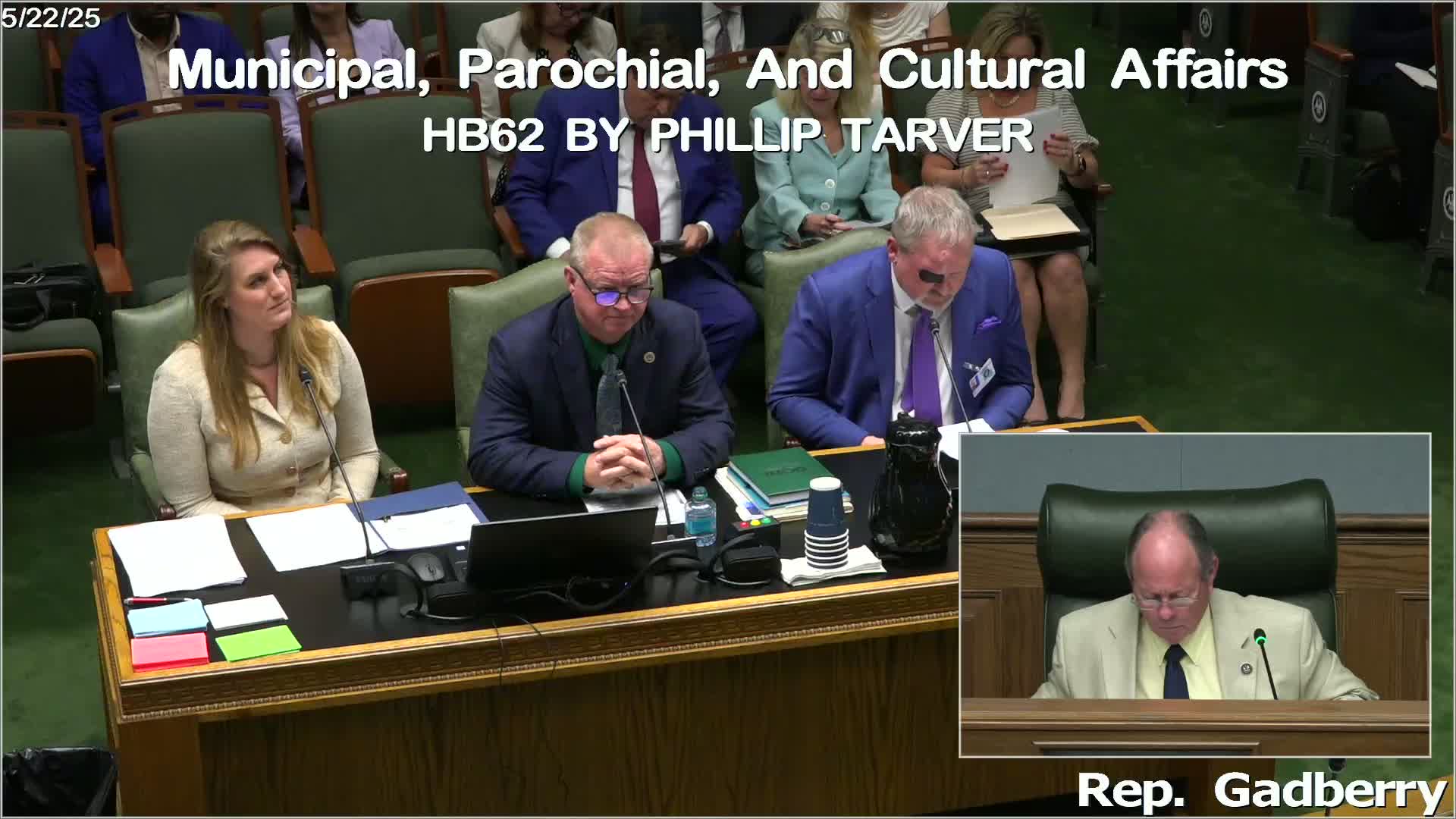
House Municipal, Parochial and Cultural Affairs Committee members on the morning of the hearing took up House Bill 62, an enabling bill that would allow parish governing authorities to adopt commercial Property Assessed Capital Expenditure and resilience (CPACE) programs and collect voluntary assessments on tax bills for privately financed upgrades.
House Municipal, Parochial and Cultural Affairs Committee members on the morning of the hearing took up House Bill 62, an enabling bill that would allow parish governing authorities to adopt commercial Property Assessed Capital Expenditure and resilience (CPACE) programs and collect voluntary assessments on tax bills for privately financed upgrades.
The bill’s sponsor, Representative Tarver, and a slate of developers and private lenders described CPACE as a voluntary, private-market tool to close small gaps in the capital stack for large commercial renovations and resilience work. Banking groups and several local bankers argued the program would give PACE lenders a tax-collection advantage ahead of mortgage holders and warned of risks to lending markets and property marketability. At the author’s request the committee voted to defer HB 62 for two weeks.
HB 62 would not create a statewide program; the measure is enabling language that, if passed, lets each parish decide by local ordinance whether to allow commercial CPACE programs. Proponents said CPACE loans are private, long-term capital repaid through a voluntary property tax assessment on commercial parcels, often used to finance storm hardening, HVAC upgrades or energy-efficiency work that lenders and owners otherwise struggle to finance.
Representative Tarver introduced the bill as a local option. “It only opens the door and allows local governments to provide a mechanism for capital project financing using a voluntary property tax assessment,” he said. Proponents from the private sector described protections they say are standard in CPACE transactions: senior-lender consent, lender access to underwriting documents and a non‑acceleration feature that, they said, prevents the full CPACE balance from being called due by the PACE lender on default.
Gabby Gilboe of Nuveen, identified in testimony as a national CPACE provider, said the product has been used in roughly 40 states with more than $10 billion of CPACE capital deployed nationwide. “CPACE is an incredible economic development tool,” Gilboe said, adding that CPACE loans typically sit alongside a senior mortgage and require the bank’s consent.
Developers and local officials who testified described projects they said needed a relatively small, lower-cost tranche of financing to reach viability. “Market rate for mezzanine debt today is probably 12.5 percent,” developer John Noble told the committee. “Market rate for CPACE financing [is] probably in the range of 6.25 percent,” he said, arguing that a lower-cost second-market loan can allow resilient upgrades that reduce long-term operating costs.
Opposition testimony came largely from Louisiana’s banking industry. Joe Gendron of the Louisiana Bankers Association warned the committee that CPACE uses the tax-collection process to give a private lender recovery priority over mortgage holders. “We believe the whole concept of PACE loan programs is a misuse of the government's tax collection authority and just bad public policy,” Gendron said, adding that prior Louisiana law authorizing PACE-like programs had been repealed in 2016.
Local bankers echoed those concerns in testimony. Steve Crispino, a commercial banker from Houma, told the committee that banks are willing to take subordinate positions in private second-lien arrangements but not to be subordinated by statute to a tax-collection mechanism. “If a PACE loan doesn't get repaid and I have to foreclose, it still primes my mortgage every single year,” Crispino said.
Committee members asked about practical mechanics: whether CPACE assessments would be billed annually with property taxes, whether local governments would have to collect and remit payments or could outsource administration, and how defaults are handled at tax-sale. Proponents said local governments can cap administrative fees and often outsource billing and enforcement to third-party administrators; they also stressed that CPACE is intended to be voluntary and requires lender consent.
After extended questioning from members and public testimony spanning both advocates and banking opponents, the bill’s author asked the committee to defer HB 62 for two weeks to continue negotiations with stakeholders. The committee adopted the deferral at the author’s request.
The deferral means no statewide authorization will be enacted at this time; if the measure returns the committee could consider amendments addressing senior-lender protections, limits on assessments, administrative-fee caps, or explicit language on the mechanics of tax-billing and tax-sale priority.
Speakers included Representative Tarver (bill sponsor); Gabby Gilboe (Nuveen, CPACE provider); Dr. John Noble (developer, Lake Charles); Paul Rainwater (City of New Orleans representative); John Sullivan (Enterprise Community Partners Gulf Coast); Evan Boudreaux (St. Mary Parish Economic Development Authority); Joe Gendron (Louisiana Bankers Association); Steve Crispino (South Louisiana Bank); and David Bonino (Louisiana Bankers Association)."