
Senate hearing spotlights harms of AI deepfakes and advances No Fakes Act
Get AI-powered insights, summaries, and transcripts
Subscribe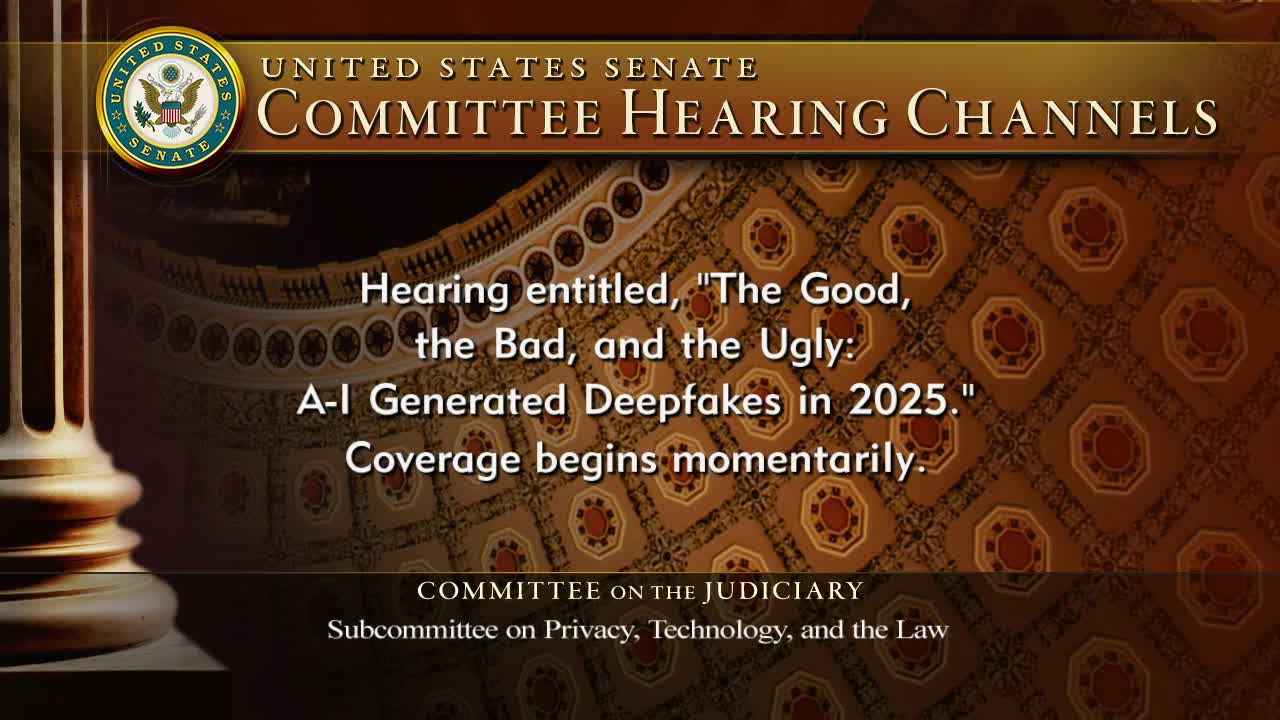
Summary
The Senate Judiciary subcommittee convened a hearing titled “The Good, the Bad, and the Ugly” to examine harms from AI-generated deepfakes and the proposed No Fakes Act (S.1367), with creators, industry and consumer advocates testifying about the bill’s potential to protect voices and likenesses.
The Senate Judiciary subcommittee convened a hearing titled “The Good, the Bad, and the Ugly” to examine harms from AI-generated deepfakes and the proposed No Fakes Act (S.1367), with creators, industry and consumer advocates testifying about the bill’s potential to protect voices and likenesses.
The hearing’s organizers said the bill would give individuals a civil remedy and a practical removal pathway for unauthorized digital replicas of voice and image, extending protections the Senate on Monday advanced in criminal takedown law. "It's frightening, and it's wrong," said Martina McBride, the country singer, describing how AI replicas could be used to harass, defraud or misrepresent artists.
Why it matters: witnesses and senators tied the issue to economic and safety impacts — from music industry revenues to scams and nonconsensual explicit content involving minors — and urged Congress to act before the technology and marketplace make harms harder to remedy. Several witnesses described a mix of policy, platform and enforcement steps as necessary: federal legislation that creates civil remedies; stronger agency resources to police scams; and platform mechanisms to identify and remove harmful content.
Testimony and evidence
Martina McBride, identified in her testimony as a Nashville singer-songwriter, described personal and industry harms if AI allows others to replicate artists’ voices and likenesses without consent. "The No Fakes Act would give each of us the ability to say when and how AI deepfakes of our voices and likenesses can be used," McBride testified, saying the bill would preserve protected uses such as news and parody.
Mitch Glazier, CEO and chairman of the Recording Industry Association of America, told senators the music industry and a broad set of stakeholders back the bill and said it was drafted to reduce litigation burdens on victims while giving practical tools for removal. "The No Fakes Act provides balanced, yet effective protections for all Americans, while supporting free speech, reducing litigation, and promoting the development of AI technology," Glazier said.
Kristen Price, senior legal counsel at the National Center on Sexual Exploitation (NCOSE), cataloged harms from nonconsensual sexual images and deepfake pornography, including long-term emotional and social effects on victims. She said the Take It Down Act — a criminal and platform-takedown law just signed by the President — is an important first step, but that civil remedies and complementary statutes are still needed. "The harms are severe and irreversible, so deterrence is essential," Price told the committee.
Justin Brookman, director of technology policy at Consumer Reports, emphasized scams and the scale of readily available cloning tools. He told senators the Federal Trade Commission and state attorneys general need more resources and technical capacity to pursue abusive services and recommended heightened developer obligations for tools likely to be abused. "The FTC only has, like, 1,200 people right now," Brookman said, arguing the agency lacks capacity to confront the wave of AI-driven scams.
Susanna Carlos, head of music policy at YouTube, described the platform’s existing tools and voluntary policies: Content ID for copyright claims, a privacy-notification pathway for individuals reporting unauthorized use of their voice or likeness, watermarking and participation in the Coalition for Content Provenance and Authenticity (C2PA). She said YouTube supports the No Fakes Act and will follow up with the committee to provide specifics about takedown processing times. "We have updated our privacy policies so that all individuals can now submit a notice to YouTube when their unauthorized voice or likeness has been used on our platform," Carlos said.
Senators’ concerns and exchanges
Senators pressed witnesses on enforcement, platform practices and the risk of inconsistent state laws. Chairwoman Blackburn and Ranking Member Klobuchar both framed the No Fakes Act as part of a suite of measures to protect children, creators and consumers, pointing to the newly enacted Take It Down Act as a related federal step. Several senators asked YouTube for specifics about how quickly notifications lead to removals and about monetization of content that teaches how to create nonconsensual material.
Senator Hawley asked whether YouTube had monetized how‑to videos that teach creation of pornographic deepfakes and pressed the company representative for data about removal timelines and ad revenue; Carlos said she would follow up with the committee. Committee leadership also noted members have five days to submit questions for the record and requested written responses to follow‑up items.
Policy implications and next steps
Witnesses and senators described the No Fakes Act as a civil‑law complement to criminal takedown rules: the Take It Down Act creates expedited removal obligations for platforms for certain criminally actionable content, while No Fakes would create a private right of action and clearer civil standards for unauthorized digital replicas of voice and likeness. Platforms and industry groups told senators they had negotiated provisions to balance free speech exemptions (parody, newsworthiness, commentary) with protections against fraud and exploitation.
Several witnesses urged Congress to act quickly to shape market incentives and technical standards before harms become entrenched; others urged more resources for enforcement agencies and better consumer education to reduce victimization.
Ending
The subcommittee concluded the hearing after receiving testimony and setting a written question deadline. Senators and witnesses left the record open for follow‑up answers and additional material. The hearing centered on S.1367, the No Fakes Act, as a legislative vehicle to give individuals — from major artists to ordinary users and children — clearer, enforceable tools against unauthorized AI replicas of voice and likeness.