Get Full Government Meeting Transcripts, Videos, & Alerts Forever!
Get email alerts on the Aipp Strategy Gcac topic
No spam. Unsubscribe anytime.
GCAC presents Art in Public Places strategy; commission and staff debate funding, maintenance, oversight
Summary
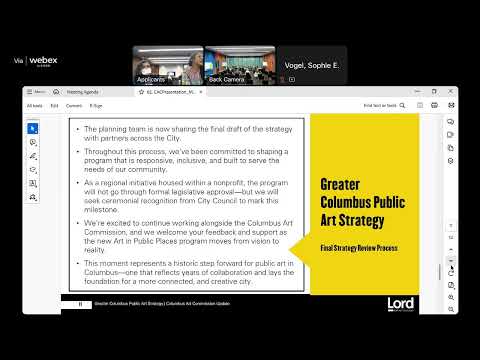
The Greater Columbus Arts Council presented a proposed Art in Public Places strategy to the Columbus City Art Commission, recommending GCAC lead a funded program with percent-for-art guidance, an advisory committee and project-selection teams.
The Greater Columbus Arts Council (GCAC) presented a proposed Art in Public Places (AIPP) strategy to the Columbus City Art Commission on June 18, outlining a plan for a GCAC-led regional public art program, dedicated funding, and an advisory committee to manage project selection and implementation.
GCAC presenters said the strategy recommends a restricted AIPP fund supported by public and private sources, including a recommended percent-for-art model that would set aside 0.5%–2.5% of eligible capital project budgets for public art. GCAC told the commission it has committed $500,000 annually for five years to launch the program and will pay the AIPP director’s salary from that funding.
"For a public art program to be successful, public funding is critical," a GCAC presenter said. The presentation noted that 82% of U.S. cities with public art programs use percent-for-art ordinances as a primary funding mechanism and that Ohio has had a state-level percent-for-art program since 1990, per the presenters’ materials.
City staff and commission members pressed for clarity on governance, maintenance and the itinerary of approvals. Sophie, a city planning staff member who administers the city’s public-art maintenance contract, outlined three key current responsibilities: staffing the commission, administering the public-art maintenance contract, and coordinating capital improvement planning and implementation as needed. Sophie said existing city maintenance coordination is handled through current planning division staff and that if the AIPP program expands, the city expects to evaluate and likely add a dedicated public-art staffer.
City planning staff reported the city’s current annual maintenance budget for the municipal public-art collection is $75,000, which covers contracts to assess and repair works in the city’s inventory. "We have an annual budget for public maintenance... this year is, I believe, $75,000," Mark Trevillis said during the meeting. GCAC presenters and city staff emphasized that maintenance responsibilities for artwork on City of Columbus property would remain with the city and its budgeting processes; GCAC funding was described as separate and intended primarily to seed new commissions and program staffing.
Commissioners raised questions about how AIPP projects would interact with the city’s existing public-art inventory and approval authority. GCAC presenters said the City Art Commission (CAC) would retain final approval for projects on city-owned property and that the AIPP program anticipates regular coordination: an annual plan developed by AIPP would outline priority projects and site approvals for CAC review. Project-specific selection teams formed by AIPP would include community members, artists and invited experts; GCAC said it seeks CAC participation on those teams.
Several commissioners expressed concern about the relationship between privately funded projects and the AIPP process. Commissioners noted the city cannot legally require private-property projects or privately funded developments to participate in AIPP; presenters said the strategy instead provides toolkits and guidance to encourage voluntary engagement and community buy-in.
GCAC’s staffing recommendations call for a GCAC-based AIPP director (funded by GCAC’s commitment) and for the City of Columbus to create a dedicated public-art staff position as the program grows. Sophie and planning staff said the city currently coordinates public art through existing planning personnel and would consider adding staff if project volume increases.
The strategy recommends an AIPP advisory committee under GCAC’s board for operational oversight and to help assemble project selection teams. Presenters said the advisory committee would have operational responsibilities in the program’s first six months, including finalizing mission language, review processes and a competency matrix for committee members.
GCAC presenters said the AIPP program aims to reduce funding restrictions that prevent mentorship and youth participation in public-art projects. Jamie Goldstein, who spoke after being sworn in, said GCAC currently cannot fund K–12 education programs under some city contract restrictions; GCAC intends the AIPP fund and program to permit artist education and youth mentorship as part of project work.
Presenters described a targeted launch timeline ("potentially in the fall") and said they will seek ceremonial recognition from City Hall while noting the regional nonprofit model does not require formal legislative approval. GCAC asked commissioners to continue the dialogue and participate in more detailed follow-up discussions during the coming month.
Commission business at the meeting also included officer appointments: commissioners nominated and the commission approved appointments for chair and vice chair for the commission’s leadership, with the motion carried by voice vote. Specific mover/second names and roll-call tallies were not recorded in the available transcript.
Commissioners asked for clearer language where the AIPP and CAC approval criteria intersect and for public-facing toolkits and talking points to help artists, developers and neighborhood stakeholders understand how to participate. GCAC and city staff said they will return with more detailed materials and said they plan one-on-one follow-up with commissioners before the program’s public launch.
The presentation prompted detailed policy questions, but no formal legislative action on percent-for-art or new city staff hiring occurred at the meeting; those items would require future decisions by the city council and/or budget authority.