
Witnesses urge caps, program-level accountability and accreditation reform to curb rising college costs
Get AI-powered insights, summaries, and transcripts
Subscribe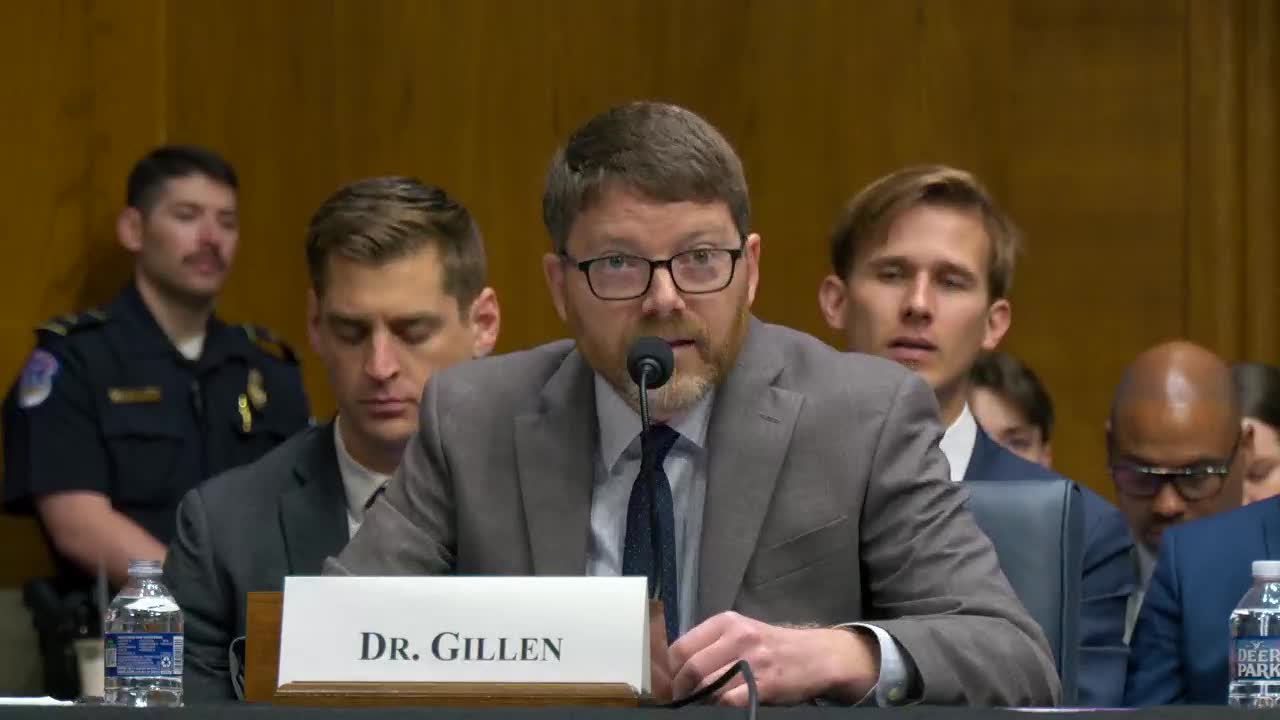
Summary
At a Senate HELP Committee hearing, a higher-education researcher urged caps on uncapped federal loans, program-level accountability tied to labor-market outcomes, and accreditation reform to spur competition and innovation.
Dr. Gillen, a researcher with an independent policy organization, told the Senate Committee on Health, Education, Labor, and Pensions that Congress should cap uncapped federal loan programs, base aid eligibility on a median cost measure and hold programs — not just institutions — accountable for graduates' labor-market outcomes.
Those changes, Gillen said, would blunt incentives that he and other witnesses said have helped push tuition higher while leaving too many students with degrees that do not pay off. "We can completely neuter that. We can sever that link, by using the median cost of college," Gillen told the committee when describing how a median-based aid benchmark would break the link between institutional price increases and higher federal aid.
Why it matters: Committee members opened the hearing by citing steep tuition growth and studies showing that a sizable share of degree programs deliver negative returns on investment, a concern witnesses tied to both student debt burdens and inefficient public spending.
Gillen recommended several policy changes that surfaced repeatedly in the hearing: capping certain federal loan programs (witnesses contrasted capped Pell and undergraduates loans with uncapped Parent PLUS and Graduate PLUS); using program-level accountability metrics such as repayment and employment outcomes; and pairing sticks (sanctions) with carrots (bonuses or regulatory relief) so high-performing programs face fewer accreditation burdens.
On accountability metrics, Gillen emphasized repayment measures and relative performance rather than fixed numerical cutoffs. "Repayment rates...actually makes the most sense. It's most logical accountability metric for student loans," he said. He also defended risk-sharing proposals in which institutions would absorb a portion of loan losses when former students default, saying those proposals would prevent institutions from "profiting from offering an education that leaves the student and the taxpayers worse off."
Witnesses also raised accreditation as a barrier to innovation. Gillen told senators accreditation currently "directs giant barriers to entry for new colleges" and forces institutions to use similar inputs and processes, suppressing new program models and competition. He urged reforms to focus accreditor attention on measurable student outcomes rather than prescriptive inputs.
Discussion vs. decision: The committee heard testimony and questions but took no formal votes or adopted policy. Senators and witnesses debated trade-offs — for example, how to protect access if Parent PLUS or Graduate PLUS loans are capped — and several panelists recommended alternatives such as expanding Pell eligibility or redirecting aid rather than eliminating it.
The committee requested further information and will accept questions for the record; witnesses said they stand ready to provide data and technical proposals for program-level metrics and risk-sharing formulas.