Get Full Government Meeting Transcripts, Videos, & Alerts Forever!
Get email alerts on the Infrastructure Water Wastewater topic
No spam. Unsubscribe anytime.
Casper officials ask council to advance three state loan applications for sewer and water projects
Summary
City staff described three State Revolving Fund (SRF) loan applications — for North Platte interceptor repairs, replacement of headworks screw pumps, and a drinking-water reservoir project — and asked the council to allow staff to proceed with formal approvals and supplemental funding requests.
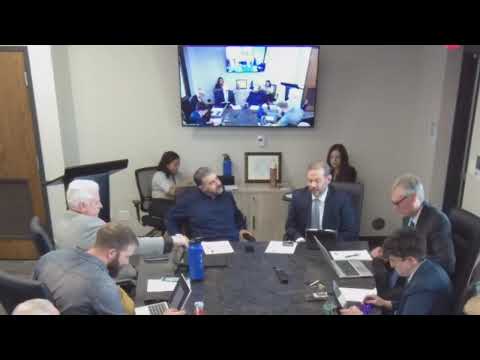
City of Casper staff on the council dais asked the Casper City Council to move forward with three State Revolving Fund (SRF) loan applications to pay for wastewater and drinking-water work, including repairs to the North Platte interceptor sewer, replacement of failed screw pumps at the wastewater treatment plant headworks and a plan to replace a leaking buried city reservoir.
Tom, city staff presenting the SRF proposals, told the council the SRF program is funded by the U.S. Environmental Protection Agency and administered through the state and that interest rates range from 0% (when projects meet federal requirements) up to 2.5% over a 20-year term. He said the state has in the past offered “principal forgiveness” — essentially grant funding that can reduce a loan by about 25% — but that new rules defining “disadvantaged communities” make that forgiveness harder for municipalities over 10,000 people.
The SRF requests described to the council were: a $2.8 million SRF loan request for lining the North Platte interceptor sewer (a project the presenter said combines SRF funds with earmarked funds from a state representative and $450,000 from another fund for an approximate $5.5 million project); an SRF loan request tied to replacement and refurbishment of the headworks screw pumps (Tom said the headworks work is an urgent project with a preliminary engineer’s range of $10 million to $15 million); and a $10 million drinking‑water SRF loan request to support replacement of a 10‑million‑gallon buried reservoir with two elevated tanks (a project with a total cost estimated at about $17 million, and a $5.6 million Wyoming Water Development Commission grant already awarded).
Tom described the technical need at the treatment plant: “the sewer comes in 18 feet below ground, and we need to get it about 25 feet above ground so that it can cascade through the treatment process,” and he warned that without working screw pumps “that whole treatment process cannot take place.” He said one screw pump has failed and another is struggling, and that the city will interview consultants to refine costs. On the interceptor sewer he cited a recent cave‑in and ongoing corrosion as reasons to line the pipe.
On cost and rate impacts, Tom said the interceptor loan, if extended over the chosen term, would incrementally affect customer bills and offered council an estimate for the average sewer bill effect. On loan structure he told the council the SRF allows construction draws so the city pays interest only on dollars drawn during construction, with the first full payment due one year after project completion. He said the city intends to keep pursuing principal forgiveness from the State Loan and Investment Board but prepared council for the possibility that the city will need to repay the full principal.
Tom also said staff will pursue a $2 million emergency mineral royalty grant (MRG) from the State Loan and Investment Board to reduce the portion of the headworks SRF loan the city must issue. He described the SRF program corpus in the state as approximately $180 million each for clean water and drinking water funds, and said that limited federal annual funding constrains how much principal forgiveness the state can offer each year.
Councilor Pat asked for clarification about the reservoir sizing and replacement plan; Pat said he read the plan as replacing the 10‑million‑gallon buried reservoir with two tanks of about 2 million to 3 million gallons each. Tom confirmed the master plan identified two side‑by‑side tanks of roughly 3 million gallons each and that staff would “look critically” at the size and could reduce each to 2 million gallons if engineering and standby power made that feasible.
Council members gave a nonbinding thumbs‑up to let staff proceed with formal SRF applications and related funding requests; Tom advised that the SRF loan items would appear on the formal council meeting agenda for approval later that night. Staff said they would return with formal documents for council action and with more precise cost estimates after consultant work is complete.
Ending: Staff will interview consultants and return to council with firm cost estimates and formal loan and grant documents. Tom said staff will continue to press the State Loan and Investment Board for any available principal forgiveness and will pursue the $2 million emergency mineral royalty grant; formal council approval of SRF loan documents was expected on the council meeting agenda later the same evening.