
Lawmakers increased health and human resources funding in 2025 budget; key Medicaid items remain contested
Get AI-powered insights, summaries, and transcripts
Subscribe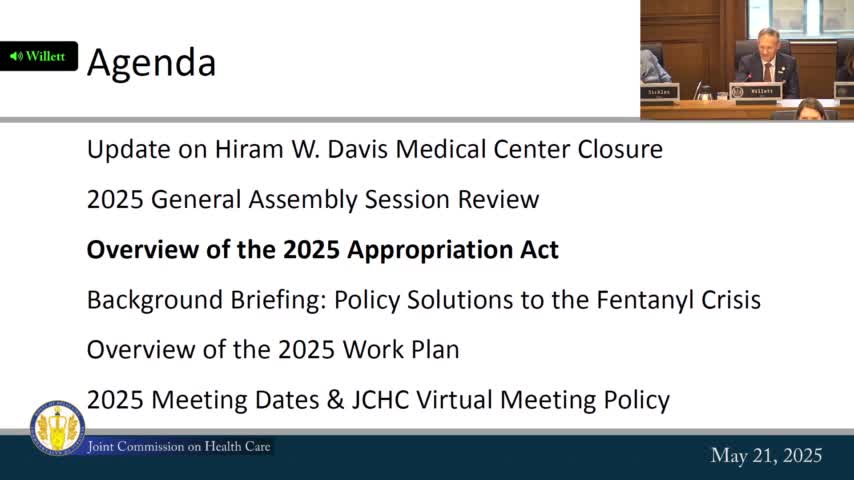
Summary
Senate Finance staff briefed the Joint Commission on Health Care on 2025 appropriation actions affecting health and human resources, highlighting large Medicaid forecast increases, investments in maternal and behavioral health, and items the governor signaled he would not execute.
Senate Finance staff gave the Joint Commission on Health Care an overview Thursday of major health and human resources actions in the 2025 amended budget, underscoring that HHR makes up approximately one‑third of the state operating budget and that most federal funding flows to Medicaid and related programs.
The briefing matters because the size and composition of HHR spending affects Medicaid enrollment, behavioral health services, long‑term care rates and other programs the commission studies; several newly appropriated items will influence the department and provider planning in the near term.
Mike Tweedy of Senate Finance told commissioners the amended budget (referred to in the briefing as “Chapter 7 25”) includes an approximate $869 million general‑fund increase for the biennium, with the Medicaid utilization and inflation/forecast component comprising the largest share. He said roughly $632 million of the increase is for the Medicaid forecast, and that when combined with prior amounts the forecast funding totals more than $1.3 billion over baseline.
Tweedy highlighted these budget actions discussed in the briefing: increases to Medicaid nursing facility rates, expanded Medicaid coverage for certain weight‑loss drugs and funding for substance‑use disorder services. He noted the governor publicly declared he would not execute two provisions — the nursing facility rate increase and the weight‑loss drug coverage — even though the General Assembly included them in the amended budget; as a result their implementation is in legal and operational limbo.
Other noted investments include funding for mobile maternal health clinics that was moved into Medicaid to secure the federal match, expanded coverage for continuous glucose monitoring, and targeted dollars for traumatic brain injury services, nursing‑facility rate adjustments, and improvements to substance‑use disorder programs. Tweedy said the budget includes about $6.7 million across agencies for maternal‑health initiatives and that certain items in the amended budget may be subject to legal review or executive non‑implementation depending on the governor’s actions.
On the Department of Behavioral Health and Developmental Services portfolio, Tweedy cited additional funding for the so‑called Marcus Alert/behavioral health co‑response expansions (to meet a 2028 statutory requirement), investments in developmental disability quality assurance related to the permanent injunction and funds for psychiatric hospital pharmaceutical costs and an adult psychiatric access line. He said the budget scales phased implementation of special‑conservator‑of‑the‑peace alternatives rather than going statewide immediately.
For social services and other programs, the briefing noted new investments for child protective services, foster care and adoption inflation, and funding to cover rising contract costs for income‑verification systems used in public‑benefit determination. The Department of Health received appropriations for a drinking‑water infrastructure grant program, a perinatal health hub pilot and increased compliance staff for drinking‑water regulation.
Tweedy also described the Commonwealth Health Reinsurance Program funding dynamics: large federal awards in recent years left a $20 million state base available for the next biennium if a state share is required; however, he cautioned federal action could change the program’s financial picture and the state exposure in future years.
Commissioners asked about vetoed items and how to interpret budget numbers. Tweedy advised that appropriations included in Chapter 7 25 are valid legislative actions, but the governor’s decision not to execute particular line items means those measures may not be implemented absent legal change or further action by the General Assembly. He added that vetoed appropriations that are not executed typically revert to the bottom line in the next budget process.
The briefing did not result in a commission vote; it was an informational presentation to inform staff and members about the fiscal environment in which future JCHC recommendations will be considered.