
Virginia officials outline closure plan for Hiram Davis Medical Center, cite infrastructure and patient moves
Get AI-powered insights, summaries, and transcripts
Subscribe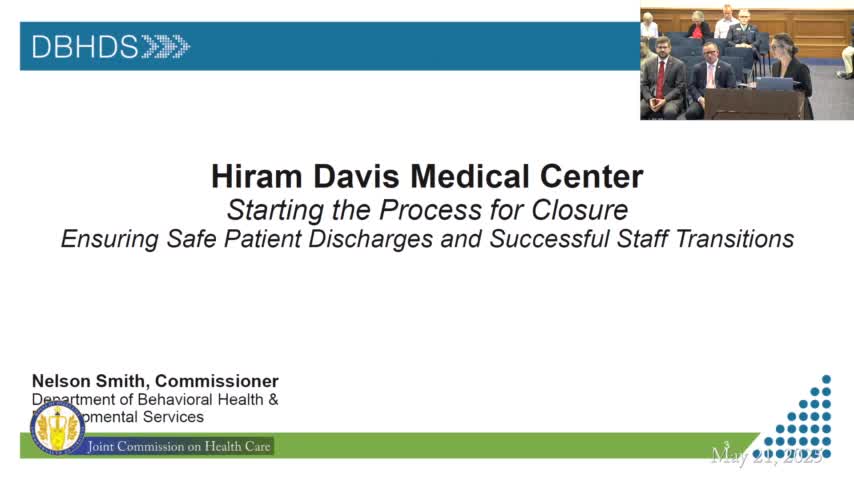
Summary
State health officials briefed the Joint Commission on Health Care on a planned closure of the 94‑bed Hiram Davis Medical Center, saying its aging infrastructure and infection risks prevent feasible renovation and describing a staged relocation plan and timeline that aims to avoid involuntary discharges.
The Joint Commission on Health Care heard an update Thursday from Commissioner Nelson Smith on plans to close Hiram Davis Medical Center, a 94‑bed state facility the department says has failing infrastructure and cannot be renovated without displacing residents.
The briefing matters because Hiram Davis serves multiple high‑need populations — people with developmental disabilities, residents with dementia and complex medical needs, and people with serious mental illness — and the closure will require individualized placement planning, regulatory steps to certify alternative beds and legislative review before the General Assembly and governor decide whether the plan moves forward.
Commissioner Nelson Smith told commissioners the facility is more than 50 years old, has antiquated systems and “open for system failure.” He said the building’s layout makes comprehensive renovation impractical because upgrades to buried plumbing and life‑safety systems would require displacing all residents for an extended construction period. “You’d have to change everything else in accordance with the current codes,” Nelson Smith said, adding a serious renovation would take at least two years.
Smith said the facility currently has 33 residents and that occupancy is down to roughly 35 percent because private providers and community options have expanded. He provided a current breakdown: 18 residents with intellectual disabilities, eight with mental health disorders and seven with dementia. Since the closure announcement, he said, 10 patients have been discharged and three additional discharges are planned by July, all individuals with developmental disabilities. He said no active, forced discharge process has begun and that “no steps are taken without their consent.”
State staff described a three‑subgroup planning process — supporting patients, supporting staff, and building community services — that includes DBHDS personnel, other agencies, parents, Hiram Davis staff and providers. Each subgroup’s plan is due August 1; staff will combine the subgroup plans into one comprehensive plan for the commission’s review. The combined plan is due to the commission, the money committees and the governor by Nov. 1, Nelson Smith said.
Agency officials also described how the Commonwealth plans to create or certify alternative skilled nursing beds. Smith said two homes at the Southeastern Virginia Training Center (SEVTC) could be renovated and certified as skilled nursing beds; permits are expected to be sought in November with certification by May 2026. He cautioned that adding nursing beds for people with developmental disabilities “is not considered integrated under the DOJ settlement agreement,” but noted Virginia code prevents discharging any Medicaid‑enrolled training center resident who chooses to remain.
Smith described transition options by clinical need: people with dementia are anticipated to move to mental‑health group homes or nursing facilities; those with serious mental illness and complex medical needs are likely to choose community nursing facilities; and many people with developmental disabilities may select waiver group homes, SEVTC options or an intermediate care facility, depending on preference and availability. He said subject‑matter experts indicate stabilization and rehabilitation options exist in the community, but that additional provider capacity and training may be needed.
Staffing and workforce considerations were a major focus. Smith said Hiram Davis employed 164 staff at the time of the closure announcement; 12 employees — about 7 percent of the workforce — have taken new positions since then. He said DBHDS is working to match staff to positions within a 50‑mile radius, including the new Central State Hospital expected to substantially complete construction in 2027, and plans to use retention bonuses and individualized career coaching to minimize layoffs. “Our goal is to have no layoffs,” he said.
Smith reiterated that the final decision on implementing any closure plan rests with the General Assembly and governor and that the department will solicit stakeholder feedback before forwarding a final plan for statutory review. He closed by restating a commitment to “work closely with families to transition their loved ones to a new setting that is safe, fulfilling and provides the supports that are needed.”
Commissioners asked about funding and timelines. Smith said the department has funds in the recent budget to begin renovations and expects an additional appropriation of $1,500,000 to support SEVTC renovations. He also warned that an emergency building failure could force an immediate evacuation and emergency placements, which would undercut deliberate planning.
Questions from commissioners emphasized family consent to moves, maintaining clinical services through Central State and SEVTC, and the need to avoid renovating more institutional beds than necessary while complying with the settlement and state law. The commission did not take formal action; staff expect to receive the planning team’s combined plan by Nov. 1 for review and potential recommendations to the General Assembly.