Get Full Government Meeting Transcripts, Videos, & Alerts Forever!
Get email alerts on the Airport Development topic
No spam. Unsubscribe anytime.
Gulf County board accepts FDOT airport design grant as debate continues over proposed White City airport
Summary
County commissioners voted to accept a state Department of Transportation grant and adopt a resolution to secure design funding for a proposed White City airport, while discussing airspace concerns raised by Tyndall Air Force Base, consultant findings on feasibility and scale, and public comments both for and against the project.
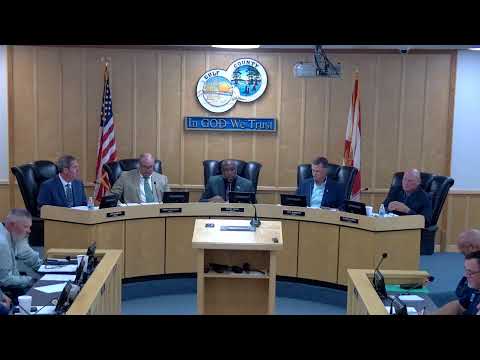
County commissioners on May 20 voted to accept a Florida Department of Transportation (FDOT) appropriation and adopt a resolution to secure state design funding for a proposed White City airport, while a longer public discussion centered on airspace, project scale and funding, and the need to consult with Tyndall Air Force Base.
The board voted to accept the FDOT grant agreement and to adopt a related resolution (motions were made and seconded during the meeting; the actions passed unanimously). The grant is described in meeting materials as an FDOT appropriation intended to support design work for the airport project; commissioners were told the appropriation must be accepted and encumbered now even if construction is years away.
Commissioners and members of the public spent the bulk of the meeting discussing a draft feasibility effort presented by CHA Consulting and public comments submitted or delivered at the meeting. Paul Puckley, an airport consultant with CHA Consulting, told commissioners the firm had completed an evaluation and believes an airport with an initial 5,000-foot runway — with potential to expand to about 6,500 feet later — could serve corporate activity and medevac needs in Gulf County. Puckley said the county’s local cash obligation would likely be small because federal Airport Improvement Program funding (AIP) could cover roughly 90 percent of construction costs if the project is added to FAA plans, and FDOT could provide additional support. He said the county would first need to secure inclusion in the Florida airport system plan and then the FAA’s National Plan of Integrated Airport Systems before AIP funding could be available.
Consultants and public speakers estimated a full buildout cost in the ballpark of $50 million and said that, if FAA funding were available, the county’s local match would be modest (consultants estimated roughly a 5 percent local share, with FDOT covering a portion of the nonfederal match). CHA representatives said the county would not be required to put significant local funding into the project up front and that donated land and private developer participation could count toward local matching requirements.
Airspace and military-operating-area issues were raised repeatedly. Commissioners and several speakers urged direct discussion with Tyndall Air Force Base. Commissioner remarks and public speakers noted the Air Force had submitted written concerns in the county’s meeting packet and that one-on-one meetings with Tyndall leadership were being scheduled. CHA consulting staff said they had prepared an airspace evaluation and believed the proposed airport could be structured to work within existing military operating areas (MOAs) and flight patterns, but they acknowledged Tyndall’s concurrence would be an important step before major federal funding decisions.
Members of the public testified on both sides. Supporters said a White City airport would bring high-paying jobs in aviation services, support medevac options, help tourism and second-home owners fly directly into the county, and expand economic development opportunities. Opponents raised concerns about noise, increased fighter training traffic already noticeable in some neighborhoods, lack of housing for incoming workers, and risk of duplicating services provided at nearby airports. Several speakers asked that the county not “get into a fight” with Tyndall and stressed the importance of coordinating with the base before moving forward.
Board members and consultants also discussed process milestones: CHA said FDOT had received a feasibility submission and was reviewing it; inclusion in the state system plan would precede FAA consideration; environmental review and permitting would be required; and, if approvals and funding aligned, a conservative earliest opening might be about five years. Commissioners emphasized that a meeting with Tyndall and further airspace coordination should happen soon, and some commissioners pressed for consultants to meet with base officials prior to additional one-on-one meetings between commissioners and the base.
Actions taken at the meeting included the board’s formal acceptance of an FDOT airport grant appropriation (motion made by Commissioner Macklemore; second by Commissioner Husband; motion passed 5–0) and adoption of a related resolution authorizing the chair to enter the necessary agreements. Commissioners said accepting the grant secures the state appropriation and allows further design and environmental work without committing the county to immediate construction.
The discussion made clear that the airport proposal remains at a feasibility and coordination stage: key next steps identified by commissioners and consultants include scheduled meetings with Tyndall leadership, completion of environmental assessments and design, state inclusion in the Florida airport system plan, and FAA review for AIP eligibility. Consultants underscored that FAA concurrence on airspace arrangements would be critical before major federal construction funding would be awarded.