Get Full Government Meeting Transcripts, Videos, & Alerts Forever!
Get email alerts on the Solid Waste Rates topic
No spam. Unsubscribe anytime.
Milwaukie council continues solid-waste rate discussion as consultant flags Metro disposal and fuel-credit impacts
Summary
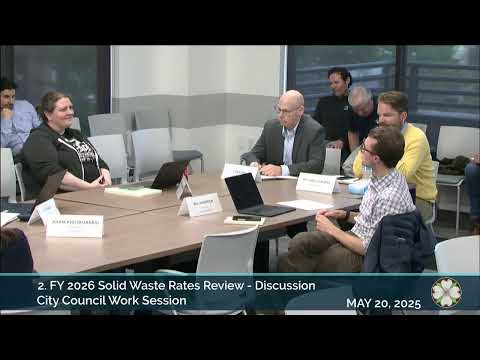
Milwaukie council members continued a detailed discussion on solid-waste franchise rates on May 20 after a presentation by consultant Chris Bell of Bell & Associates.
Milwaukie council members continued a detailed discussion on solid-waste franchise rates on May 20 after a presentation by consultant Chris Bell of Bell & Associates.
The question is consequential for residents because disposal and collection cost drivers identified by the consultant — Metro disposal fees, organics-processing costs and the end of a compressed natural gas (CNG) tax credit — are expected to raise franchise costs the city passes through to customers.
Chris Bell summarized franchise areas, customer counts and the principal cost drivers. He said Metro’s organic-disposal fee increased 6.9 percent and that the city’s disposal rate is now about $163.27 per ton. Bell said one significant new cost is the expiration of a CNG tax credit that had subsidized haulers that run compressed natural-gas trucks; that change produces an estimated added cost of about $74,000 to the city franchise pool. Bell also said labor-cost assumptions used for haulers were driven by an existing union contract and that overall the year’s disposal increase ended up lower than an initially proposed 9.98 percent — the figure used for budgeting discussions was lowered to about 5.58 percent after regional review. "This was the first in about 5 years where the cost of the disposal increase wasn't significant," Bell said.
Bell walked council through how the franchise rates are calculated: staff compare actual collection and disposal costs for the prior year to the current contracted rates, estimate the delta, and spread that difference across the customer base. He explained that commercial customers and high-weight users (for example, restaurants with food waste) can have different cost impacts because food-heavy loads weigh more, and that some commercial rates are effectively subsidized by the current allocation method.
Council members raised several concerns. Several asked that the city press Metro for more information and for mitigation steps — calling out a regional group that has pressed Metro to reexamine tipping fees and rate-setting. Council members suggested sending a letter or deputizing one or more councilors to speak at a Metro regional committee meeting; staff said Metro’s regional waste committee was meeting May 22 and that elected officials could attend by Zoom.
Councilors also debated two city programs that add to monthly bills: an organics/food-waste pickup program and a bulky-waste pickup program. Staff and the consultant said the marginal cost to the city of organics disposal is materially higher than yard-debris-only processing; councilors discussed utilization, equity and whether the city should pause organics until it can better estimate program participation. Several councilors asked staff to include specific survey questions in an upcoming resident-engagement effort to gauge use of organics and bulky-waste services.
On next steps, staff said they will place the proposed franchise rate adjustments into the city fee schedule for the June 3 council meeting so the schedule can be adopted on the usual timetable, but they will also add resident survey items and return with additional outreach results and possible amendments later if warranted. The council asked two councilors to consider attending the May 22 Metro meeting and to report back.
Quotes from the meeting included Bell’s explanation of how rates are calculated: "We take the current rate and the new rate, and we calculate what that additional cost is gonna be," and his observation about recent disposal cost trends: "This was the first in about 5 years where the cost of the disposal increase wasn't significant." Council members emphasized both the need to push Metro for clarity and the desire to seek resident input before finalizing program changes.
No final vote was recorded at the work session. Staff will bring the fee schedule with the proposed changes to the council for adoption and will return with survey results and any recommended amendments.