Get Full Government Meeting Transcripts, Videos, & Alerts Forever!
Get email alerts on the Downtown Development topic
No spam. Unsubscribe anytime.
Milwaukie, Metro Reopen Talks on Main‑and‑Harrison Lot, Emphasize Affordable housing and Public Space
Summary
City leaders and Metro’s transit‑oriented development team reopened planning for the Main and Harrison parking lot, urging preservation of community events and prioritizing affordable housing while Metro outlined tools, constraints and a multi‑year timeline.
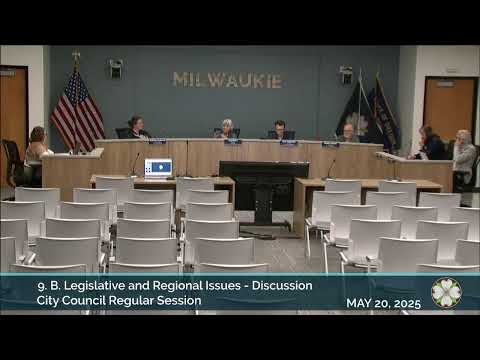
Milwaukie city staff and Metro’s transit‑oriented development (TOD) team resumed discussions on redevelopment of the city‑owned Main and Harrison parking lot, emphasizing affordable housing, active ground‑floor uses and keeping the site’s role as a downtown gathering place.
City officials told Metro the lot functions as the city’s “front door” and must continue to host community activities such as the farmers market, tree lighting and downtown events while also exploring options for affordable housing and parking. Metro staff described the agency’s TOD program, its investment tools and the precedent of multi‑phase projects in the region.
Assistant City Manager Joseph Brillio said the city and Metro met in January to reengage a decades‑old redevelopment effort, and that the city wants a “creative” outcome that balances competing priorities: affordable and market housing, commercial space, parking and public event space. Brillio noted the site’s configuration—about one acre total, with the city owning the eastern half and Metro owning the western half—and reminded council the site is in the city’s urban renewal area and next to Historic City Hall.
Erin Kihee, Metro urban policy and development manager, outlined TOD program tools and experience. She said Metro’s program uses three main levers: small grants, ground‑floor retail activation funds and direct acquisition of properties to leverage targeted development. “The TOD program makes catalytic investments to build climate‑friendly communities near transit that prioritize the needs of low‑income households and people of color,” Kihee said, summarizing Metro’s program mission and noting Metro has supported thousands of housing units and active commercial space in past projects.
City and Metro staff told council the parking lot is physically small but strategically significant. Council members pressed Metro on practical constraints: how to retain some parking, whether structured or underground parking is feasible, and how to preserve the lot’s event uses during and after development. Metro staff cautioned structured or below‑grade parking is costly—roughly tens of thousands of dollars per space—and that fitting all desired elements onto an acre will require design trade‑offs.
Councilors stressed they want deeply affordable housing, community space that can host the farmers market and other long‑running events, and a development that adds a “wow” element for visitors. Several councilors and public speakers asked Metro to prioritize developer partnerships that include space for local small businesses and market‑hall style retail. Metro acknowledged those priorities and said owning the site is the single most important lever the agencies can use to shape outcomes and that grant funds (up to Metro’s stated grant caps) might also be available to support affordable housing or innovation bonuses for climate or equity features.
Council members and Metro agreed on process points: more community engagement is needed before an RFP or formal solicitation; the city and Metro will continue technical work on parking, utilities and phasing; and any development timeline is likely measured in years rather than months. Council members asked staff to be mindful of competing workload priorities—several ongoing projects were identified as higher immediate staff priorities—and to pace public outreach accordingly.
Public comments during and after the presentation reinforced community concerns about preserving event space for the farmers market, preventing displacement of downtown activities and ensuring Parks and business groups are included in planning. Some speakers urged the city to delay formal solicitations until there is clearer community consensus and better data on parking demand.
City and Metro staff did not present a final plan or vote. Instead, staff said the next steps are further design and financial analysis, more outreach, and drafting an RFP that reflects council priorities. Council members suggested returning for an update later in the year and flagged the project as likely multi‑year in timeline.
If the city and Metro proceed with a solicitation later, council members said they expect the RFP to seek: (1) deeply affordable housing options, (2) active ground‑floor space for community uses and small businesses, and (3) creative parking solutions that do not swallow the public realm. Metro staff offered to brief council again and to begin outreach to potential developers and local partners.
The council did not approve any formal action tonight; staff will return with refined community engagement plans and technical analysis.