Get Full Government Meeting Transcripts, Videos, & Alerts Forever!
Get email alerts on the Public Safety Probation Supervision topic
No spam. Unsubscribe anytime.
Minnesota DOC outlines probation, supervised-release caseloads and local services for Beltrami County
Summary
A Minnesota Department of Corrections field-services representative summarized investigation and supervision workloads, local specialty programs and staffing dedicated to Beltrami County and answered commissioners’ questions about revocations, housing and a proposed FY26 lease payment to the county.
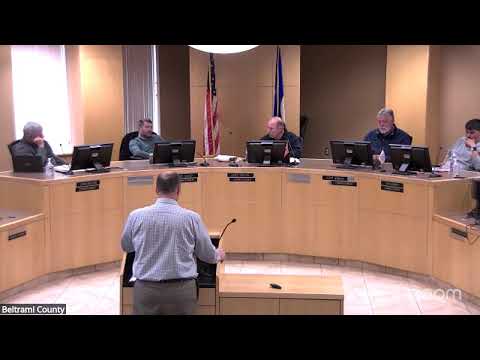
Trish Hansen, a representative of the Minnesota Department of Corrections’ Field Services Division, told the Beltrami County Board of Commissioners during a work session that her office handles both investigation work — including pre-sentence investigation reports and Minnesota sentencing-guidelines worksheets — and supervision work, which covers probation, supervised release and some pretrial domestic-violence supervision.
Hansen said the office compiles pre-sentence investigations (PSIs) and related worksheets that can take “roughly 6 to 8 hours” per report and that the office performs bail studies as directed by state court administration. “When we talk about investigations, it’s usually our pre sentence investigation reports,” she said.
The presentation emphasized caseload and outcomes data. Hansen said the office supervises about 1,000 individuals on a point-in-time basis and roughly 1,500 cases over the same period. “On average, we roughly have just a little over a thousand clients under supervision for that time period,” she said. She identified drug offenses as the largest category among adults, followed by domestic assaults and DWI, and noted juvenile cases are concentrated in assaults and disorderly conduct rather than drug-possession crimes.
Hansen described the department’s intensive supervised release (ISR) unit for the highest-risk individuals released from prison: “Those individuals are supervised by a team of agents that work 24/7 because those are our highest risk individuals coming out of a Minnesota Correctional Facility or prison.” She said ISR work generates a disproportionately high number of violation reports because of closer monitoring; for example, with a small ISR population the office still submitted many violation reports in a year when ISR headcounts were small.
She summarized outcomes for violations: the office submitted roughly 700–715 violation reports annually on a five-year average for the supervised population, with about three-quarters of violation reports on medium- or high-risk individuals. Of cases where violations were submitted, most are not revoked; in one year cited she said 72 cases were revoked while 490 were reinstated or restructured to allow continued supervision.
Hansen listed local collaborations and supports tied to supervision and reentry: the Dually Involved Youth Project (with the county attorney, Beltrami County Health and Human Services, Red Lake and Leech Lake child protection), local specialty courts (domestic violence court, DWI court, drug court), a housing grant with the HRA paired with enhanced supervision, and a $250,000-per-year DOC grant to the Northwest Indian Community Development Center for reentry services. She said the DOC leases housing in Beltrami County for ISR clients and that the state pays the county a lease that “as of fiscal year 26, it will actually be just above $72,000 a year.”
Staffing and budget figures provided by Hansen: about 1.3 supervisors, 17 agents and 4 support staff allocated to Beltrami County, and a proposed budget for the year “about $380,000 for the year minus the $72,000 I’m going to give you back for the lease.” She also noted the state supplies three of four vehicles, body armor, phones, IT and HR functions and assumes liability for employees’ actions.
Commissioners asked operational questions. Commissioner Carlson asked whether fewer PSIs meant less crime; Hansen replied that PSI counts reflect only sentenced cases and deferred to law enforcement for broader crime trends. Commissioner Winger raised family concerns about short jail stays for repeat arrests; Hansen said release decisions are made by judges and hearings units but offered to take family calls and explained that brief jail stays after arrest can occur when cases proceed quickly to court.
The department concluded by offering follow-up and more detailed briefings if commissioners want a deeper dive into the statistics or local programs.