Get Full Government Meeting Transcripts, Videos, & Alerts Forever!
Get email alerts on the Lake Placid Regional Plan And Utilities topic
No spam. Unsubscribe anytime.
Lake Placid reviews regional plan and $40 million sewer grant; workshop set to settle priorities
Summary
Town attorney Bert Harris summarized the Lake Placid Regional Plan and the town’s role as the regional utility and urged prioritizing hookups for existing residents under a $40 million DEP grant.
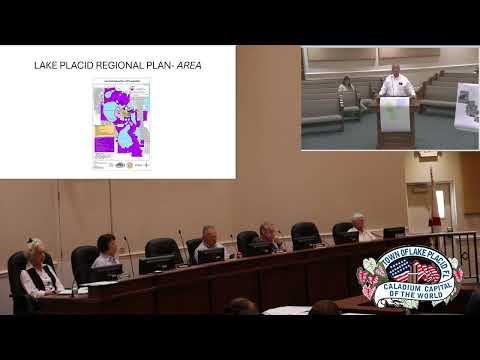
Town attorney Bert Harris summarized the Lake Placid Regional Plan and the town’s role as the regional utility on May 7, telling the Lake Placid Regional Planning and Utility Board that the $40 million grant from the Florida Department of Environmental Protection (DEP) was intended to serve existing residents and protect the lakes, not to subsidize new large-scale development.
Harris said the regional plan, adopted by both the town council and the county and incorporated into county code, sets density, signage, waterfront park and build-height standards for the Lake Placid planning area and was designed so county and town would apply the same development rules. “We got the 40,000,000,” Harris said, describing an amended DEP scope that funds the study work, the new advanced wastewater treatment plant and lines to consolidate and close older plants.
The attorney outlined operational details of the town’s utility consolidation: the town bought several small systems, plans to close older plants such as the County Road 29 and Tomoka facilities, and to treat wastewater at the new advanced plant. He said the grant originally envisioned serving 1,600 homes but cost increases after COVID forced an amended scope; the town is now seeking additional state and federal hookup grants.
Why it matters: the town’s decisions will shape who gets sewer service and whether the treatment plant’s finite capacity is preserved for current residents, targeted neighborhoods and lake-protection priorities or sold to new developers.
Harris urged the board to prioritize hookups for existing residents and lake-edge neighborhoods and to avoid selling substantial capacity to developers. He noted tradeoffs in line design (gravity vs. low-pressure systems), potential project costs and a recommendation that each line be evaluated on its technical and lifecycle costs. He also recommended a template for planned developments, continued work on undergrounding utilities and a clearer public checklist so developers can find standards in one place.
Public commenters pressed both sides. Pam Pinterest, who identified herself as a Lake Placid resident, said the regional plan has restrained economic growth and urged the town to decide whether it wants more development. “Do you want growth or not? Do you want to just hold something and wait 50, 70 years?” she asked. Charlotte Rodriguez, town administrator, urged a clear vision for policy and cited local economic metrics to underscore urgency, saying, “Without vision, the people perish.”
Board and staff discussion touched on technical and budget risks: the plant and distribution lines face higher construction costs than originally estimated; the town’s operating budget is limited; and major maintenance issues were flagged (staff reported a broken pump shaft at a Magnolia well that may require six figures to repair). Harris and staff recommended continuing grant applications for hookup funds, asking Highlands County to apply concurrently for DEP grants for county jurisdictions, and drafting clearer local policies for system development charges and annexation triggers.
Actions and next steps set at the meeting included scheduling a workshop to refine recommendations and policies and a joint meeting with the Local Planning Agency (LPA). The board set a workshop for May 21 at 9 a.m. and a joint LPA meeting for June 2 at 5:30 p.m. Staff will prepare maps, the interlocal agreement language, the amended DEP scope and supporting cost estimates for those sessions.
Harris and staff also noted existing authorities that constrain choices: the Lake Placid Regional Plan (adopted and codified in the county code), an interlocal agreement with Highlands County that transferred certain utilities to the town and committed the town to certain rate and service conditions, and DEP grant terms that shaped the scope of eligible hookup projects. Harris said the town waived a standard 25% out-of-town surcharge for certain acquired systems as part of those agreements.
Board members and commenters emphasized competing goals: protect lake water quality by replacing septic systems around the lakes, continue grant-seeking to pay for hookups, and balance the town’s stated development standards with economic opportunities that might emerge if some standards are relaxed. Staff warned grants typically do not cover ongoing operations and emphasized the need to define who will pay for operation, maintenance and future plant expansions.
The meeting closed with staff and the attorney promising more detailed cost and prioritization analyses at the May 21 workshop and the June 2 joint LPA session so the board can form a recommendation to the town council and to Highlands County.