Get Full Government Meeting Transcripts, Videos, & Alerts Forever!
Get email alerts on the Ranked Choice Voting topic
No spam. Unsubscribe anytime.
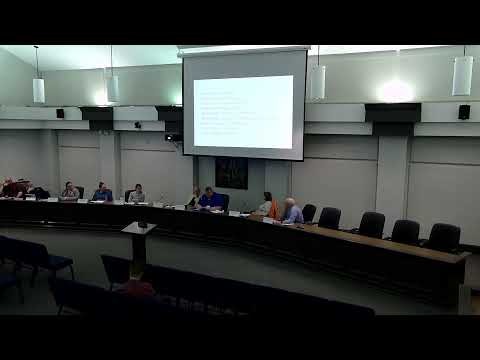
Charter review town hall draws large public debate over ranked-choice voting
Summary
The Stowe Charter Review Commission held extended public discussion on ranked-choice voting (instant-runoff), with dozens of residents expressing support and opposition; commissioners said they are collecting feedback and tracking a state bill that could withhold local funds if RCV is adopted.
At a City of Stowe Charter Review Commission town hall, ranked-choice voting (RCV), described in the meeting as an “instant runoff” process, drew the largest public turnout and the most sustained debate.
Commissioners explained RCV mechanics: voters rank candidates by preference and the candidate with the fewest first-choice votes is eliminated, with those ballots’ next choices redistributed in rounds until a candidate reaches a majority. Commissioner Dennis Riley said the subject “has had the most input from the community” and the commission is seeking additional feedback before drafting any charter language.
More than a dozen residents spoke for and against RCV. Supporters said RCV can reduce negative campaigning, let voters support third-party or independent candidates without “spoiling” outcomes and produce winners with broader majorities. Amy Cajka (4612 Muirwood Place) told the commission she supported placing RCV on the ballot and said it would encourage candidates “to reach out to other voters.” Angie Charles (3447 Saratoga Boulevard) said RCV could be important in a crowded mayoral race and would help ensure winners have majority support.
Opponents raised concerns about ballot exhaustion and complexity, potential tabulation delays, costs for new equipment or software, and opportunities for tactical voting. Dave Baumburner (378 Snowshoe Circle) argued RCV is “redundant” for a nonpartisan local election. Sam Gallioto (2120 Norton Road) said RCV “confuse[s] many voters” and claimed it can weaken transparency and accountability. Several speakers said schools of thought about sponsors and funding for national RCV campaigns warranted skepticism.
Legal and fiscal risks were discussed. A resident told the commission a state bill identified as “state bill 63” had passed the senate and, if enacted, could allow the state to withhold local government funds from municipalities that adopt RCV; commissioners said they were tracking the legislation and had asked the law director to provide updates. Commissioner Drew and other speakers also noted that some details—such as how ballots are counted, whether the board of elections would permit specific tabulation procedures, and local rules on ballot exhaustion—would depend on state and election-administration rules.
Speakers and commissioners emphasized voter education as crucial if the city pursues RCV. The commission said it had not drafted final language and that any amendment would require council review and, if approved by council, placement on the ballot and voter approval. The commission encouraged written feedback; two supportive emails were read into the record from Tim Shaw (3140 Berwyn Drive) and John Behringer.
No vote or formal recommendation on RCV was taken at the town hall; commissioners said they will continue to collect public input and consult legal staff about statutory and funding risks before deciding whether to draft a charter amendment to forward to council.