Get Full Government Meeting Transcripts, Videos, & Alerts Forever!
Get email alerts on the Public Safety Military Equipment topic
No spam. Unsubscribe anytime.
Pleasanton council accepts annual military-equipment report, debates armored rescue vehicle displays
Summary
The Pleasanton City Council unanimously accepted the police department’s 2024 military equipment use report and approved an ordinance adding replacement equipment, while residents and some council members debated whether the department’s armored rescue vehicle (ARV) should be displayed at community events such as National Night Out.
The Pleasanton City Council voted unanimously May 20 to accept the Pleasanton Police Department’s annual military equipment use report for 2024 and approve a first-reading ordinance amending the city’s military equipment policy to add a replacement robot.
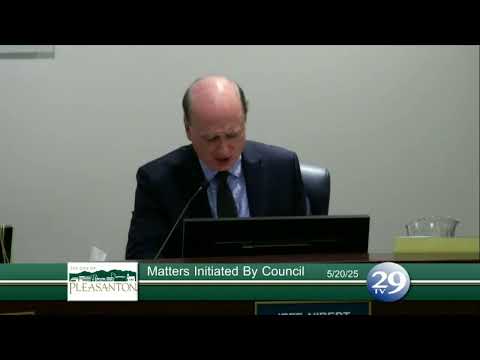
The action followed a presentation by Lieutenant Nicholas Albert of the Pleasanton Police Department, who said the department’s armored rescue vehicle “was utilized 1 time in that 2024 calendar year” in support of an East County Tactical Team arrest, and that allied agencies deployed unmanned aerial vehicles (UAVs) 14 times in the reporting period. Albert also told council the department is requesting replacement of a decade-old robot with a newer model; he said the replacement is funded through the department’s repair-and-replacement budget and “has no offensive or weaponized capability.”
The vote to accept the annual report and to introduce the ordinance came after more than an hour of public comment on whether the ARV and other listed equipment should be shown at public events. Speakers were sharply divided: some residents urged the city to prohibit public displays, arguing the ARV “normalizes” military hardware in community settings, while others asked to keep the vehicle available for educational displays and neighborhood events. Vicki LaBarge, a neighborhood captain, told the council she supports ARV and command-vehicle displays and asked the council to prohibit loaning the ARV to other cities for major community events.
Council members and staff clarified the current policy and prior direction. Police policy (policy 710) authorizes deployment of the ARV for high-risk incidents with supervisor authorization; community-event displays currently require approval by the chief of police. City Manager Jerry Thorne said a prior council majority had directed him and the chief not to authorize community-event displays, but the written policy still vests final discretion with the chief. City Attorney staff advised that formally changing who may authorize community displays would require an ordinance amendment brought back to council.
Council discussion focused on two related questions: whether the council should change the policy to remove chief-level authorization for community displays and whether the ARV should be deployed at specific events such as National Night Out. The council voted unanimously to adopt the staff-recommended items (accept the 2024 report and introduce the ordinance adding the replacement robot). Council members did not change the written policy that allows the chief to authorize community displays; members discussed but did not adopt any new ordinance limiting the vehicle’s appearance at community events. Several council members asked staff to return with a formal amendment if the council wishes to change the chief’s authority.
Public speakers who opposed community displays framed their views as a matter of civic safety and tone. John Bauer said the ARV “does not belong in Pleasanton” and urged the city to “get rid of the bat.” Other residents, including parents and neighborhood volunteers, described positive experiences with ARV displays at National Night Out and urged the council to allow educational access for children.
Staff and police leaders said the ARV is intended as a defensive, lifesaving tool for hostage, barricade or active-threat incidents and that officers receive training on its safe operation. Lieutenant Albert told the council each use is reviewed through the chain of command and there were no complaints reported during the 2024 period.
The council’s action leaves the policy language intact; if a future majority of the council wants to restrict community displays, staff said the change should be handled by ordinance and brought back for a future meeting.
Council actions on the item were unanimous at roll call.