Get Full Government Meeting Transcripts, Videos, & Alerts Forever!
Get email alerts on the Downtown Development topic
No spam. Unsubscribe anytime.
Temple Terrace CRA staff seeks flexibility for 8901 parcel, opens door to speculative development with public‑space incentives
Summary
Community development staff updated the CRA board on marketing and potential uses for downtown parcels—especially the 8901 piece—proposing greater openness to speculative development if projects include community value or public space components. Board members asked staff to bring proposals forward more quickly when they near execution.
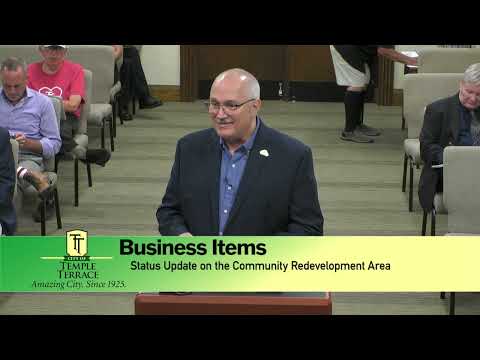
City Community Development staff on May 20 briefed the Temple Terrace Community Redevelopment Agency board on updated marketing guidance and possible development directions for CRA parcels in the downtown overlay area, with most discussion focusing on the property identified as the “8901 piece.”
Greg Pauley, community development staff, told the board he and the city’s broker (Florida ROI liaison John Lochner) have been asked to market the CRA properties with looser restrictions on speculative development, provided proposals meet parameters for end users and deliver overall community value. Pauley said staff has suggested allowing negotiating for a public space to be included alongside commercial development on the 8901 parcel.
Pauley explained options for subdividing the 8901 parcel, saying the property is physically possible to split north–south or east–west but that smaller narrow parcels could create parking constraints and leftover parcels with reduced marketability. He said the 8901 site is already subdivided into 13 small parcels that run to an interior road, and staff’s broker is primarily seeking a buyer who would take the whole piece, although staff will entertain proposals for portions if those proposals leave remaining parcels viable.
Pauley reviewed the downtown overlay district (DOD) permitted uses and the REOA agreement that imposes additional prohibitions within a portion of the area. He noted a general prohibition on drive‑throughs in the overlay but said the city has made exceptions in the past. Pauley presented a non‑exhaustive list of uses the CRA could consider adding for discussion at a future workshop—examples included hotels, bars and lounges, sporting activities with restaurant uses, and certain retail such as vape or specialty shops—but he stressed these ideas were not formal proposals and would require policy direction from the board and city council.
Board members asked procedural questions. Vice Mayor Schuster and other board members urged staff to call special meetings rather than wait until the CRA’s next quarterly meeting in August if viable proposals come in sooner. Councilmember Fernandez pressed staff to ensure that any proposed subdivision or sale leaves remaining parcels marketable and requested clearer guidance about when the CRA board and council would be asked to approve individual transactions. Pauley described the broker‑led initial intake process: potential buyers submit letters of interest to the broker; staff reviews viable proposals; once an application is sufficiently developed it receives public notice (30 days) and the CRA board considers a recommendation before the city council makes a final decision.
No formal action or vote was taken; the briefing was informational and staff was directed to continue marketing with the updated guidance and to request special meetings when near‑term proposals require board or council action.