Get Full Government Meeting Transcripts, Videos, & Alerts Forever!
Get email alerts on the Budget topic
No spam. Unsubscribe anytime.
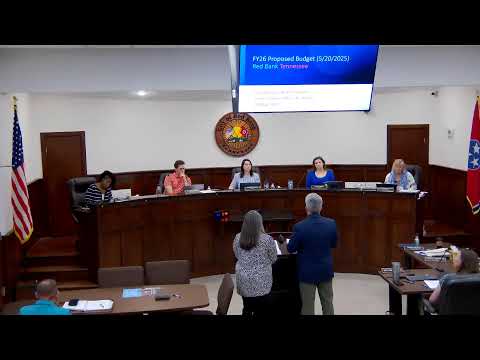
Red Bank holds first reading of FY26 budget; staff proposes 5% property-tax revenue increase, 2% COLA
Summary
At a May 20 work session the City of Red Bank presented the proposed FY26 budget, including a built-in 5% increase to property-tax revenue, a 2% cost-of-living adjustment for staff and targeted staffing and borrowing recommendations; the commission held a first reading and scheduled a second reading for June 3.
The City of Red Bank held the first reading of its proposed fiscal year 2026 budget during a May 20 work session, with City Manager Mark Grama and Chief Financial Officer Crystal Pickle presenting details to the commission and the public. The draft budget includes a 2% cost-of-living adjustment for staff and a proposal to increase property-tax revenue by 5 percent; a separate ordinance to set the tax rate will follow after Hamilton County’s reappraisal data is certified.
Why it matters: The reappraisal process underway in Hamilton County shows a median appraisal change of about 59.05 percent for Red Bank parcels, a figure city staff said will affect many taxpayers once the comptroller issues a certified tax rate. The budget’s revenue and spending choices will determine how much of that appraisal change is absorbed by rate-setting versus changes in local revenue and use of fund balance.
Grama opened the presentation, saying, “we are here to present to you the FY 26 proposed budget for the City of Red Bank, Tennessee.” Pickle and Grama walked commissioners through the budget packet posted on the city website and a calendar that sets the second reading for Tuesday, June 3.
The draft budget proposes targeted staffing changes and service funding: it would make permanent a detective position (described by staff at roughly $75,000), reclassify two administrative positions (one in community development and one in police administration), and convert a part-time parks and recreation program assistant to full time (approximately $18,500). Grama said the packet includes a jobs-by-grade exhibit and department memos explaining the work behind the numbers.
On services and operating items, the proposal would: 1) increase the property-tax revenue line from $5,250,000 to $5,512,500 (a 5% increase in revenue in the draft submission); 2) budget a $30,000 appropriation to sustain CARTA paratransit service; 3) set aside approximately $15,000 for on-call data-analyst services to support data-driven budgeting and capital planning; and 4) continue a tax-relief match for qualifying taxpayers (staff estimated the forgone revenue at about $25,718.64 in total).
Grama outlined the city’s proposed use of debt in public works, listing roughly $230,000 in the general fund for a pickup and tractor for streets, $110,000 for two pickups in the solid-waste division, and $900,000 for a dump truck with snow-removal attachments plus a significant paving effort on secondary streets.
Commissioners pressed staff on the decision to include a 5% built-in property-tax revenue increase. One commissioner said, “I do have a concern about the 5% baked in tax raise because it’s baked in based on inflation,” adding that the current inflation rate is 2.3 percent and proposing a lower number. Grama answered that the 5 percent reflects cumulative personnel-related COLA decisions over two years (3 percent in an earlier year plus 2 percent proposed now) and is meant to reduce reliance on a large one-time draw from fund balance. He said the previous budget estimate included an approximately $600,000 use of fund balance and that eliminating that use entirely would have required a larger immediate tax increase.
Staff and the manager framed the 5% proposal as a middle course: reduce one-time fund-balance use while spreading revenue changes over time pending growth in the tax base, conservative revenue estimates, and likely under-execution in some spending lines. The manager said the city expects to receive the comptroller’s certified tax rate in the coming months and noted that the commission must adopt the tax rate in a separate ordinance after that notification.
There was no final adoption at the work session; the commission held the first reading and scheduled the second reading for June 3. Grama emphasized that the budget packet and supporting documents — department memos, Q&A, jobs-by-grade and proposed use-of-debt exhibits — are posted on the city’s website for public review.
The presentation also reiterated commission priorities from a recent strategic planning retreat — including land-use updates, safe-streets improvements, economic development, parks plan implementation and low-cost activation of city property — and noted that several citizen advisory boards will assist staff in meeting those goals.
Next steps: The second reading of the FY26 budget ordinance (Ordinance No. 25-1281) is scheduled for June 3. The commission will adopt a property-tax rate only after the county reappraisal is certified and the comptroller issues a revenue-neutral certified tax rate (CTR).