Get Full Government Meeting Transcripts, Videos, & Alerts Forever!
Get email alerts on the State Department Reorganization topic
No spam. Unsubscribe anytime.
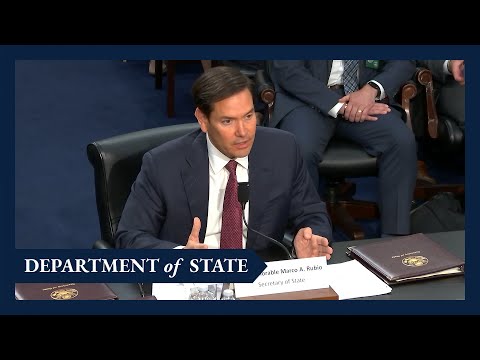
Secretary Rubio tells House committee foreign aid must serve U.S. national interest; proposes State Department reorganization
Summary
In testimony before a House committee, Secretary Rubio said the U.S. should reorganize the State Department to give regional bureaus and embassies more authority and integrate foreign assistance into a single strategy tied to U.S. interests, not withdraw from global engagement. He urged appropriators to work with the administration on the plan.
Secretary Rubio told a House committee that the United States must align foreign policy and foreign assistance with a clearly defined national interest and proposed reorganizing the State Department so regional bureaus and U.S. embassies can execute tailored strategies.
The proposal, delivered as testimony and accompanied by a written statement placed in the hearing record, would move to give regional bureaus a broader “toolbox” — including diplomacy, economic development and aid — so decisions are driven from embassies and regional offices rather than solely from Washington, Rubio said.
“Our foreign policy has to once again return to the national interest,” Secretary Rubio said. “What is good for America?” He added that the administration does not intend to withdraw from global engagement: “We are not withdrawing from the world, but we’re going to engage in the world and we’re going to conduct foreign aid and foreign assistance in a way that furthers the national interest.”
Rubio told members he reads “every single day” a bundle of dispatches from posts abroad and said the most useful ideas often come from embassies. “Every morning I get a book with 10 or 15 cables from our embassies around the world,” he said, arguing those posts are “literally the front lines of American diplomacy.”
He said past practice sometimes placed humanitarian and development assistance at odds with other diplomatic objectives and that the administration wants aid decisions to be coordinated with broader foreign-policy goals. “What we want is for our regional bureaus to have available to them aid, diplomacy, economic development, all of these different tools in the toolbox of statecraft,” Rubio said.
Rubio contrasted U.S. practice with how he said China uses foreign assistance. “All of their help is primarily loans, so they lend you money that you pay them back so you can hire Chinese companies to do work in their country with Chinese workers,” he said, adding that China leverages its assistance to secure economic and political advantages. Rubio said the United States should seek a clearer link between the help it provides and what the country receives in return, including diplomatic support in international organizations.
He acknowledged resource limits and the need to prioritize: “We don’t have unlimited resources,” he said, noting that the U.S. already spends more on humanitarian and development assistance than any other country but that spending should be tailored to a strategy that yields returns for the United States.
Rubio said the reorganization is not intended as a cost-saving exercise but to “deliver results in a better way” by empowering regional bureaus and embassies. He referenced past secretaries who privately favored bringing foreign assistance more closely under the State Department’s umbrella, citing Condoleezza Rice and Madeleine Albright.
A procedural interruption was addressed at the hearing when the chairman told the room that “disruptive demonstrations from audience are a violation of the House and will not be tolerated,” indicating the testimony proceeded under standard House hearing decorum.
Rubio asked members of Congress, particularly appropriators, to engage with the administration on the plan, saying budget language and congressional input will be necessary to implement changes. “I look forward to working with you, I have to work with you because you are the appropriators,” he said.