Get Full Government Meeting Transcripts, Videos, & Alerts Forever!
Get email alerts on the Property Taxes Budget topic
No spam. Unsubscribe anytime.
Residents press council on property-tax increases as Reedy Financial outlines SB1 budget impacts
Summary
Several residents told the Morgan County Council property taxes are “out of control” while Reedy Financial presented preliminary estimates of how Senate Bill 1 could reduce property tax revenue and shift revenue to income taxes; no formal budget decisions were taken at the meeting.
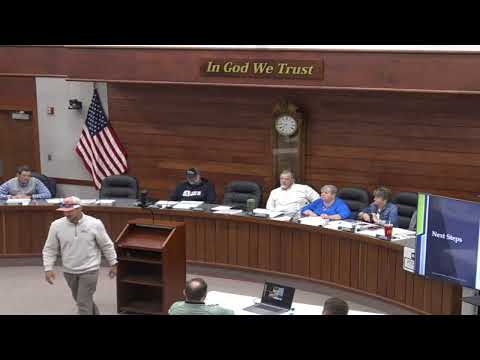
Residents urged the Morgan County Council on Wednesday to reconsider county spending and taxes as Reedy Financial presented preliminary, estimate-based impacts of Senate Bill 1 on county revenues.
During public comment, Rod Stafford told the council, “Our spending has grown to the point that it's out of control.” Larry Ralph and other residents said their property-tax bills have risen sharply and described anxiety among elderly homeowners. Mike Holloway, a local landlord, said rising property taxes had forced him to raise rents. “It's time to shut the checkbook, stop the spanton,” Holloway told the council.
Reedy Financial consultant Tyler prefaced his presentation by stressing the numbers were estimates: “I just wanna make clear all what we're presenting, It's all estimates right now. And it's it's not anything that the county has decided to do.” His firm reviewed how Senate Bill 1 restructures county income-tax rates, phases certain homestead and deduction credits, and changes which deductions apply to rental and non‑residential properties.
Tyler's slides projected a roughly $1.37 million reduction in property-tax revenue for 2026 under the new law compared with prior law, and showed net assessed values declining through the 2020s as state deductions phase in. The presentation also illustrated that, depending on county choices under SB1, the county could raise new income-tax rates (a county-level 1.2% option was shown in estimates) to offset some property-tax losses; Reedy Financial noted those choices are subject to state rules and municipal optioning.
Former county council member Brian Collier told the council the prior local income-tax structure had been used to lower property taxes and warned that HB1’s limits would restrict that tool: “We take 1% of our 2.72, the eighth highest income tax. We lower everyone's property tax with that. Under the new bill, you're only gonna be allowed to use 0.3.”
Council members and Reedy Financial staff discussed operational choices the county could make during the budget process, including reviewing capital plans, moving some salaries out of specific funds (for example, bridge or road funds), and using stabilization funds strategically. Reedy Financial's projections included a scenario that raised the county’s tax rate by about 15 cents by 2032 compared with the pre‑SB1 baseline, and estimated potential income-tax revenue if the county implemented the full new 1.2% county rate.
No formal budget rate changes or new taxes were adopted at the meeting. Council members said Reedy Financial's material would inform upcoming budget work sessions and form-one communications to department heads. The presenters and county staff said they would wait for further state guidance from the Department of Local Government Finance (DLGF) on some SB1 details before finalizing recommendations.