Get Full Government Meeting Transcripts, Videos, & Alerts Forever!
Get email alerts on the Interim Zoning Hb11 10 topic
No spam. Unsubscribe anytime.
Seattle committee advances interim zoning changes to meet state housing law, adopts tree and setback provisions
Summary
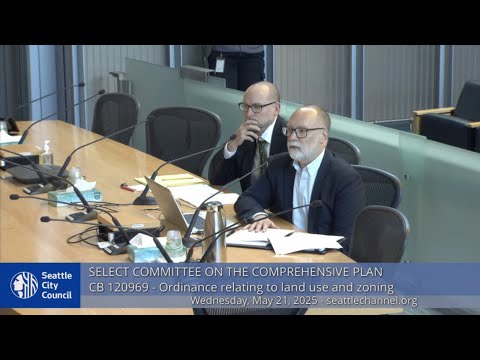
The select committee on the comprehensive plan voted unanimously May 21 to recommend passage of council bill 120969, interim zoning legislation intended to implement state House Bill 11‑10 and to add a work plan and protections for trees and certain historic boulevards.
Seattle — The select committee on the comprehensive plan voted unanimously May 21 to recommend passage of council bill 120969, interim zoning legislation the committee said is intended to bring the city into compliance with state House Bill 11‑10 and to set a work plan for permanent code changes.
Chair Joy Hollingsworth, chair of the Select Committee on the Comprehensive Plan, opened the session saying, “We are nearing the finish line of our interim legislation for house bill 11 10,” and the committee proceeded to consider eight amendments before forwarding the package to the full City Council for the May 27 meeting.
Why it matters: The interim bill and its amendments change how Seattle will regulate middle housing and accessory dwelling units (ADUs) in the near term to meet a state implementation deadline of June 30, 2025. The committee adopted technical clarifications, protections for certain trees and historic boulevards, and a council work plan that lays out issues to be resolved in permanent legislation.
Most important decisions
- The committee recommended passage of council bill 120969 as amended by a series of votes (final committee roll call: 9 in favor, none opposed). The committee’s recommendation will go to full council on May 27, 2025.
- Amendment 1 reconciled the interim bill with earlier ADU code changes enacted by the council in council bill 120949 and updated legislative findings. Council member Solomon, sponsor of the amendment, said the change “responds to the ADU legislation that we passed earlier this year,” which the amendment was intended to align with state law on ADUs enacted in 2023.
- Amendment 2 added a work plan for the permanent legislation, including items to consider such as adjustments to setbacks and amenity area regulations, tree retention language, buffers along major thoroughfares, support for diverse housing near public amenities, and possible modification of off‑street parking requirements.
- Amendment 3 kept a lower lot coverage cap for single‑family proposals (35 percent), while maintaining higher coverage allowances intended for middle‑housing development types.
- Amendment 4 created an exception for lots abutting Queen Anne Boulevard Park, retaining the current 20‑foot front yard requirement for those lots. Sponsor Council member Kettle described Queen Anne Boulevard Park as a nearly 4‑mile historic boulevard with views and park‑like character, and multiple committee members supported the exception as a technical protection for that public amenity.
- Amendment 5 restored a minimum single‑building floor area standard of 2,500 square feet for small lots that the committee said had been unintentionally removed in the version sent by the executive office.
- Amendment 6 combined numerous technical clarifications about how density rules apply, clarified rounding rules, confirmed that the effective date for the HB 11‑10 provisions is June 30, 2025, and restored language to ensure density limits apply only to certain housing types in specified zones (a drafting error had left the clause ambiguous).
- Amendment 7 asked the Seattle Department of Construction & Inspections (SDCI) to report on work at the Washington State Building Code Council about which housing types remain subject to the state building code versus the state residential code, and to provide a city work program for implementing any state changes. The sponsor said the goal is to inform whether more middle‑housing types could be built under the (typically less costly) residential code.
- Amendment 8 adopted portions of the Washington State Department of Commerce’s model ordinance on yard requirements: where the model specifies different front‑yard depths by structure size, the amendment applies 15‑foot front yards for one‑ and two‑unit structures and 10‑foot front yards for structures with more units, while preserving the Queen Anne Boulevard exception described above.
Supporting details and technical points
- Effective date: The committee clarified that the HB 11‑10 provisions in the interim ordinance become effective June 30, 2025, to align with the state implementation timeline.
- ADUs and state law: Committee discussion tied council Bill 120949 (ADU changes enacted earlier) and the interim ordinance to state ADU requirements passed in 2023; sponsors said the interim bill must be consistent with those prior changes.
- Trees and setbacks: Multiple members pressed for explicit tree‑retention language. Council member Rivera succeeded in adding the phrase to the work plan to “support retention of existing trees during development,” and supporters of Amendment 8 framed the model yard standards as a compromise that preserves more space for trees than some other options.
- Lot coverage and FAR: Amendment 3 retained a 35 percent lot coverage maximum when a single‑family home is proposed on a lot, while the broader code updates for middle housing anticipate higher coverage (50 percent in some provisions) to encourage more units. Committee members noted a separate change increasing a baseline FAR from 0.5 to 0.6 in some draft language; the restoration of the 2,500 square‑foot minimum on small lots was intended to avoid unintended shrinkage of buildable unit sizes on narrow lots.
- Density and housing types: The committee adopted clarifying language that, in low‑rise zones, density limits should not be read to apply to apartment‑style (stacked) buildings and that the code text should make the practical allowance for 4‑ or 6‑unit middle‑housing configurations where permitted by HB 11‑10. Members asked that the permanent legislation include clearer definitions of housing types (for example, “stacked flats”).
Votes and formal actions
- The committee recorded roll‑call votes for each amendment; recorded tallies were included in the official minutes. Most amendments passed with unanimous or near‑unanimous support; a handful of technical amendments produced a small number of abstentions on procedural or clarity grounds. The committee’s formal recommendation that council bill 120969 pass as amended will be placed on the full council agenda for May 27, 2025.
What comes next
The select committee and central staff will move to phase‑1 work on the permanent comprehensive‑plan legislation. The interim ordinance and its work plan identify topics for deeper review — including tree retention strategies, setback and amenity‑area rules, parking requirements, and definitions of middle housing — that the committee said it will take up in the coming weeks. The committee also asked SDCI to report on state building code review work so the city can assess whether regulatory changes could improve the financial feasibility of middle‑housing projects.
Reporting note: Public comment for the next select‑committee briefing on June 5 will be accepted in writing only, per the chair. The ordinance language adopted by the committee as amended and the roll‑call vote tallies will be available in the record submitted to the full council.