Get Full Government Meeting Transcripts, Videos, & Alerts Forever!
Get email alerts on the Comprehensive Planning Housing topic
No spam. Unsubscribe anytime.
Planning commission holds second review of comprehensive plan vision and housing element; commissioners press for clarity on tools and protections
Summary
The planning commission conducted a second review of the comprehensive plan’s introduction and housing element; staff and consultants outlined additions requested by council and commissioners sought clearer language on tools, manufactured‑home protections and neighborhood character.
The planning commission conducted a second review of the comprehensive plan’s Chapter 1 (vision and introduction) and Chapter 3 (housing). Tom (planning staff) and consultant Matt Covert of FASET briefed commissioners on council comments and draft revisions; commissioners debated policy wording, protections for manufactured home parks, cottage‑housing language and how specific action items should be.
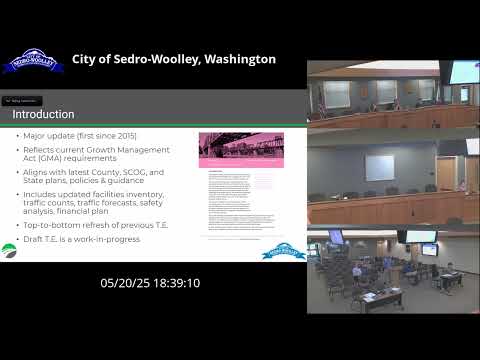
Matt Covert, a consultant with FASET, told the commission that council requested two additions to the introduction: a short public‑engagement summary and a call‑out box showing population projections and housing allocations. “Those are the only two additional things that weren’t in the draft the council saw,” Covert said; staff said the items will be added in a later draft.
Why it matters: the housing element contains policies and action items that shape zoning, incentives and future code changes. Commissioners and council members repeatedly urged care in listing specific implementation tools in the comprehensive plan because overly prescriptive action items can constrain future code options or create expectations before staff and council have vetted details.
Manufactured home parks: council members asked staff to explore measures to protect existing manufactured home parks as sources of naturally occurring affordable housing. Staff said the plan currently proposes examining an overlay or district and adding “right‑of‑first‑refusal” style tools and other supports (for example grant assistance or helping residents form a purchase application) to help residents purchase the land beneath parks. Commissioners discussed the range of tools, including moratoria and overlay districts; staff noted one example from Bellingham, which paired an overlay with a moratorium in its own planning work.
Cottage clusters, ADUs and design review: council asked staff to avoid language that would be read as an immediate commitment to a specific code change before council’s policy direction is final. The commission flagged language on cottage clusters and requested that multi‑family‑in‑single‑family neighborhoods be framed to preserve neighborhood character while allowing small‑scale multi‑unit housing where appropriate. Commissioners raised concerns about how design review should be applied going forward: staff said the intent is to keep review administrative (by staff) while the standards themselves should be developed with public input, and the draft language will be clarified to reflect that distinction.
Neighborhood character and terminology: commissioners recommended replacing the phrase “social characteristics” with “neighborhood character” to avoid ambiguity and to be consistent across elements. Several commissioners also suggested using more inclusive, modern terminology — for example, “household” rather than “family” — where the code or plan is not meant to exclude other household types.
Action items vs. policies: multiple commissioners questioned whether some action items are redundant with policies or too prescriptive for a policy document. Staff and the consultant said the intent is for the actions to give staff direction and flags for future code work, not to lock the city into a single technical tool. Commissioners asked staff to consider grouping or clarifying actions so the plan can support future code amendments without requiring immediate, specific program adoption.
Other edits and technical fixes: commissioners identified typographical and clarity edits (for example correcting “modern” vs “modem” in the library description) and asked staff to reconcile references to incentives such as MFTE where council indicated it did not want MFTE included as an incentive. Commissioners also asked staff to ensure policies referencing zones (for example cottage clusters permitted in specified residential zones) match the code.
Discussion vs. decisions: this meeting served as a second review and policy discussion; no formal adoption took place. Staff will revise language to: add the introduction callouts, clarify concurrency and implementation language, adjust ambiguous terms (such as neighborhood character), and return the housing element for further review. The cottage‑housing ordinance and any code amendments remain subject to future council direction and formal code‑amendment processes.
Next steps: staff will bring the revised chapters back for a second read with clarified policy/action wording and will coordinate scheduling for council review of specific code proposals such as the cottage‑housing ordinance.