Get Full Government Meeting Transcripts, Videos, & Alerts Forever!
Get email alerts on the Transportation topic
No spam. Unsubscribe anytime.
Sedro-Woolley planning commission reviews major update to transportation element
Summary
Sedro‑Woolley public works director Bill Bullock gave the planning commission a first reading of Chapter 4, the transportation element, describing updates that add pedestrian and bicycle facilities to concurrency, expand traffic modeling and run a 20‑year financial forecast.
Sedro-Woolley public works director Bill Bullock gave the planning commission a first reading of Chapter 4, the transportation element of the city’s comprehensive plan, explaining updates to traffic modeling, safety analysis, inventory methods and a 20‑year financial forecast for transportation projects.
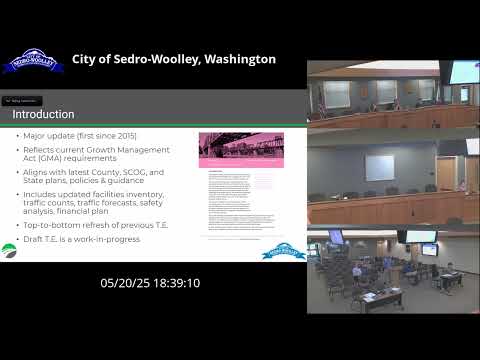
Bullock said the update responds to recent Growth Management Act (GMA) language that requires cities to include “active transportation” — pedestrian and bicycle facilities and connectivity — in concurrency management, not just vehicle level-of-service. “This transportation element is a major update,” Bullock told the commission, summarizing the scope as an inventory of sidewalks and streets, traffic forecasting, safety analysis, and a financial plan that covers the six-year Transportation Improvement Program and a 20-year forecast.
The draft element uses 15 years of annual traffic counts as the baseline for forecasting and identifies near-term intersections that are approaching unacceptable congestion. Bullock said Metcalfe Street at Highway 20, Reed Street at Highway 20, and Township and John Liner Road on SR 9 are approaching level‑of‑service E in short-range forecasts, while the Cook Road/Trail Road intersection is currently operating at roughly level‑of‑service D. He noted construction of the McGargle/SR 9 roundabout is scheduled to begin May 15 and is expected to mitigate one of those locations.
Why it matters: the update changes how Sedro‑Woolley assesses concurrency and developer impacts. Bullock emphasized that the new GMA component requires pedestrian and bicycle facilities be considered in concurrency and shift some mitigation expectations from single‑occupancy vehicle metrics to multimodal performance.
The presentation covered existing system inventory (including federally defined functional classification and freight routes), travel demand modeling methods, and safety analysis. Bullock described the city’s counting equipment and methods: two double‑tube classification counters for spot counts that capture vehicle class, speeds and hourly profiles and that allow staff to estimate truck percentages and annual tonnage on measured roadways.
On safety, Bullock said the city’s collision rates are low compared with “high accident” thresholds used in standard analysis, though staff have identified about 10 serious or fatal collisions in the past four years. He said the roundabout at SR 9 and McGargle should substantially reduce crash risk at that location.
Commissioners pressed staff on several policy specifics. One commissioner asked how long an intersection may remain at an unacceptable level of service before improvements are required. Bullock explained that Washington State Department of Transportation intersections are exempt from mandatory improvements when they hit level‑of‑service E, but cities often fund mitigation that affects local operations. He also previewed a proposed shift in concurrency policy intended to apportion developer contributions more equitably: treating level‑of‑service D as the mitigation threshold and assigning proportional “fair share” contributions for developers who trigger a known portion of the pipeline cost, rather than holding the last developer financially responsible for a large signal or intersection improvement.
Bullock said the next steps are to revise goals and policies (about 10–20% need tweaks), finalize the active transportation concurrency language, calibrate the travel demand forecast for 10‑ and 20‑year horizons, and bring the chapter back for a second hearing after more modeling and regional coordination with SCOG (Skagit Council of Governments) and Skagit Transit. He recommended waiting roughly three years after the John Liner arterial is open to re‑study traffic patterns before adjusting long‑range projects tied to that corridor.
Discussion vs. decisions: the presentation was a first reading and discussion; no formal action was taken. Commissioners directed staff to return with a second draft addressing concurrency language, the active‑transportation component, and clarified policy language on developer fair‑share mitigation.
Background and context: the draft references coordination with Skagit Transit for transit planning, SCOG for regional compliance checks, and freight reporting to federal programs that can influence pavement and freight funding. Bullock said the draft will include a facilities inventory and an updated functional classification tailored to federal and state funding eligibility.
Next steps: staff will revise the chapter, add the active transportation/concurrency language, and return for the commission’s second review before forwarding the chapter to city council.