Get Full Government Meeting Transcripts, Videos, & Alerts Forever!
Get email alerts on the Nonconforming Lots topic
No spam. Unsubscribe anytime.
Planning board endorses easing rules for substandard residential lots to encourage infill
Summary
The board unanimously recommended that the City Commission approve ordinance 19-20-25 to simplify development of legally recorded single-family lots that do not meet current lot-area or width standards, reducing the number of variances required.
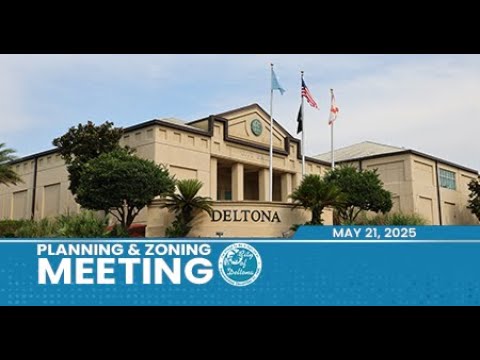
The Deltona Planning and Zoning Board unanimously recommended the City Commission approve ordinance number 19-20-25 on May 21, a code amendment designed to ease development of legally recorded single-family lots that do not meet current minimum lot-area or lot-width requirements.
Matthew West, the city's planning manager, said the ordinance reduces the need for owners of substandard lots to seek multiple variances when a house can be sited to meet setbacks and other dimensional standards. "This ordinance intends to update the land development code regarding the development of residential nonconforming lots," West said. He noted the change would not relax other zoning requirements such as setbacks, maximum impervious surface or building height.
West explained how lots become nonconforming: municipal incorporation, later adoption of the city's land-development code and differing county standards left some preexisting lots below current size thresholds. He apologized to the board for an inaccurate map in the staff report and said staff would clarify the exact number of truly nonconforming lots; the full parcel count shown in the report includes all vacant residential lots citywide and overstates the number that are nonconforming.
He described administrative relief and cost savings for property owners: the current process typically requires two variance applications (each with a $400 application fee), plus additional staff time; the ordinance would remove the need for those separate variances when the lot qualifies as a single-family lot of record and other dimensional standards can be met.
Board members sought practical clarifications: Member Stewart asked whether modular or manufactured homes would be allowed under the change; staff replied that modular homes are permitted only in mobile-home zoning districts and the ordinance would not change that requirement. Member Wernicke confirmed the smallest single-family dwelling size in the city's code is 1,200 square feet in R-1 zoning; staff confirmed that minimums and other development standards remain in force unless a variance is requested.
Member Northey moved, and a second was recorded, that the board recommend commission approval of ordinance 19-20-25. With no public comment at the P&Z hearing, the board voted unanimously to forward the recommendation to the City Commission.
If the commission adopts the ordinance, property owners of qualifying lots should face a simpler administrative path to build single-family homes on legally recorded substandard lots, provided the proposed house meets setbacks and other zoning dimensional standards. Staff said it will confirm the precise number of nonconforming lots and noted that lots unable to meet minimum house-size or setback requirements would still need to pursue variances.