Get Full Government Meeting Transcripts, Videos, & Alerts Forever!
Get email alerts on the Zoning Consolidation topic
No spam. Unsubscribe anytime.
Planning commission discusses consolidating zoning districts, simplified zoning presentation planned for June workshop
Summary
Commissioners reviewed a proposed consolidation of Columbia Borough’s zoning districts aligned with the future land use map, discussed effects on short‑term rentals and other uses, and agreed to invite a county planning presenter to the June 17 workshop to explain a simplified zoning approach.
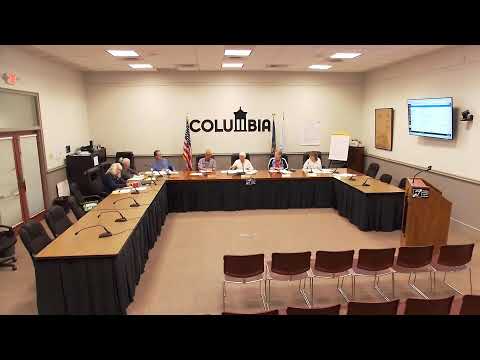
At a May 21 workshop, the Columbia Borough Planning Commission discussed a proposed consolidation of zoning districts drawn from the borough’s comprehensive‑plan future land‑use map and agreed to schedule a presentation on a county planning “simplified zoning” model for the June 17 work session.
Planning staff described a proposal to reduce the borough’s existing district structure to roughly eight districts. The plan would combine several existing categories — for example, downtown commercial, riverfront commercial, medium‑density residential and neighborhood commercial — into a single “downtown mixed‑use” district. Light business, light industrial and general industrial would be combined into a more narrowly defined industrial area; some districts such as LV were noted as not proposed for combination.
Staff said the proposed downtown mixed‑use consolidation could expand the number of areas where short‑term rentals (STRs) are permitted because STRs are currently allowed in the medium‑density residential business district. Commissioners stressed that any expansion would still require properties to meet STR criteria in the ordinance. Several members expressed reservations about combining short‑term and long‑term rental rules into a single ordinance, noting the two uses present different regulatory and staffing needs.
Commissioners also reviewed a county planning document Heather had shared that focuses zoning on permitted impacts (traffic, noise, pedestrian activity) rather than enumerated uses. Several members praised the clarity of the mapping and district categories but raised concerns that an impact‑based approach could be excessively subjective — for example, how to define “moderate” noise or traffic impact for different locations and times of day. Member Evans asked how an applicant would present such subjective impact measures to a zoning hearing board.
Staff proposed, and the commission agreed, to invite a county planning representative to the June 17 workshop to give a presentation on simplified zoning. Commission chairperson Wickenheiser asked staff to prepare a recommendation for the borough zoning map and future land use map changes so the commission can decide whether to forward a recommendation to council.
Other directions from the workshop included staff follow‑up: Paul was asked to coordinate with Jessica on accessory dwelling unit (ADU) materials so the commission does not “lose” that item in future agendas. The commission also agreed to consider making some items actionable on the same evening as discussion to avoid losing follow‑up items between work sessions and formal meetings.
No formal vote was taken on map consolidation at the workshop; staff will prepare materials for a future meeting for the commission’s review.