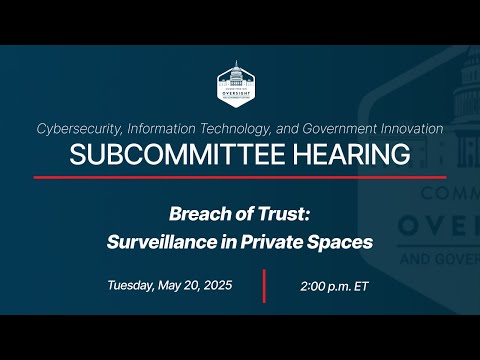
Subcommittee hearing spotlights hidden-camera abuses; chairwoman, experts press Congress for federal law
Get AI-powered insights, summaries, and transcripts
SubscribeSummary
Chairwoman Mace, chairwoman of the Subcommittee on Cybersecurity, Information Technology, and Government Innovation, told a congressional hearing that she discovered hidden camera footage of herself and other women and urged passage of two bills to create new civil and criminal remedies.
"Liberty begins with the right to close a door," Chairwoman Mace said in her opening statement. "I speak not just as a lawmaker, but as a survivor." She told the panel she discovered on 2023-11-05 that a former fiancé, identified in her remarks as Patrick Bryant, had filmed women without their knowledge or consent and that one recording device contained "10,633 videos just on this one recording device." Mace said South Carolina law treats many such voyeurism offenses as misdemeanors carrying a maximum $500 fine.
The hearing brought three witnesses: Joseph LaSorsa, founder and president of LaSorsa and Associates; Laura Chadwick, president and CEO of Travel Technology Association ("TravelTech"); and Alan Butler, executive director of the Electronic Privacy Information Center (EPIC). All three described how inexpensive, hard‑to‑detect consumer devices and gaps in law and practice permit covert surveillance in short‑term rentals, hotels and other semi‑private spaces.
"Small high definition cameras and audio recorders can be purchased online for less than a hundred dollars," Joseph LaSorsa told the subcommittee, explaining why covert devices disguised as everyday objects are common in the inspections and counter‑surveillance sweeps his firm conducts. LaSorsa recommended a federal privacy standard for short‑term rentals, mandatory disclosure of any surveillance devices, and a ban on cameras in bedrooms and bathrooms of rented properties.
Laura Chadwick said platforms that facilitate short‑term rental bookings have explicit policies banning surveillance in private spaces and that member companies investigate guest reports and can remove properties. "Surveillance devices are prohibited, full stop," Chadwick said. She added that platforms provide resources to help guests contact law enforcement and that removal or other enforcement actions are handled case by case.
Alan Butler described broader technological trends that have amplified the harms of hidden recordings: smaller devices, integrated analytics, cloud storage and voice‑cloning tools that can extend abuse far beyond a single recording. "Now high resolution images are stored for months or years," Butler said, adding that statutes and standards have lagged behind technological change.
Mace said she introduced the "Sue Voyers Act" and the "Stop Voyers Act," describing them as measures that would create a federal civil right of action for victims and expand narrow federal prohibitions on certain types of video voyeurism. The bills were discussed but were not voted on at the hearing; no committee vote was recorded.
Members of the subcommittee pressed witnesses on detection, enforcement and demographic impacts. Representative Lauren Boebert asked whether ordinary bug detectors find modern devices; LaSorsa responded they can be effective against commercially transmitted equipment but said skill is required and false positives are common. Lawmakers also demonstrated several sample devices witnesses brought to the hearing; when Chairwoman Mace held a bulky outlet‑plug camera she said it looked familiar to one she had found and asked whether hosts who are caught filming guests should be removed from platforms. "Absolutely," LaSorsa replied; Chadwick said removal is "an option" platform members may use.
Mace also supplied contact information for the South Carolina State Law Enforcement Division (SLED) investigator she said she notified, and for a congressional tip line in her office: SLED investigator Haley Nelson, hnelson@SLED.SC.gov, and a tip line at (843) 212-7048.
The hearing included repeated statements of concern that current state and federal laws are uneven and often limited by consent rules and by differing expectations of privacy in common areas. Witnesses and members described gaps in statutory definitions and enforcement tools, and urged Congress to adopt clearer, nationwide standards to protect people in short‑term rentals and other temporary living spaces.
No formal legislative action was taken at the hearing. The chair closed the session by giving members five legislative days to submit additional materials and written questions for the witnesses.
Sources: oral testimony and exchanges at the Subcommittee on Cybersecurity, Information Technology, and Government Innovation hearing; witness written statements submitted for the record.