Get Full Government Meeting Transcripts, Videos, & Alerts Forever!
Get email alerts on the Parking Regulation topic
No spam. Unsubscribe anytime.
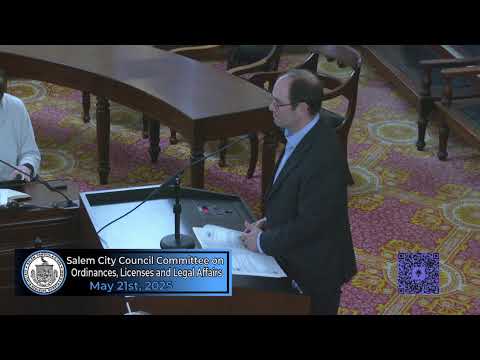
Salem committee narrows October parking expansion, approves commercial-only change and forwards excise petition
Summary
A Salem City Council committee voted to amend a proposed citywide October parking overlay so it applies only to nonresidential lots, and it referred an accompanying Home Rule petition that would allow a $2 per-space daily excise to the full council with positive recommendations.
The Salem City Council Committee on Ordinances and Legal Affairs voted to amend a proposal to expand the city’s October parking overlay so it would apply only to nonresidential (commercial) lots and forwarded the amended ordinance and a Home Rule petition to the full council with positive recommendations.
The measure before the committee would have expanded the October parking overlay to the entire city and, as drafted, allowed residential property owners on non–resident-only streets to register off‑street spaces for short‑term public parking in October. The accompanying Home Rule petition would authorize Salem to assess a $2 excise per registered space per day on private property used for public parking, with annual adjustments of $0.25.
The proposal was presented by Mayor Pengalo, who described the choice the city faces in October: “We can either ignore the cars that are coming to Salem. We don't have the public parking capacity to accommodate them generally, which results in significant congestion and gridlock … or we can choose to regulate it.” The mayor said the $2 rate matches surcharges used in other Massachusetts cities and is intended to help fund the city’s transportation enhancement programs, including the Salem Skipper shuttle and the Blue Bikes bike-share program.
City staff member Christina Hodge told the committee the Planning Board returned a favorable recommendation on the zoning amendment. “The zoning ordinance came back from the Planning Board with their favorable recommendation,” Hodge said.
Committee members questioned enforcement, equity and tenant impacts. Councilor Stott said she was concerned about adding residential usage without broader community outreach: “I haven't done any community conversations or additional research … I think adding both of these changes … is just messy.” Councilor Cohen voiced support for expanding the overlay to the whole city for commercial properties but said he was conflicted about the residential component, citing worries about tenants losing parking.
Committee discussion included operational details staff presented: a $100 registration fee regardless of lot size; a registration process that requires operators to declare the number of spaces and the dates they will be used; random audits and fines for underreporting; and a goal of using a published registry to reduce enforcement calls. Staff said last October the city issued 73 tickets related to this class of violation and that the existing overlay zone included about 1,400 commercial spaces requested in 2024, plus several thousand public parking spaces in municipal lots.
Councilor Morzillo moved an amendment to remove residential lots from the ordinance and limit the expanded overlay to nonresidential lots; the amendment was seconded by Councilor Cohen and carried in committee. The committee then voted to refer the amended ordinance to the full council with a positive recommendation. Separately, the Home Rule petition to permit the $2-per-space excise — filed as a special-act request to the state legislature — was also referred to the full council with a positive recommendation.
The committee’s action does not change the Home Rule petition’s requirement for state approval; staff said the petition’s language does not distinguish residential from commercial lots (that distinction is contained in the zoning ordinance). Staff also noted the petition includes an inflationary adjustment to the surcharge so small annual changes would not require returning to the Legislature.
Supporters said the registration-and-surcharge approach would create transparency and a sustainable revenue source for transportation programs; critics urged a more incremental approach and more outreach to residents and tenants. The committee asked staff to publish the list of permitted spots online and to finalize draft regulations that would, if adopted, prohibit owners of rental properties from using spaces designated for tenants as October visitor parking.
The matter now goes to the full Salem City Council for consideration of the committee’s amended ordinance and the Home Rule petition.