Get Full Government Meeting Transcripts, Videos, & Alerts Forever!
Get email alerts on the Land Use Development topic
No spam. Unsubscribe anytime.
Oak Creek council approves conditional use permit for Buc-ee’s after lengthy hearing and neighborhood opposition
Summary
After a multi-hour public hearing with dozens of residents and organizations raising traffic, environmental and process concerns, the Oak Creek Common Council voted to approve a conditional use permit and a certified survey map allowing a Buc-ee’s travel center to pursue site development pending state approvals.
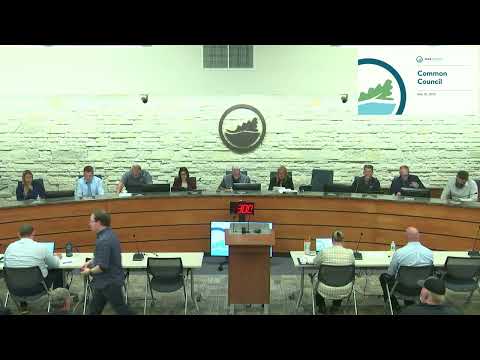
The Oak Creek Common Council on May 20 approved a conditional use permit (CUP) and a certified survey map to allow a Buc-ee’s fueling plaza and travel center at three parcels on South 20th Street, after a lengthy public hearing that drew neighborhood opposition and a pending court challenge.
The CUP approval permits the applicant to move forward with detailed site, landscaping and traffic work required by city code and by the Wisconsin Department of Transportation (WisDOT). Christie Lane, the city’s community development director, explained that the zoning review requires findings under Article 4 of the municipal code and additional fueling-plaza standards, and that any required improvements or conditions identified by WisDOT must be met before the project can proceed.
Neighbors, organized groups and environmental and health professionals urged the council to pause or deny the permit because of traffic, air emissions, groundwater and process concerns. Joe Sincotta, attorney for Oak Creek Neighbors United, said the association has filed a court action challenging prior rezoning and comprehensive-plan amendments and asked the council to stay further action. “Because of the court case, we ask that further review of this project be stayed so the court process could proceed,” Sincotta said.
Multiple residents and nearby property owners raised concerns about traffic on West Oakwood Road and 20th Street, odor and air emissions near homes and wells, nighttime lighting and noise, and stormwater runoff to the Root River watershed. Mary Ellen Malcolm said the community had repeatedly asked for a pause and more independent study: “Please restore our faith in this body of representing all of Oak Creek.” Physician Jonathan Berkoff said he was concerned about environmental impacts to his family’s century-old property. Other speakers raised the number of pumps, the scale of the proposed 73,000–74,000 square-foot building and the potential for regional, nonlocal traffic to overload local roads.
Stan Beard, director of real estate and development for Buc-ee’s, spoke for the applicant. He described Buc-ee’s as a “tourist destination” travel center and said its traffic estimates are based on counts from operating Buc-ee’s stores elsewhere and on a methodology negotiated with WisDOT. Beard told the council that the company expects roughly 70,500 vehicles per week (about 10,000 per day) at full capacity in the traffic-impact analysis and that most customers would come from beyond the city and state boundaries. He also said the project includes multiple measures intended to limit environmental and public-safety risk, including double-walled fiberglass tanks and interstitial monitoring for fuel containment and an on-site stormwater pond plus pretreatment elements.
Assistant City Administrator and City Engineer Matt Sullivan told the council the city and applicant have discussed traffic and capacity and that the site and any public improvements at the Elm Road / I‑94 interchange fall under WisDOT jurisdiction. Sullivan said West Oakwood Road, a two‑lane minor arterial, currently operates at Level of Service A and is well under typical capacity thresholds, and that any traffic improvements required by WisDOT will be conditions of moving forward.
After public comment and council discussion, Alderman Burke moved to adopt Resolution No. 12581‑052025 approving the conditional use permit; the council carried the resolution by roll call and granted approval to proceed with the conditional use permit and to adopt the related certified survey map (Resolution No. 12582‑052025). The approvals include the conditions described in the city’s conditions and restrictions document (see authorities). The council vote authorized the applicant to continue coordination with WisDOT, DNR and other agencies and to return to the planning commission for site-plan, landscaping, lighting and signage reviews.
The approvals do not relieve the project of subsequent regulatory reviews. City staff and the applicant emphasized that final building permits, detailed stormwater plans, wetland determinations and any WisDOT access or intersection improvements must be completed and approved before construction. The record also reflects that Oak Creek Neighbors United has filed litigation challenging earlier zoning actions; Sincotta told the council the association “renew[ed] that objection” and requested a stay.
The certified survey map approved the reconfiguration and combination of the three parcels into a primary lot for the Buc‑ee’s facility, a second lot potentially for future development, and an outlot for the detention pond. Christie Lane said the planning commission recommended approval at its April 22 meeting. The CUP and CSM approvals do not include final architectural, landscaping or lighting permits; those will return to the planning commission for review.
Next steps for the applicant include completing the WisDOT traffic‑impact review and meeting any site improvements required by that review, securing DNR approvals related to gasoline dispensing and any wetland requirements, finalizing detailed site plans for planning‑commission review, and obtaining building permits. Oak Creek Neighbors United and other objectors indicated they may continue to seek remedies through ongoing court proceedings.
How the council voted: the council adopted the CUP and certified survey map by roll call during the May 20 meeting; the council recorded affirmative roll‑call responses during the vote and carried the resolutions. (Roll‑call names and individual votes were recorded in the official minutes.)
Why this matters: the project would create a large, interstate‑oriented travel center adjacent to an interchange and industrial/business area, with consequential traffic, environmental and local‑quality‑of‑life impacts that residents said deserved further study. The approvals allow the project to proceed to the next regulatory steps but do not authorize final construction until state and technical requirements are satisfied.